

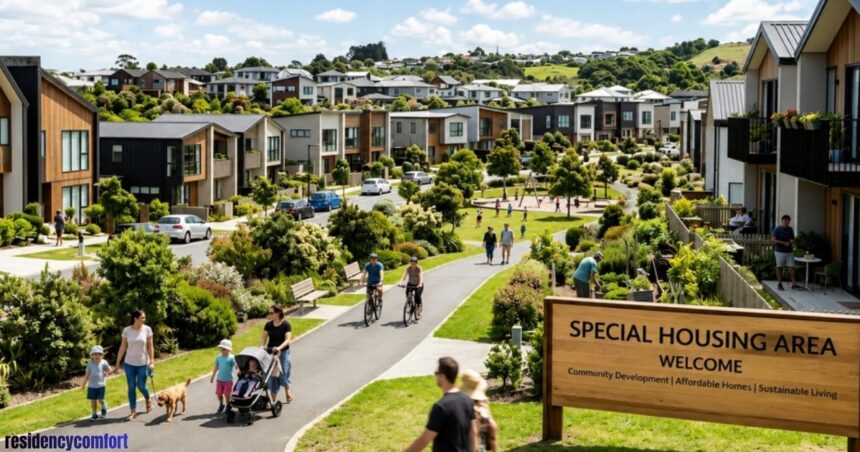
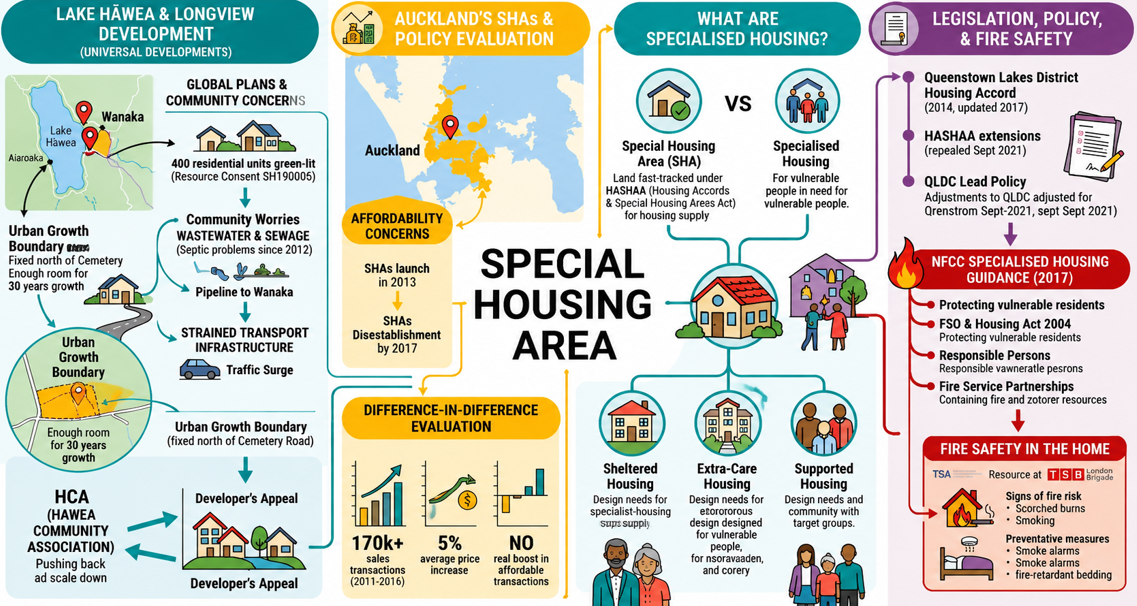
Universal Developments brought big plans to Lake Hāwea through the Longview Development, and QLDC gave the green light for 400 residential units under this special housing area. Local families worried about wastewater, sewage management, and strained transport infrastructure, and these community concerns grew louder once construction in Hawea actually started.
Universal Developments, Special Housing Area, and NFCC Guidance
By March 2021, Universal Developments had pushed through a deed amendment that allowed higher prices on house and land packages and loosened the rules around build contracts. Meanwhile, a separate appeal touched the Urban Growth Boundary as part of the Proposed District Plan, with developers hoping to build past cemetery road through the Township Re-Zoning process.
On the fire-safety side, the NFCC rolled out its Special Housing Area Guidance back in May 2017, aiming to protect roughly three-quarters of a million residents living in vulnerable housing setups.
This guidance pushed fire safety standards for premises run by Responsible Persons, tying them to the FSO and Housing Act 2004, while reminding enforcing authorities that the underlying legislation still mattered for protecting vulnerable residents in their own private accommodation and encouraging good practice along the way.
Special Housing Area in Auckland and the Difference-in-Difference Evaluation
Down in Auckland, rising housing prices pushed officials to launch Special Housing Area in September 2013 as a fix for affordability, though the scheme was quietly disestablished by 2017. Researchers studying the causal effects of this policy used a Difference-in-Difference model built on more than 170 thousand sales transactions between 2011 and 2016, focusing on specific tranches of land marked for treatment.
Their findings showed an average price increase of about 5% with no real boost in affordable transactions, and these results held up across multiple specifications, raising doubts about the overall effectiveness of the program.
What is specialized housing?
An SHA is simply an area of land set aside for new housing, built to be fast-tracked thanks to special consenting powers under the Housing Accords and Special Housing Area Act, known as HASHAA.
Officials created these zones to boost housing supply and improve housing affordability, especially as cities deal with a growing population that needs somewhere to live. On the flip side, specialised housing means something different altogether, since it covers homes built for vulnerable people who don’t fit into a Registered Care Home or a General Needs Block.
Understanding the Different Care and Support Living Categories
This kind of specialized housing instead includes sheltered housing, extra-care housing, and supported housing, each designed with specific needs in mind. I’ve seen firsthand how confusing these terms can get for families trying to find the right fit for an elderly relative. Getting clarity on which category applies makes all the difference when navigating housing applications.
HCA Involvement and the Pushback Against Expansion
The Hawea Community Association stood up for the community by submitting formal submissions and pushing back against decision makers whenever they could. Their efforts didn’t stop the SHA entirely, but the project that received Resource Consent ended up scaled down to 400 sections under reference SH190005, far smaller than the 2,000 units originally proposed. QLDC also turned down a re-zoning request tied to the proposed district plan, citing inadequate infrastructure as the main sticking point.
The Developer’s Appeal and Lessons in Community Advocacy
Universal Developments didn’t accept that outcome quietly and filed an appeal against the decision. From what I’ve gathered talking to locals, persistence from community groups genuinely shapes outcomes even when the bigger project still moves forward. That lesson applies far beyond just this one case in Hawea.
Reasons for Opposition
The Hawea community raised real concerns about how Lake Hawea would handle extra strain, starting with the sewage system itself. Wastewater and Septic problems had already left the system non-compliant since 2012, and the proposed upgrade involved a pipeline sending waste to Project Pure in Wanaka, which residents weren’t thrilled about either. QLDC eventually pursued a short term solution instead, tied into broader Three Waters planning.
Commuting added another layer of worry, since most residents drive roughly 17 minute commute distances to Wanaka for work, dealing with tight parking along the way, and city planners questioned whether adding more population increase so far from jobs, facilities, and services made sense environmentally.
Traffic Infrastructure Constraints and the Urban Growth Boundary
Transport Infrastructure concerns followed close behind, with locals doubting whether a planned Roundabout at Domain and Capell could handle the coming traffic surge. On top of all that, residents wanted the Urban Growth Boundary to stay fixed north of cemetery road, and that community support was nearly universal.
Evidence suggested the area already had enough room within that boundary to handle 30 years of population growth without expanding further. People I’ve spoken with in similar towns describe this exact tension between growth and infrastructure capacity again and again.
The Legislation, the Accord and Lead Policy
QLDC and Central Government signed the Queenstown Lakes District Housing Accord back in October 2014, then refreshed it with an updated Accord in July 2017, applying the agreement district-wide.
This Accord set agreed targets around land supply and dwelling consents, giving the Council authority to recommend projects directly to the Minister of Housing and Urban Development. Things shifted again on 16 September 2016 when the Housing Legislation Amendment Act 2016 extended HASHAA by another three years.
Legislative Extensions and Policy Implementation Timelines
That extension pushed the deadline for new SHAs out to 16 September 2019, with full repeal scheduled for 16 September 2021. On 8 August 2019, the Council finalized its amended Lead Policy to guide how all of this gets implemented going forward. Watching these timelines shift over the years, it’s clear how much political back-and-forth shapes housing policy at the local level.
Legislative Extensions for Special Housing Area and Policy Timelines
That extension pushed the deadline for new special housing area out to 16 September 2019, with full repeal scheduled for 16 September 2021. On 8 August 2019, the Council finalized its amended Lead Policy to guide how all of this gets implemented going forward. Watching these timelines shift over the years, it’s clear how much political back-and-forth shapes housing policy at the local level.
The Housing Accord
Going back to 23 October 2014, QLDC formally entered the Queenstown Lakes District Housing Accord with the Government, later refreshing it through an updated Accord signed 12 July 2017.
The whole point centered on boosting land and housing supply while improving housing affordability and suitability across the Queenstown Lakes District. This gave QLDC real authority to recommend projects to the Minister of Building and Housing.
The Accord laid out agreed aims and specific targets tied to land supply and dwelling consents, creating accountability on both sides. Anyone digging into regional housing policy quickly realizes how these accords act as the backbone for everything that follows. Without this agreement, individual SHAs wouldn’t have the legal footing to move forward at all.
The Lead Policy
The Lead Policy works as a live document, meaning the Council can update it anytime through a formal resolution. On 8 August 2019, the Council approved its amended Lead Policy, shaping how implementation of HASHAA plays out locally. Having this flexibility built in means policy can adapt as housing needs shift over time, rather than staying locked into outdated rules.
Support and development resources for higher risk accommodation
This guide helps identify premises with shortcomings in their fire precautions, especially where deficiencies point toward bigger fire safety measures that need attention. When major structural work or heavy capital expenditure comes into play, building a program around the Action Plan from a fire risk assessment makes sense, ideally alongside the local fire and rescue service. Enforcing Officers should remember that compliance with fire safety legislation can come through more than one route.
NFCC Recommendations for Fire Service Partnerships and Risk Management
The NFCC encourages fire and rescue services to partner closely with special housing area providers to protect vulnerable people living on site, particularly where NHS and other health and care related premises intersect with housing. Strong risk management practices cut down on avoidable incidents, freeing up Fire and Rescue Service resources for emergencies elsewhere. Further detail sits within LACORS guidance and the Special Housing Area Guidance Summary Sheet, both worth reviewing closely.
Fire safety in the home for careers and housing providers
Fire Safety in the Home got its own e-learning resource back in October 2016, built by the Tele care Services Association, known as TSA, with backing from the London Fire Brigade, or LFB. Funding came through the Community Safety Investment Fund, and the course targets Careers, Housing Providers, and anyone working closely with vulnerable people facing fire risk.
It walks through signs of fire risk like scorched cigarette burns on carpets, plus habits like smoking while drinking. From there, the training covers practical preventative measures, including fitting smoke alarms and switching to fire retardant bedding wherever possible.
It also stresses referring high-risk people through proper adult social care channels rather than letting warning signs slide. Anyone who has worked alongside elderly relatives knows how easily these small fire risks get overlooked until something goes wrong.
Housing for older people
Good design principles matter just as much in mainstream housing as they do in specialist housing built for older adults and other vulnerable adults. The Housing Learning and Improvement Network, shortened to Housing LIN, keeps a useful resource library covering topics like Fire Safety In Extra Care Housing across the UK.
Alongside that sits HAPPI, short for Housing our Ageing Population Panel for Innovation, which lays out 10 key design criteria meant to guide best practice when shaping living space for older residents.
NHS England Guidance on Special Housing Area and End of Life Care
NHS England rounds things out with extra guidance for people managing longer-term conditions or needing end of life care at home. Pulling all these resources together gives families and housing providers a clearer picture of what good elderly special housing area actually looks like. It’s a topic that deserves far more public attention than it currently gets.
FAQs
What is a Special Housing Area List?
It is an official directory of designated zones chosen for fast-tracked residential development, serving as a catalogue of land ready to provide new homes and shelter for the community.
What does a Special Housing Area Housing Association do?
This is a not-for-profit provider that builds and manages affordable housing within those zones, focusing on creating secure tenure, social support, and a true sense of belonging for residents.
What is the Hampshire Council Local Plan?
It is a high-level strategic blueprint for the whole county that guides future infrastructure and growth, balancing necessary modern expansion with the preservation of Hampshire’s heritage and landscapes.
How does the East Hampshire Local Plan differ?
This is a localized planning policy specifically for the East Hampshire district. It directly decides where new neighborhoods go, closely impacting the local community fabric, market towns, and cherished green spaces.
What is the purpose of the East Hampshire Policies Map?
It is the visual map and spatial guide that accompanies the plan. Using color-coded zones, it charts exactly where new developments can happen and where the area’s natural beauty is strictly protected.