

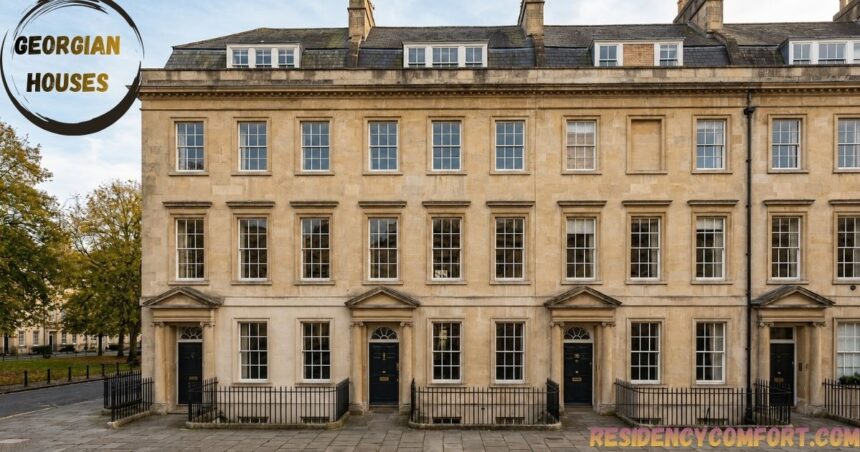
I have walked through more old English houses than I can count, and Georgian houses always stand out first. The proportions feel right the moment you step through the door, long before you notice a single detail. That is the whole secret of this style, and it is why so many buyers, designers, and history lovers still chase Georgian houses today.
How to Decorate and Restore Georgian Houses
I always tell my clients that decorating Georgian houses is easier than people think, because good bones do most of the work for you. Historian Oliver Gerrish, an architectural historian I quote often, once said that Georgian interiors built between 1714 and 1830, spanning the reigns of George I, George II, George III, and George IV, rely on harmonious proportions and symmetry rather than clutter a lesson the Victorians never quite learned.
Their classical restraint means you can decorate or restore almost any room in these properties with bold decorative schemes without upsetting the balance; even the wealthiest owners of Georgian houses loved vibrant colours far more than today’s obsession with grey.
Their serene proportions can handle real gaudiness, whether that means the drama of the Ante Room at Syon or the calmer feel of Regency rooms that followed, which could be daring and colourful, or plain and simple, letting natural light do the talking.
Global Influences Inside Georgian Houses
Architects of the period borrowed from everywhere Egyptian motifs in the dining room at Goodwood House, Indo-Chinese flourishes at the Royal Pavilion in Brighton, and heavy Greek references elsewhere which is exactly why Art Deco pieces and plain furniture slot into Georgian houses so naturally today. There are no hard-and-fast rules, only respect for interior architecture as the true focal point, balancing aesthetics with practicality.
Flicking through the House & Garden archive, I always notice how a Palladian country pile and a modest London terrace teach the same decorating lessons. Take Henrietta Courtauld’s Cornish farmhouse: once a Tudor dwelling surrounded by leafy gardens, it now features the classic lines of Georgian houses with sash windows and well-proportioned rooms, dressed with hand-printed wallpapers by Marthe Armitage and Jo Broadhurst full of flora and fauna.
In the sitting room, Tobacco Plant wallpaper sits above tongue-and-groove panelling, with white linen covers and rush matting over a stone floor, giving quiet restrained elegance around the fireplace beneath its panelled ceiling.
Contemporary Design Trends for Georgian Houses
Will Fisher and Charlotte Freemantle of Jamb filled their Camberwell house with period-appropriate antiques; their drawing room has floor-to-ceiling windows and pale blue walls in Fenching Blue by Papers and Paints, plus one of the finest chimneypieces carved from Portland stone, dated to the mid-18th century.
Interior Design Examples of the Georgian Style
The timeless framework of Georgian houses has been copied ever since a 1930s Georgian-style country house by Henri Fitzwilliam-Lay shows original columns given a marble effect, mixed with an eclectic mix of pieces and a distinctive palette of colours and materials that feels unstuffy.
Carlos Garcia designed a Georgian townhouse with walls in Edward Bulmer’s Welmish Blew, classical allusions like pedimented bookcases, bold pattern in the curtains and rug, restrained fabrics, and a mix of formal and relaxed furniture. When Peter Sheppard and Keith Day restored Wolterton Hall in Norfolk, they added a contemporary kitchen that won the 2020 Historic Houses Kitchen Award proof that history and modern life can share a room.
The Modest and Varied Side of Georgian Architecture
Not all Georgian houses were grand: the weavers’ houses in Spitalfields started as commercial premises and residences together, so their restorations honour those humble beginnings with pale grey walls and reclaimed early-19th-century floorboards from a Welsh chapel. Beckside House keeps prints and medallions around its carved frieze, while a West Country house owned by Rose Hulse uses a bold hallway colour, French Blue from Woolley & Wallis, to set off warm rugs.
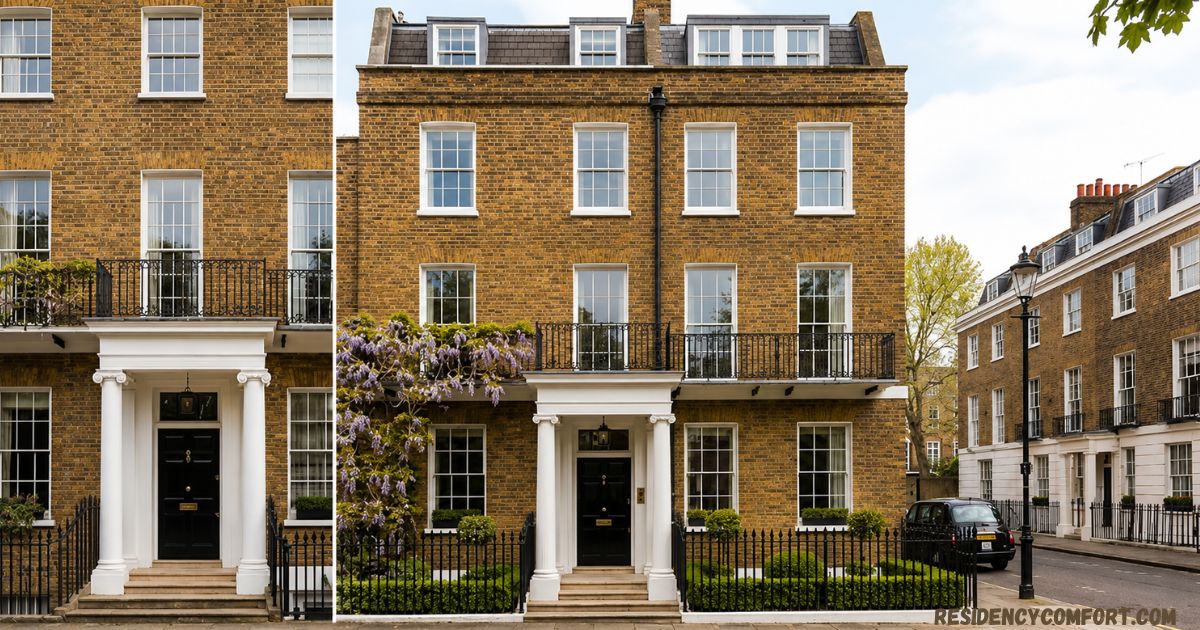
Identifying Period Homes How to Spot Georgian Houses
Anyone scrolling through property listings has probably seen words like Victorian used to describe different housing styles, and most buyers can spot a period look without knowing exactly why it works.
Will Watson, Head of The Buying Solution at Knight Frank, a well-known buying consultancy, told me that period homes stay popular with international clients because typical Georgian houses offer sash windows, generous proportions, and high ceilings that many buyers cannot find back home, along with graceful formal entertaining spaces.
There is no fixed definition of a period property, but most people agree it means anything built before the First World War, covering several architectural styles and among these, Georgian houses and Edwardian homes remain two of the most requested today.
Key Considerations Before Buying
Every period home has real charm and plenty of character, and it is easy to fall for its unique architectural details without thinking ahead. I always warn people that renovations cost more than expected, and ongoing maintenance never really stops owning an old house is a bit like owning a classic car, you are always tinkering with something.
Proper due diligence matters even more with a listed building, since any changes take longer to approve. Smart buyers manage their expectations about both the style of property and its location, because architecture often dictates where you can live, and sometimes compromise is simply unavoidable.
The Layout and Proportions of Georgian Design
The Georgian era runs from 1714, under King George I, right through to King George IV’s death in 1830, with the late Georgian period stretching on to 1837. These houses felt genuinely revolutionary for their time, offering generous proportions, large windows, and plenty of natural light, unlike the cramped homes that came before.
Look closely and you will notice the top floor usually has lower ceilings and smaller windows, because that is where the household staff lived, while the main family enjoyed the roomier first floor and second floor below.
Key Characteristics of a Georgian Property
You can usually spot a real Georgian house by its sliding sash windows with small panes, and a bricked-up window is often a giveaway too, since the old window tax, in place instead of income tax between 1696 and 1851, pushed owners to seal up windows to save money. Most of these townhouses rise across three storeys or four storeys, sometimes with dormer windows tucked at the top, and they always show off symmetrical exteriors paired with airy interiors.
Many have stucco-fronted façades, where the original stonework was covered in white plaster or cream plaster, though early examples often left the upper brickwork bare, only becoming fully rendered by the Regency period between 1811 and 1820, when full rendering grew fashionable. A lot of these houses skip a private garden entirely, built instead around shared garden squares.
Transitioning to the Victorian Era
Running from 1837 to 1901, the Victorian era under Queen Victoria brought huge shifts in social attitudes and home ownership. Georgian houses had mostly been commissioned by the gentry or wealthy landowners, but the Industrial Revolution created a real boom in modest housing and accessible housing for ordinary families. Victorian builders kept familiar Georgian touches like large windows and high ceilings, even as the smaller homes themselves shrank in size, and the look slowly grew into more decorative architecture, eventually feeding into the Arts and Crafts movement and then the Edwardian style.
The Historic Architecture of Georgian Houses
The Georgian period stretches from 1714, marked by George I’s accession, to 1830, the year of George IV’s death; the late Georgian label often covers the reign of William IV too, up until 1837, when the term Victorian takes over. Britain enjoyed a fairly peaceful and prosperous stretch during these years, and building work boomed everywhere, from industrial buildings and civic buildings to grand town houses, country houses, and villas, most following the Classical style, alongside carefully designed landscapes.
Many of these buildings survive today as listed buildings or sit inside a Conservation Area. Great British country houses, and the largely vanished town palaces, still mark the high point of Georgian architectural innovation, style, and taste, while the elegant terraces of Bath, Bristol, London, Edinburgh, Dublin, and Newcastle upon Tyne capture its lasting architectural elegance and sophistication.
Palladian Architecture and Its Lasting Legacy
When the Hanoverian monarchy arrived in 1714, it inspired a fresh style called Palladianism, or neo-Palladianism, based on the work of Andrea Palladio, a Venetian architect who lived from 1508 to 1580 and drew heavily on ancient Roman architecture. He cared about proportion, symmetry, and correct Classical orders, and later builders added ideas from Serlio and the wider Renaissance, keeping the style popular until about 1760.
None of this was new to Britain, since Inigo Jones, who lived from 1573 to 1652, had already championed it through buildings like the Queen’s House in Greenwich, the Banqueting House in Whitehall, and the Queen’s Chapel in St James’s, London.
The Civil War and the Interregnum stalled things, and after the Great Fire of London in 1666, builders turned instead to the theatrical Baroque style that had emerged from Italy, full of rich ornament, bold masses, curvilinear forms and powerful lines think of Seaton Delaval Hall in Northumberland by Sir John Vanbrugh, who lived from 1664 to 1726, or St Paul’s Cathedral by Sir Christopher Wren, born 1632 and died 1723.
The Revival of Palladianism in Georgian Houses
Fashion soon swung back toward the purer neo-Classical forms of Palladianism, helped along by an English translation of Palladio’s Four Books of Architecture in 1716. This shift profoundly influenced how architects approached the design of Georgian houses across the country. Richard Boyle, the 3rd Earl of Burlington, who lived from 1694 to 1753, worked with William Kent, born 1685 and died 1748, to design Chiswick House, where a plain exterior hides richly decorated interiors.
Other famous examples of grand Georgian houses include Holkham Hall in Norfolk and Woburn Abbey in Bedfordshire, championed by figures such as Colen Campbell, who lived from 1676 to 1729 and published Vitruvius Britannicus between 1715 and 1725, along with Henry Flitcroft, who lived from 1697 to 1769, and Matthew Brettingham, born in 1699.
Frequently Asked Questions
What is the main difference between Georgian and Victorian houses?
The core difference lies in their architectural philosophy. Georgian design is defined by strict classical symmetry, proportion, and restraint, whereas Victorian homes favor more ornate, eclectic, and asymmetrical gothic-revival craftsmanship.
What are the defining characteristics of a Georgian house interior?
Stepping inside, you will typically find stately proportions highlighted by soaring ceilings, intricate plasterwork cornicing, and grand sash windows that flood the reception rooms with natural light.
Can you buy authentic Georgian houses for sale today?
Yes, many of these historic properties survive as a vital part of British architectural heritage. They are highly sought after by buyers looking for homes that seamlessly blend timeless elegance with a deep, historic character.
How do modern Georgian houses differ from historic ones?
They offer a contemporary twist by pairing traditional curb appeal and neo-classical facades with 21st-century functionality, modern insulation, and sustainable layout designs.
Why do photos of Georgian houses look so uniquely balanced?
Their visual appeal comes entirely from harmony. Visual galleries showcase a perfect mathematical balance, from the symmetry of the facades to the iconic panelled front doors centered beneath classic fanlights.