

Anyone who has spent time around commercial property knows the sector rarely stands still. Rules change, rents shift, and buildings that seemed perfect five years ago suddenly need a rethink. Having watched clients weigh up leases, mortgages, and location choices over the years, I’ve noticed the same questions come up again and again is now the right time to buy, how do new laws affect a lease, and how much space does a growing team really need? This article walks through the bigger picture first, then gets practical.
Market Uncertainty and the Global Commercial Property Asset Class
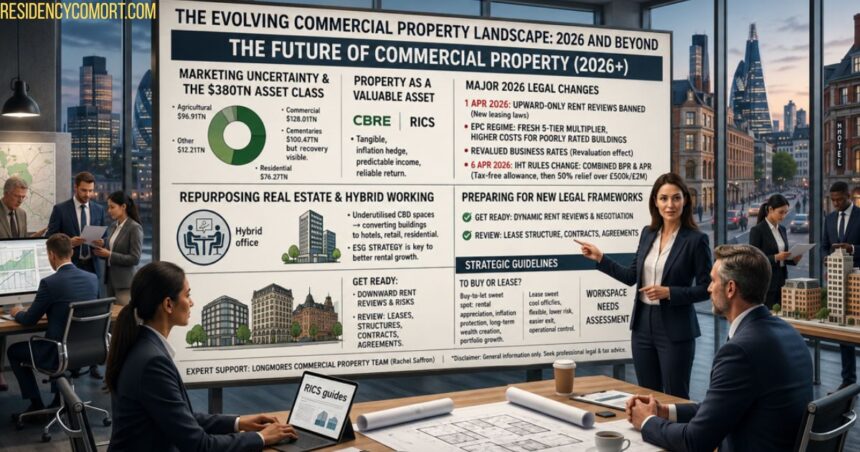
Over the past decade, the real estate market has grown into one of the biggest parts of the world economy. According to Savills World Research, the global real estate value now sits close to $380tn, making property the largest asset class on the planet bigger than global GDP, equities, and debt securities combined. Breaking that figure down, residential property makes up £276.7tn, commercial property adds $129.8tn, and agricultural land contributes $98.9tn, with the remaining sectors bringing in a further $12.2tn.
Investors often sit on the sidelines during periods of uncertainty, waiting for interest rates to settle before moving cash into fresh investment portfolios. Years of artificially low rates pushed many businesses and households toward property, gold, and fixed income products as a way to guard wealth against inflation. Rising rates have since caused disruption across several asset classes, and current market trends show more caution in the short term while everyone waits to see how the wider economy settles.
Why Real Estate Remains a Valuable Commercial Property Asset
Property has long been treated as a valuable asset class because it is tangible and immovable you can walk into it, unlike a share certificate or a bond. CBRE, the world’s largest commercial real estate services provider and investment firm, has tracked how real estate assets performed through the pandemic and beyond, and its work shows that real estate holds the largest concentration of wealth across many economies.
Since 2021-23, rental values and capital values have moved through several market upheavals, yet the commercial real estate market has largely recovered. In May, total returns rose by 0.7 per cent in a single month, following an earlier reading of 0.3 per cent, and annual returns in some segments reached around 15 per cent.
This kind of recovery shows that property values and the price of real estate can bounce back even once debt costs and interest rates climb. Because rents tend to rise alongside prices, property acts as a natural hedge against inflation, giving commercial property owners steady long-term income and a reliable return.
Investment activity across global real estate investment markets has held up well despite cost of living pressures on households, and property keeps its dominant position as a safe place to hold capital, offering strong value of investment compared with other options, with rent providing dependable growth over time.
Repurposing Real Estate in a Changing Economy
Covid changed work patterns for good, and hybrid working together with remote working have left many office buildings with higher vacancy rates than before. Analysts writing market reports on the UK commercial property market point to office space in central business districts suffering real underutilisation, which puts pressure on office investment as demand softens and economic uncertainty grows.
To respond, UK developers are turning to redevelopment, converting old buildings into hotel use, retail, or residential properties. In cities such as Edinburgh, existing buildings are being repurposed rather than left empty, which cuts the chance of a building becoming a stranded asset. This kind of change demands careful management, since day-to-day operations must carry on while repair costs from property damage, or simple wear and tear, get folded into ongoing running costs, whether the eventual use is residential or something else entirely.
Investor interest now leans toward buildings with strong ESG credentials, since environmental, social, and governance factors an ESG strategy increasingly shape how tenants choose space. A well-managed asset built on sustainable practices and ethical practices tends to enjoy better rental growth and steadier rental values, while neglected land or buildings carry more risk factors. Across the various commercial real estate subsectors, caution remains the mood of the moment, but recovery is visible, and many now see repurposed buildings as a genuine investment option rather than a liability.
Key Changes to Commercial Property Law in 2026
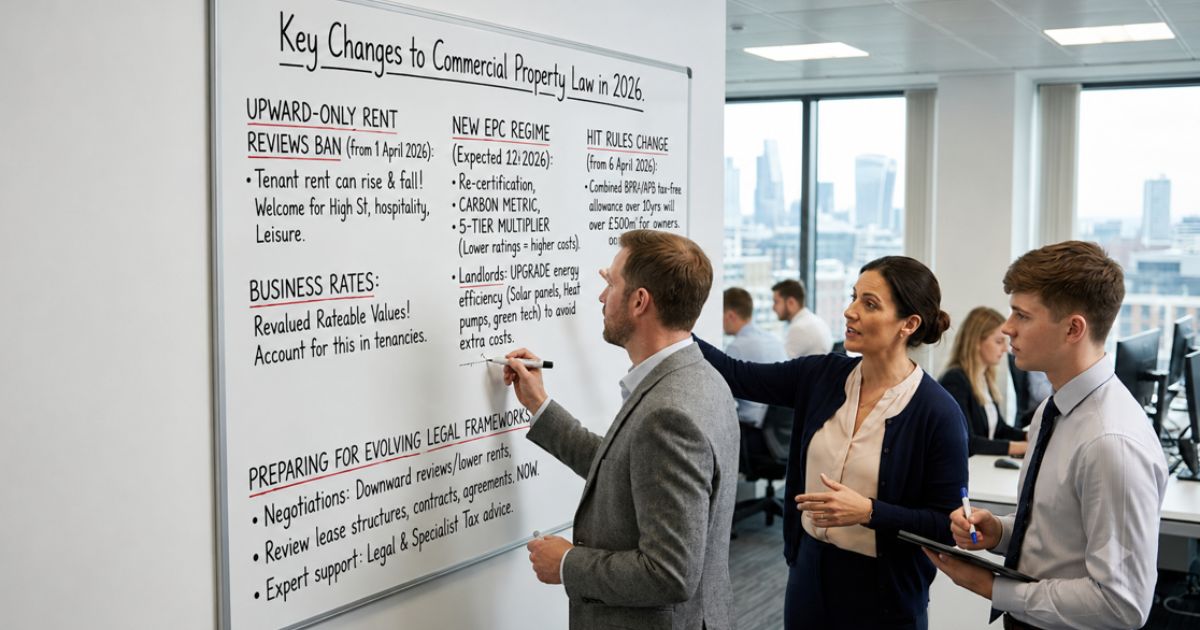
Big changes are landing on commercial property rules in 2026. From 1 April 2026, upward-only rent reviews will be banned in new commercial property leases, meaning a tenant’s rent can fall as well as rise at each rent review welcome news for high street, hospitality, and leisure sectors tenants who have struggled since 1 April 2024 with climbing rental values. The EPC regime is changing too.
An Energy Performance Certificate (EPC) will need re-certification under new environmental rules, and a carbon metric will sit alongside a fresh five-tier multiplier structure, bringing higher multipliers for poorly rated buildings. Commercial landlords will need to consider energy efficiency upgrades, such as solar panels and heat pumps or other green technology, to avoid extra costs once these standards take effect, expected in the second half of 2026. Business rates are shifting as well.
The rateable value used to calculate business rates will be revalued, and any tenancy should account for this. On the tax side, from 6 April 2026, Inheritance Tax rules change: combined Business Property Relief (BPR) and Agricultural Property Relief (APR) will offer a tax-free allowance on the first slice of an estate, then 50% relief on amounts above £500,000, or up to £2.5 million for certain qualifying assets, including listed buildings.
Preparing for Evolving Legal Frameworks
With upward-only rent reviews being banned, both landlords and tenants should get ready for negotiations around downward rent reviews and lower rents in future leases and new leases. Reviewing lease structures, contracts, and commercial property agreements now, before terms lock in, helps avoid conflict later.
Many are already looking at revisions to older short terms deals and setting a sensible cap on increases through fixed rate rent increases. The sector impact of these changes will vary high street shops, farms, and family businesses each face different pressures, so professional support matters. Anyone unsure how BPR and APR allowances affect their asset values should seek expert legal advice and specialist tax advice early, since compliance rules are tightening. All interested parties should keep talking, so new contracts work fairly for everyone.
Expert Support for Your Legal Needs
Longmores’ commercial property team, including specialists such as Rachael Spalton, gives expert support to landlords, occupiers, developers, and investors working through property law matters. The team offers clear guidance and practical legal advice on contracts and negotiations, helping clients stay on top of compliance. Every situation is different, so advice is always shaped around specific circumstances this article is general information only, and this note acts as a disclaimer rather than a substitute for direct advice.
Strategic Guidelines for Choosing a Commercial Property Premises
Every growing business needs the right space to support swift expansion, and choosing the correct premises early sets the stage for smoother growth later on.
Assessing Your Current Workspace Needs
Before making any big commercial property decision, it pays to run a full assessment of your existing workspace. Start with an honest look at your current situation: is the office crowded, is there a storage issue, or is the layout simply not working anymore? Weigh the advantages and disadvantages of staying put against the cost of a move, and think about whether reorganising the current workspace could solve your property needs without upheaval. Checking government advice can also help you plan space for future employees as the team grows.
Considering Short-Term and Long-Term Objectives
A rigid solution rarely suits a business that plans to evolve over time. Good business premises advice always starts with your wider corporate growth strategy what are your needs today, and how might they shift tomorrow? Reading the government’s commercial property lease guide and taking professional advice from bodies such as RICS, the Royal Institution of Chartered Surveyors, helps you understand lease terms before signing anything. Look for flexibility to make modifications, room for future expansions, and new premises that can cope with shifting needs in a dynamic business environment.
To Buy or to Lease Commercial Property?
Buying commercial property gives a business full control over its space, along with privacy, potential asset appreciation, and predictable mortgage repayments rather than surprise rent increases. It also means finding upfront capital, covering maintenance costs, and accepting the risk that property value can move in either direction, so it suits longer-term growth plans rather than quick moves.
Leasing, on the other hand, is often more cost-effective for a smaller initial investment, offering a flexible, fixed term arrangement without the renewal uncertainty of ownership. Ready-to-use options such as shared industrial units or co-working spaces let a business start operating quickly, though tenants should weigh the risk of losing the space at renewal against the freedom leasing provides.
FAQs
What are the benefits of a commercial property for sale over renting?
Buying a commercial property for sale builds equity and ensures long-term stability. Instead of paying rent, you invest in a permanent brick-and-mortar premise, protecting your business from lease changes and gaining from potential asset appreciation.
Why choose a commercial property for rent?
A commercial property for rent offers flexibility and preserves capital for growing businesses. A commercial tenancy reduces upfront costs, allowing you to re-invest cash flow and easily scale or move your business premises as needed.
What does it mean to buy a freehold commercial property for sale UK?
Buying a freehold commercial property for sale UK means you own the building structure and the land indefinitely. With a freehold interest, you avoid ground rents and landlord restrictions, securing a permanent asset in the British market.
How does searching Zoopla commercial property rent help my business?
Searching Zoopla commercial property rent gives you instant access to active commercial lettings. You can easily filter by rental rates and location to find the right retail spaces, warehouses, or offices with minimal stress.
Why look for a freehold commercial property for sale near me?
Finding a freehold commercial property for sale near me lets you invest in your local community where you know the market best. It allows you to closely manage and nurture a real estate investment right on your doorstep.