

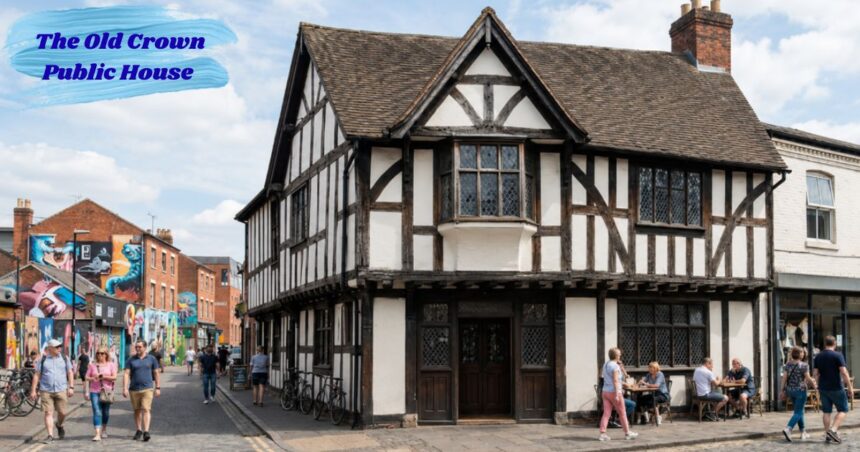
Walk into The Old Crown Public House in Central London and you almost expect someone to tell you it dates back to the Ming Dynasty, that’s how old the place feels. Locals often call it the oldest pub in the area, tucked into Bloomsbury as a proud secular building that has watched the neighbourhood grow up around it.
Head north to Digbeth and the shopfronts and storefronts tell a different but related story, one that sits far from the polish of the West End yet shares the same deep drinking culture.
The Old Crown Public House A Story Told Through Two Cities
Both buildings lean on a Tudor timber frame, and both have become a high-traffic pub in their own right. In London, the historic façades along the street give way to the timber charm of the alternative venue, whereas The Old Crown Public House in its Digbeth location is a name that keeps popping up whenever people talk about Birmingham’s nightlife scene. Some say the bones of the building go back to the 14th century, and once you’re inside, the wood interiors make that claim easy to believe.
Digbeth itself has become something of a creative quarter, its busiest corridors packed with tourists drawn in by the street art and general Brummie charm of the area, alongside a run of independent eateries that keep the whole strip lively.
Back in London, the pub sits near Tottenham Court Road Station, where commuters pour past its doors every single day. The layout inside still carries a black-and-white timber look that gives visitors a warm welcome the moment they step off New Oxford Street.
Between the theatre-goers heading toward Covent Garden and the crowd settling in at the long bar, the pub pulls in shoppers looking for a break.
There’s a nonstop rhythm to the place, a steady volume of conversation that never really dies down. The pace and energy of the location make the venue feel like two pubs living under one name, one in Birmingham and one in the capital.
Historical Origins of The Old Crown Public House
The civic importance of Digbeth’s old inn is hard to overstate, and historians often point to its national significance when discussing the School of St John Deritend. Records describe a set of timber-framed structures rising around 1450, work that would eventually earn the building its Grade II listed* status. Its jettied upper floors lean out over the street in a style shared with the old Guildhall, and nearby stood a priests’ house believed to date from around 1500.
Over the centuries, the site went through several rounds of modernization, even though the core structure was reportedly built in 1368. Look up and you’ll spot the central gabled oriel window, a detail that helped the building earn its reputation as a lone survivor of the district’s earliest days.
Visitors are often struck by its pre-industrial charm, and the striking façade alone is worth the trip. Some records point to 1492 as another key construction date, tied to the Guild of St. John the Baptist, who had a hand in shaping the original building. Today the pub represents roughly 6% of the protected structures that shape Birmingham’s landscape, standing proudly in Deritend. Various modifications followed in the early 1500s, each one adding another layer to an already rich timeline.
Listed Building Status
Because of its age and rarity, The Old Crown Public House carries Grade II listed status, marking it as a protected structure within the wider category of UK building heritage. Authorities work hard to preserve it, citing its national significance and special interest as reasons the building deserves special care. Some older records simply describe it as Grade 2 listed, and it remains part of a small group that makes up just 6% of listed buildings in the country.
Royal Encounters Queen Elizabeth I Visit
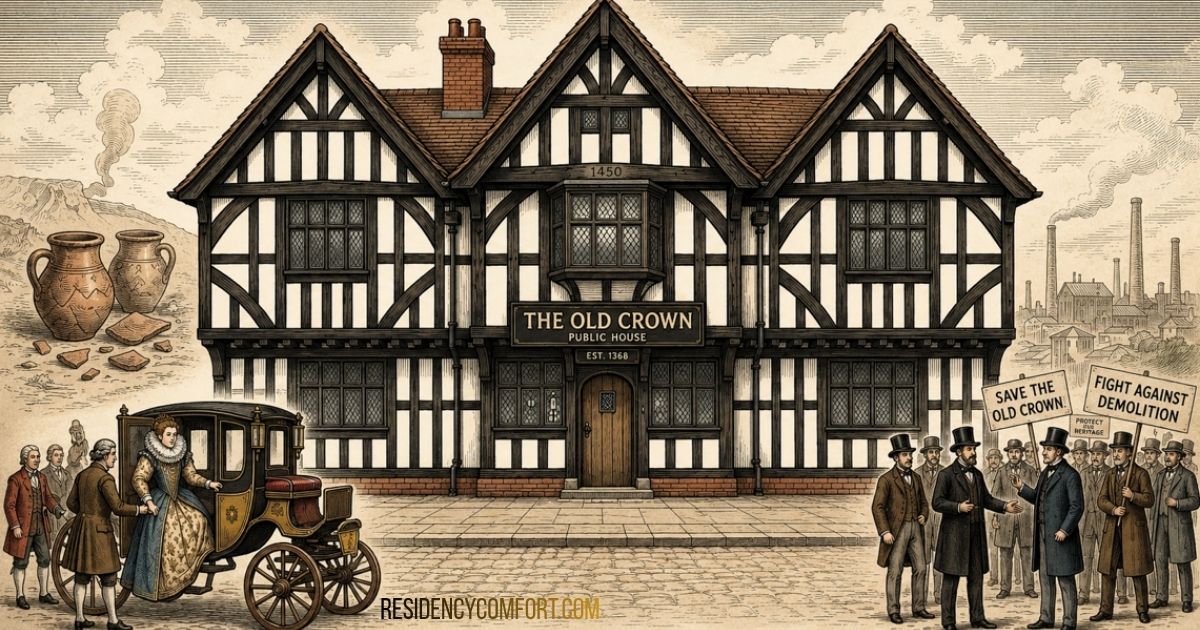
Legend has it that the pub once welcomed royalty into its gallery chamber, a space normally reserved above the heads of ordinary commoners. The story goes that the visit happened on the way to or from Kenilworth Castle, with guests passing through the main entrance much like anyone else might today. That brush with royalty is dated to 1575, back when travelling nobles often stopped at wayside inns, and locals still love repeating the tale of Queen Elizabeth I passing through.
Chronological Journey of The Old Crown Public House
Sitting along old trade routes, The Old Crown Public House first shows up in records as a stop for a carrier of goods, with documents from 1589 referring to it under the alias Bayleys. A London operator is even mentioned in some accounts, suggesting the inn served as a staging post for travellers moving between cities.
One name tied to this era is John Dyckson, and later records describe cockfighting events held on site, along with a mention from 1666. Merchants passing through would have known the building by the sign of the Crowne, and an old document refers to a Caryer who used the site as an inn.
A local entrepreneur is said to have run the place through parts of the 18th century, hosting travelers who came for a meal, a bed, and, according to one strange old claim, excellent water for the teeth. The earliest documentary evidence of the pub’s existence as a drinking house is generally traced back to around 1626.
Splitting Into Houses
By 1693, changing demand meant the building had to adapt to the needs of the time, eventually being divided into three houses. The structure had to adapt more than once, first splitting into two houses around 1684, before further changes rolled through in the 19th century.
Preservation and the Fight Against Demolition
When redevelopment plans threatened the old building in 1862, it was the city corporation that pushed the hardest for change. An antiquarian stepped in with concerns as early as 1856, arguing that the building’s foresight value was too great to lose, and that it still carried the likeness it bore in the days of its youth. The Corporation wanted the structure gone to make way for demolition that would improve the street, but Joshua Toulmin Smith fought to save The Old Crown Public House, with the campaign gaining real traction by 1851.
Modern Restoration of The Old Crown Public House
The restoration story really belongs to Ellen Brennan, who took on the task of reviving The Old Crown Public House to its former glory by 1998. Family members Patrick, Gary, and Peter all played a part, and the pub later picked up recognition at the Midland Food and Drink Hospitality Awards, a nod to its medieval origins and its reputation as the best traditional pub in the region. Locals still describe the years of work as a monumental restoration, one that even uncovered an ancient well during the process.
It marked a genuine urban transformation, with major work continuing through 1994 and further updates arriving by 2019. Plans for an English tea room were part of the vision, backed by a £2 million investment that helped the pub get reopened, complete with new guest accommodations. Pat Brennan is often credited as the driving force, steering the pub through the pressures of industrialization and clearing out old sheds near the rear entrance.
What started as a popular pub stretching back 100 years was fully restored, cementing the Brennan family name in local history. Workers also uncovered another old well during repairs, and the site is now run by a local pub company.
Contemporary Amenities and Guest Bedrooms
Guests staying over can expect fresh towels and a genuinely cozy apartment, just a short walk from the Custard Factory.
- Accommodations: 10 boutique bedrooms attached to the restaurant.
- Room Features: En-suite or shared bathrooms, free Wi-Fi, TV, and individual decor.
- Convenience: Located minutes from the Red Brick Market.
- Reception Hours: Monday to Saturday (12:00 PM – 6:00 PM), Sunday (12:00 PM – 9:00 PM).
- Bonus Space: 1 luxury apartment available for extra room during a getaway.
Visitor Impressions and Architectural Charm
People often mention the old ceiling beams overhead, especially when comparing notes on the nearby Birmingham Bull Ring markets. The venue sits close to the main train station, and stepping inside The Old Crown Public House gives visitors a real sense of the past, helped along by the mock-Tudor styling throughout. It’s also within easy reach of the main coach station. Some visitors comment on the fruit machines tucked in a corner, and others notice the building’s crooked twisted look, a reminder that this is no ordinary bar.
Historical Tributes and Wartime Resilience
Long before modern tourism, the trade streets nearby were known for their cutlers, and one writer described the pub as a mansion house of timber standing tall on High Street Deritend. It became something of a landmark for local smiths, and it was John Leland, a respected antiquary, who wrote about it. His account praised the Tudor-style architecture and the busy merchants working nearby, with his notes dated to around 1538.
During the conflict of the English Civil War, Prince Rupert is said to have passed through the area amid the general chaos of the fighting. The pub’s sturdy timber walls reportedly held firm even as the surrounding streets became something of a battleground, weathering at least one raid connected to the war a chapter that still gets a mention in books on British history from around 1643.
The Community Legacy of The Old Crown Public House
Part of why The Old Crown Public House stands out comes from its role as a genuine community hub, pulling in a wonderfully diverse crowd night after night. The building survived WWII bombings, gives space to local artists, and has lived through civil wars and multiple petitions for demolition over the centuries. It has also been named Best Town Pub, a fitting tribute to its rich history and its packed calendar of inclusive events, all still going strong.
FAQs
What is the history behind The Old Crown public house?
This legendary heritage site is celebrated as Birmingham’s oldest surviving secular timber-framed building, with roots dating back to 1368. It officially transitioned into a licensed inn around 1626, surviving the English Civil War to stand today as a venerable landmark.
Who currently owns and operates The Old Crown public house?
The historic tavern is under the independent family ownership and proprietorship of the Brennan family, who acquired it in 1991. They invested heavily in its structural restoration, ensuring its legacy lives on as a beloved community hub.
Is there a historic Old Crown public house located in Leytonstone?
No, there is no major heritage alehouse or prominent watering hole by that exact name within Leytonstone. It is frequently confused with other traditional drinking establishments situated in East London or the famous namesake inn in the West End.
What do customer reviews highlight about The Old Crown public house?
Patron feedback and customer testimonials consistently praise its nostalgic, quaint atmosphere, excellent hospitality, and spacious beer garden. Visitors highly recommend it for its charming period features and vibrant energy as a classic social venue.
Where exactly is The Old Crown on New Oxford Street and what is it like?
Situated at 33 New Oxford Street, this Grade II listed building dates back to 1847. It serves as a beautiful metropolitan pub and multi-floored urban escape, making it the perfect spot for a classic libation near the British Museum.