

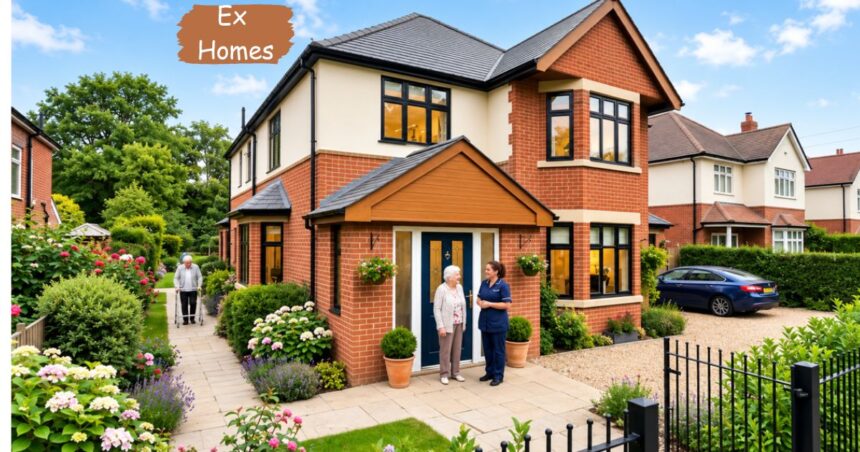
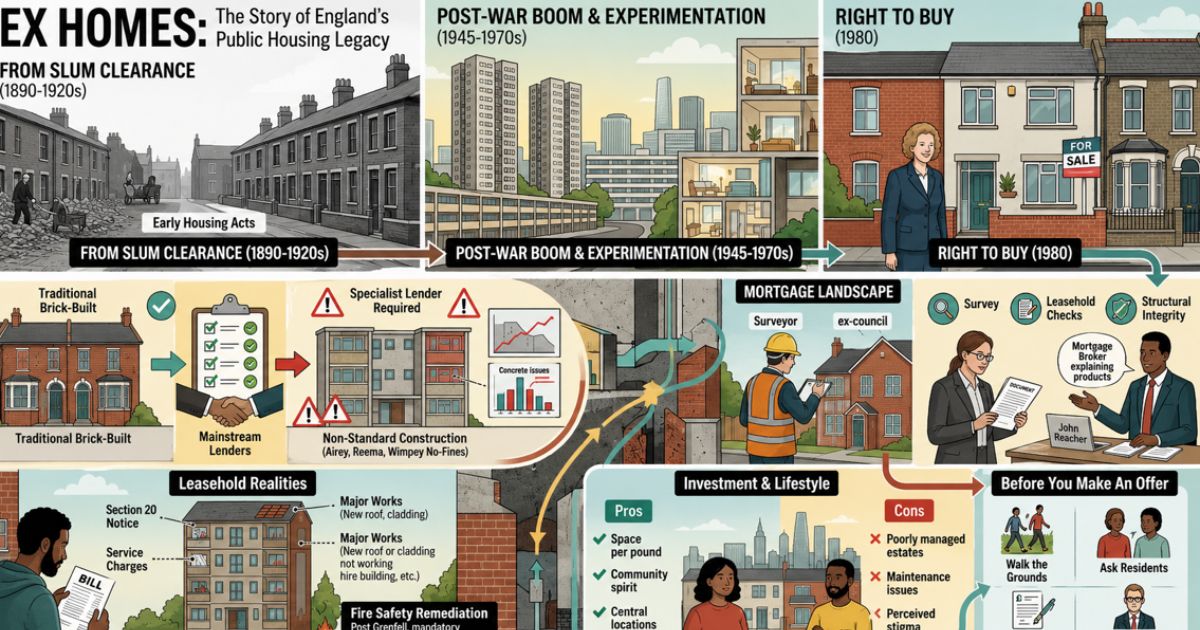
When I first started looking at council properties across England, I quickly learned that nearly 17% of ex homes here trace back to public housing stock. The story begins with the Housing for the Working Classes Act of 1890, when local councils cleared slum properties and pushed slum clearance and house building forward through the 1920s, though World War II halted almost everything..
The History of Public Housing and Ex Homes
Post-war building picked up fast, and the London County Council raised 44,000 new homes between 1945 and 1949, using pre-cast concrete to reshape council house design, while modernist architects and builders experimented with fresh layouts and construction methods through the 1950s, 1960s, and 1970s to create light-filled interiors across tower blocks and system-built estates.
Thatcher then launched the Right to Buy scheme in 1980, and this single move turned council housing into a booming open market, letting owner-occupiers start renovating and modernising these ex homes into properties that barely resemble their Victorian terraces neighbours in London anymore.
I’ve walked past plenty of these ex-local house rows myself, and I always tell buyers that these ex homes now sit happily beside private building stock; still, a good mortgage depends on lenders checking property condition standards, lease length, and privately owned units, so working with skilled mortgage brokers like John Charcol helps you meet strict criteria and requirements for financing, cut through confusing mortgage products for these unique ex homes, and protect yourself against nasty long-term costs through solid insurance and housing cover, especially since flats carry their own separate rules.
Construction Types of Ex Homes
Mortgage Lender Attitudes Toward Ex Homes
Not every ex-council property fits one monolithic category, and working out the exact construction type among many different construction types matters more than buyers expect before anyone calls these ex homes a viable purchase.
Most mortgage lenders happily accept traditional brick-built council houses and flats raised before 1970, since mainstream lenders trust solid brickwork built through the 1970s, but non-standard construction types born from the housing crisis after the second world war worry lenders badly, especially system-built construction and prefabricated construction styles like Airey houses, Reema Hollow Panel, Cornish Unit Type 1, and Wimpey No-Fines all leftover post-war experimental designs from the 1960s that later caused structural issues such as concrete carbonation in the concrete mix and wall tie failure, pushing the local authority toward repurchase rights under the Housing Defects Act 1984.
Navigating the Mortgage Landscape for Ex Homes
I always tell clients looking at these ex homes to bring in a surveyor, ask their solicitor, and question the estate agent early about any non-standard construction before exchanging contracts, because specialist lenders do exist for non-standard construction homes and non-standard construction buildings, though their rates run higher and their mortgage eligibility rules stay tighter, so a proper survey saves you from wasted legal fees.
Beyond bricks and concrete, hesitant lenders also weigh soft factors like undesirable areas, heavily developed areas, rising crime rates, thin local amenities, and any outstanding necessary repairs on these ex homes, since ignored repairs on cheap steel-framed homes built with prefabricated houses, steel frames, or timber frames raise doubt over structural integrity, shorten the expected lifespan, and threaten the market value a borrower could lose through repossession.
This is exactly why mortgage acceptability and fair lender attitudes decide whether plain old council houses, once labelled standard house types, and once cheap affordable houses now living on as ordinary ex homes across wider social housing stock, get financed through everyday materials and building methods instead of being dismissed as unsafe.
Ex Homes: Leasehold Charges & Flats
Section 20 and Financial Demands
Almost every one of these Ex-council flats comes as leasehold, which means the local authority or a housing association, acting as freeholder and landlord, handles all maintenance on the building, communal areas, and wider estate, and must follow Section 20 of the Landlord and Tenant Act 1985 before billing any leaseholder more than £250 for major works.
I’ve seen volatile service charges hit families hard because these blocks lean on shared infrastructure like lifts, communal heating, and old flat roofs, so a single major works project such as roof replacement, lift refurbishment, or fire safety improvements can land as scary one-off bills on these ex homes, and some buildings even carry fire safety remediation bills running into tens of thousands once cladding problems surface after fresh fire safety reviews following Grenfell.
Not all news is bad low-rise blocks often keep service charges modest and predictable, which makes life much easier for everyone involved. Before signing anything for these ex homes, always request three years of service charge accounts, push the seller to reveal any planned major works, ask for a recent fire risk assessment, and check whether remedial works are done, since a sharp solicitor raising standard enquiries in the legal pack catches problems most buyers miss.
Understanding the Risks and Realities of Ex-Council Flats
On the lending side, mortgage lenders get fussy about ex-council flats where other owners don’t hold a majority privately owned share, since ongoing maintenance issues, high-rise flats above five storeys or six storeys, climbing maintenance costs, weak lender security, and general loan risk all push lenders to hesitate, and studio flats with one shared living area and kitchen area raise extra fire risk and reselling difficulty too. Watch out for cladding types flagged since the Grenfell Tower tragedy, and get a professional surveyor to check any communal walkways for security risk, because none of these points alone is a deal-breaker, but stacked together across several risk categories, they can quietly shrink your mortgage options.
Pros and Cons of Purchasing
Is It Worth Buying an Investment?
For many UK buyers, the real appeal of these ex homes comes down to space per pound, since these properties often beat private-sector homes on size, especially across London and the South East. The construction type matters here too homes raised in the 1960s and 1970s carry different mortgageability, and mainstream lenders want a clear exit strategy in mind before selling, so a proper survey and honest solicitor fees protect you early on.
Plenty of ex-council houses offer real living space compared with equal private-sector stock, and when they’re well-built and conventionally constructed, generations of private owners have turned them into homes that fit right into sought-after areas; a well-presented house here often looks just like any privately built equivalent, only at a welcome material discount. Ex-council flats inside high-rise blocks or built with uncertain construction need far more care, since service charge uncertainty, potential major works, and fire safety issues all breed lender caution and turn some deals into complicated purchases not automatically poor investments, but ones that demand real due diligence, especially for any leasehold flat.
I’ve walked through plenty of old council housing myself, built on land freed up by slum clearance, bomb damage, and old brownfield sites, and these council blocks and estates sit centrally located in sought-after postcodes that private period stock simply can’t touch swap a tiny one-bedroom flat in Islington or near Victoria Park for a full three-bedroom flat with double the floor space on a nearby estate, and the value speaks for itself.
The Realities of Estate Living and Layouts
These homes were built for family living, not profit, so you get solid construction, thick walls for real privacy, large rooms, ample storage, and big windows pulling in plenty of light, with open layouts offering a blank canvas free of fussy historical details. Many estates still hold onto real community spirit too, with fun days, fetes, and workshops bringing residents together in ways you rarely see elsewhere.
Of course, some buyers stay away because of old links to crime and poverty; poorly managed estates with broken maintenance, stuck lifts, dumped rubbish, and open antisocial behaviour do exist, and a few blocks wear a genuinely brutal exterior design that puts people off before they even step inside.
Mortgages can feel harder to secure too, since banks worry about value retention compared with period properties, but the right location rewards a little legwork and honest research. Don’t judge a home by its ugly exterior alone the interior can carry real wow factor, and studios like Archmongers, who specialise in revamps of old midcentury properties, prove that every single time.
Right to Buy History and Safety
Before You Make an Offer & Conclusion
Right to Buy, often shortened to RTB, arrived in 1980 and let council tenants who’d cleared a set qualifying period buy their homes at a significant discount, sometimes 25%, sometimes 50%, well below true market value, with the exact figure tied to tenancy length; that shift handed millions their first taste of private ownership.
If a subsequent owner buys later, the old discount repayment rule tied to the first 10 years no longer touches them, since only the original purchaser owes that proportional reduction, though a pre-emption clause favouring the local authority can still block a quick sale to an open-market buyer, so check the title deeds with your solicitor before anything else.
The Grenfell Tower tragedy in 2017 forced a full building safety review of external cladding and fire safety systems across higher-rise residential blocks, and plenty of ex-council high-rise blocks got caught out by old cladding systems and weak internal structures that failed modern fire safety standards, sparking years of remediation work that reshaped the whole leasehold property market from 2018 onward.
Any block above 11 metres now needs an EWS1 form covering its External Wall System, plus a fresh fire risk assessment, before mortgage lenders will even consider lending, and the Building Safety Act 2022 gave leaseholders new power to push landlords toward proper remediation funding, though older system construction methods still leave some buildings with an unclear fire safety status.
Essential Due Diligence for Purchasing Ex Homes
Before you commit, real estate exploration helps walk the grounds at different points of daily activity, chat with residents, check the general condition and maintenance, and pull up past sales online. It is vital to then ask straight questions about annual service charges, maintenance charges, and any planned major works on these ex homes, ideally with a specialist mortgage adviser by your side to ensure your funding remains secure.
There’s still real stigma around ex homes, and I get why people hesitate, but for buyers who tick off this box-ticking criteria properly, these properties sit inside genuinely desirable neighbourhoods, stay centrally-located, come as cheaper options than any period equivalent, and hand you extra space as a true blank canvas to make your own.
FAQs
What are Ex homes in the context of a house swap?
In social housing, Ex homes refer to properties available through a mutual exchange. This is a free process where two or more council tenants trade their properties, allowing you to swap into a new home without waiting on a local authority housing register.
Can I swap into Ex homes anywhere in the UK?
Yes. You can use platforms like HomeSwapper or House Exchange to find a matching property pool nationwide. However, you must get official landlord approval from both councils or housing associations before moving into any Ex homes.
How do I buy Ex homes listed by eXp Realty UK?
You can find Ex homes for sale by searching for eXp Realty UK listings on major property portals like Rightmove and Zoopla. These properties are managed by self-employed business owners who act as your dedicated, one-to-one estate agent.
What do reviews say about buying Ex homes through eXp?
Public eXp estate agents reviews show high satisfaction. Buyers and sellers of Ex homes praise the personal experience of working with a single independent property professional rather than being passed around a traditional high street branch.
Why do people choose Ex homes via eXp over high street agents?
Because eXp agents are personal estate agents running their own businesses, they are highly motivated. They provide closer communication and deeper focus when marketing Ex homes, making the emotional journey of moving much smoother.