

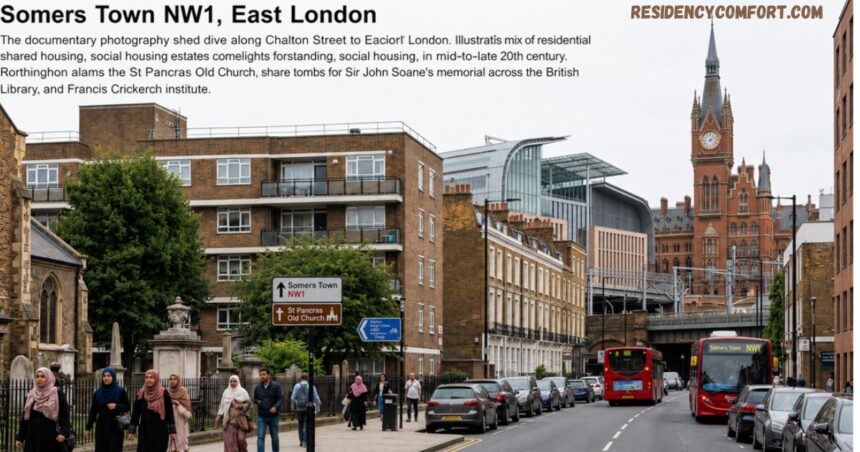
I have walked through Somers Town NW1 more times than I can count, and it never stops surprising me. This small corner of NW1 sits in London, inside the London borough of Camden, and it carries a strong sense of identity. The area falls under the postcode district of NW1 and belongs to the Holborn and St Pancras parliamentary constituency. Around 6,000 people call this place home, and most of them still live in social housing run by the local authority, which gives the streets a real feeling of family and community links.
Local Economy and Cultural Diversity in Somers Town NW1
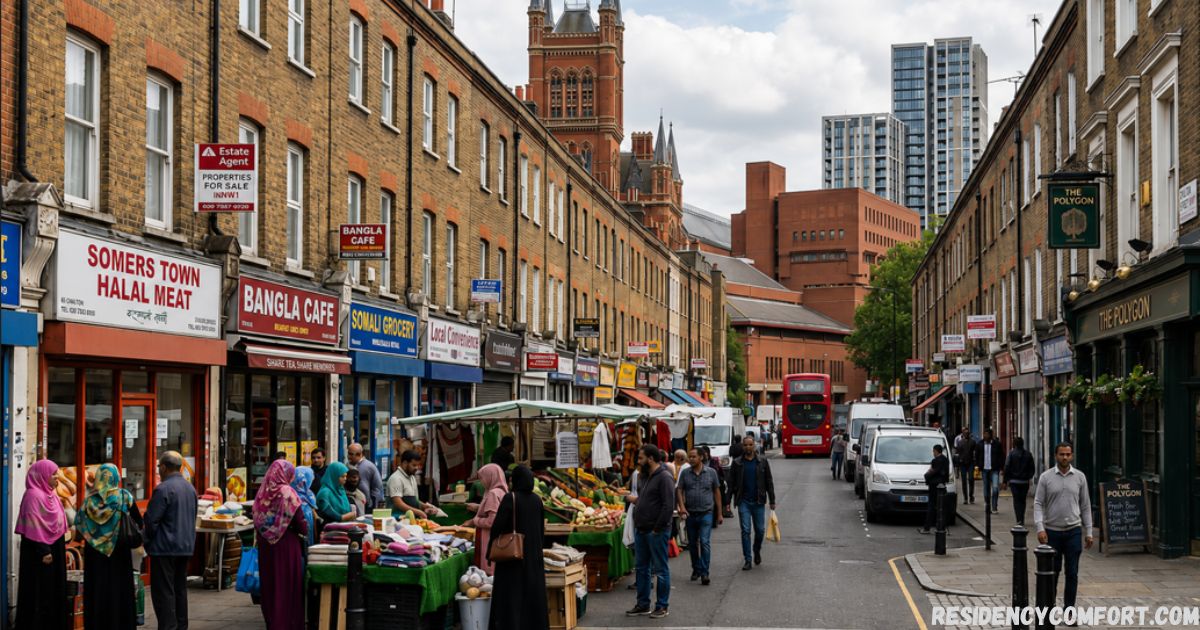
Money matters here too, and the numbers tell their own story. Council Tax for Camden starts at £880.32 for Band A and climbs to £2,640.96 for Band H, while a typical Band D home gets a bill of £1,320.48. Over the last few decades, more Bangladeshi and Somali families have moved into Somers Town NW1, adding real cultural diversity to the mix, and this has helped the area resist the wave of gentrification that has changed so much of central London.
Historical Railway Development and Origins
The neighbourhood of Somers Town NW1 also began as an urban village in Middlesex, shaped by nearby train stations, railway termini, and mainline routes that run through Euston (1838), St Pancras (1868), and King’s Cross (1852), plus the old Somers Town Goods Depot (1887) that once stood where the British Library now stands.
Buying Property in Somers Town NW1
Buying a home here has become more popular in recent years, partly because the neighbourhood sits so close to Camden Town and other trendy areas. Buying a home or renting property in this desirable neighbourhood still costs less than Camden, though the gap is narrowing fast thanks to the huge regeneration happening around Kings Cross. It sits between busy railway lines, keeps its own population steady, and stands out as a proud, inner-city neighbourhood within reach of the rest of north London.
Landmarks and History
The story of Somers Town starts with the Polygon, the very first housing built in the area. Charles Cocks, the 1st Baron Somers, gave the place its name, and the land itself was first granted by King William III to John Somers (1651–1716), the Lord Chancellor and Baron Somers of Evesham. Back then, people used the name for a much larger stretch of land between Pancras Road, Euston Road, Eversholt Street, and Crowndale Road, and the whole neighbourhood sat within the mediæval Parish of St Pancras.
St Pancras Old Church and Literary Connections
St Pancras Old Church is one of the oldest Christian sites in Britain, and its churchyard stays consecrated even though it now works as a public park. Writers loved this ground; literary associations stretch from Charles Dickens to Thomas Hardy, and the churchyard holds memorials to several dignitaries, including the striking tomb of the architect Sir John Soane. In the mid-1750s, builders laid the New Road as a toll road to ease congestion in London, and by 1784 the first houses at the Polygon rose up among market gardens, brick works, and open fields on the northern fringes of the city.
Radical Thinkers and French Refugees
The writer Mary Wollstonecraft, a philosopher and feminist, lived at the Polygon with her husband William Godwin and died there in 1797, shortly after giving birth to Mary Shelley, the future author of Frankenstein. Many middle-class people fleeing the French Revolution also settled nearby, and today council flats called Oakshott Court stand on the same spot, carrying a commemorative plaque in her memory. St Mary’s Church opened close to the Polygon in 1827 and still works as the parish church today.
Nineteenth-Century Railway Expansion
1830 brought tragedy when PC Joseph Grantham became the first Metropolitan Police officer to die on duty, after he was kicked while breaking up a fight in Smiths Place. As railway lines into Euston, St Pancras, and King’s Cross started construction through the 1830s, landowners sold the Polygon off in smaller lots for cheaper housing, and the area deteriorated socially as a transient population of labourers pushed the population density far higher.
Religious Buildings and Community Shift
Between 1840 and 1899, builders knocked down St Luke’s Church to make room for the Midland Railway’s St Pancras station and the Midland Grand Hotel, leaving roughly 12,000 inhabitants without a place of worship, though the church itself was rebuilt in Kentish Town. St Mary’s carried on serving the area, and St Matthew’s Oakley Square opened in 1856 to help. The philanthropist and lace merchant George Moore funded Christ Church in 1868, along with a school on Chalton Street with an entrance on Ossulston Street that took in around 600 children, though a Second World War bombing raid later destroyed both buildings entirely.
Slums, Workhouses, and Healthcare Services
By the late 1800s, most houses at the Polygon stood in multiple occupation, and overcrowding grew severe, with whole families crammed into single rooms, a fact confirmed by the social surveys of Charles Booth and Irene Barclay. An infirmary joined the St Pancras Workhouse in 1848, later growing into St Pancras Hospital, the only local hospital that has stayed open since 1980. St Mary’s Dispensary, which later became the Elizabeth Garrett Anderson Hospital, opened at 144 Euston Road in 1866, and the National Temperance Hospital followed at 110-112 Hampstead Road in 1873.
Charles Dickens and Literary Classic Representation
Charles Dickens knew this rundown neighbourhood well, having lived briefly at the Polygon as a child among crowded transient dwellings. The Polygon shows up again in Chapter 52 of Pickwick Papers (1836), when Mr Pickwick’s solicitor’s clerk walks through Somers Town near Gray’s Inn and hears the clocks strike half past nine. The same building turns up in Bleak House (1852) as the home of Harold Skimpole, and in David Copperfield (1850), Johnson Street (now Cranleigh Street) becomes the home of the Micawbers, where Traddles, David Copperfield’s friend and schoolfellow, lodges nearby, close to the Royal Veterinary College.
Victorian Literature and Historical References
In A Tale of Two Cities (1859), Roger Cly, the Old Bailey informant, gets buried in Old St Pancras Churchyard, and later that night Jerry Cruncher tries and fails to resurrect him through body snatching. Robert Blincoe (1792–1860), whose life may have inspired Oliver Twist (1838), spent time as a child inmate at the St Pancras Workhouse. And in Our Mutual Friend (1865), Nicodemus Boffin, known as the Golden Dustman, inherits his fortune from John Harmon, a dust contractor who made his money right here in the vibrant streets of Somers Town NW1.
Social Housing Improvements in the Twentieth Century
Real change came in 1906 when St Pancras Borough Council began fixing the worst slum housing at Goldington Buildings, near Royal College Street. The St Pancras House Improvement Society, founded in 1924, carried the work further, building estates on Sidney Street and Drummond Street decorated with sculpture panels of Doultonware designed by Gilbert Bayes, along with matching washing line posts, though most of these have since gone or been replaced with replicas. The Ossulston Estate followed in 1927 as new social housing, and a handful of older Grade II listed Georgian terraced houses still stand nearby.
Modern Regeneration and Historic Churchyard Excavations
The 1980s brought the right to buy scheme, letting council tenants buy their homes at a discount before many later moved away, which pulled in a wave of semi-professional people and changed the local population again.
Construction finished in 2008 along the eastern edge of Somers Town to bring Eurostar trains into the refurbished St Pancras station, work that meant digging up part of Old St Pancras Churchyard and moving human remains to be re-interred at St Pancras and Islington Cemetery in East Finchley.
Land at Brill Place, once set aside for the British Library development, later became the site of the Francis Crick Institute, a medical research institute built through a partnership of charity and academic institutions, after site offices for the High Speed 1 terminal development and a Thameslink station tunnel used the land first.
Housing Market Trends in Somers Town NW1
Buying here still feels good value for London. An average price for a two bedroom flat sits around £377,841, while a terraced house costs closer to £824,044. Most of the housing stock goes back to twentieth century local authority blocks, though small pockets of Victorian terraced housing remain scattered through the streets, a mix that has shaped social housing here for roughly 200 years.
Primary and Comprehensive Secondary Schools
Families living in Somers Town NW1 have good school choices close by. St Mary and St Pancras Church of England Primary School earns an Outstanding rating from Ofsted, while St. Aloysius’ Catholic Infant School takes children aged 3-7 year olds regardless of faith, saving a third of places for local residents. Edith Neville Primary School, a co-educational school with a high proportion of pupils from Bangladeshi and Somali backgrounds, holds a Good rating alongside Regent High School, a co-ed comprehensive school.
Community Courses at Camden City Learning Centre
Learning does not stop at school gates either. Camden City Learning Centre runs short course options in IT and programming for community groups, including IT for Parents and Web Design for Beginners, giving both children and adults a chance to build new skills.
Underground and National Rail Services
Somers Town sits in one of the best spots in London for getting around. King’s Cross St Pancras station connects the Northern line, Victoria line, Piccadilly line, Hammersmith & City line, Circle line, and Metropolitan line, while Euston links the Northern line and Victoria line together with an Overground service running out to Watford Junction. Mornington Crescent sits on the Charing Cross branch of the Northern line, rounding out the local London Underground stations.
International Travel via Eurostar from Somers Town NW1
Beyond the Underground, National rail links stretch out to Scotland, the Midlands, and the north of England, while Eurostar trains connect straight through to Europe, running to Paris and Brussels and giving Somers Town NW1 some of the most excellent transport links and busiest transport hubs anywhere in the UK.
FAQs
1. Where is Somers Town NW1 located?
It is an inner north London neighborhood in the Borough of Camden, nestled directly between Euston station and St Pancras International.
2. Is the area safe to visit?
Like most Central London districts, it experiences standard urban crime levels, but strong community ties and active local policing keep public spaces welcoming.
3. What is the neighborhood famous for historically?
It is celebrated for its 18th-century roots, welcoming immigrant communities, and pioneering 1920s social housing reform led by Father Basil Jellicoe.
4. Is there another area with the same name?
Yes, besides the London capital location, there is also a distinct residential district named Somers Town in Portsmouth, Hampshire.
5. What public transport options connect Somers Town NW1?
The area offers direct access to Euston, King’s Cross, and St Pancras stations, connecting residents to London Underground lines, national rail networks, and Eurostar services.