

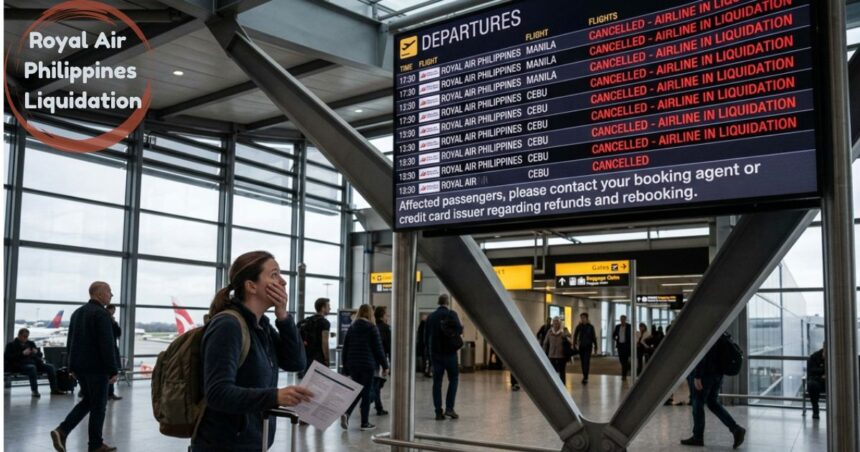
The Royal Air Philippines liquidation marks a major shift in the Southeast Asian aviation landscape. Below is the detailed breakdown of the Manila carrier’s sudden downfall, its history, and what it means for affected passengers.
Royal Air Philippines Liquidation Inside the Fall of a Manila Carrier
I have watched a lot of small airlines struggle, but the Royal Air Philippines story still stands out. This Manila-based low-cost operator, owned by the Cambodia-registered Lanmei Group, pulled every scheduled commercial service on 4 January and entered Royal Air Philippines liquidation soon after, becoming the first carrier of 2026 to formally stop flying after a rocky four-year stretch.
Its website now shows only a holding notice that promises refunds and hints at resuming operations, though industry observers treat that idea as remote given the size of the financial hole underneath it. The airline had leaned hard on inbound leisure traffic from China and South Korea, feeding travelers into resort hubs like Boracay and Palawan, and that business model simply unwound.
Collapse by the Numbers
The numbers tell the real story. International passenger volumes slipped to roughly 51,800 in the first nine months of 2025, while domestic numbers tumbled more than 60 per cent year on year, a sharp reversal from 2023 and 2024, when the carrier cleared over 100,000 passengers annually. Rising regional tensions, a softening Chinese outbound market, and aggressive competition from bigger flag carriers and low-cost carriers left the company badly exposed, and by the turn of the year recovery looked implausible.
Its small Airbus A320 and A321 fleet sat grounded while liquidators began their work, and reports put the stranded total at 3,000 to 4,000 passengers, all holding tickets through March 2026 that suddenly became invalid bookings.
Royal Air Philippines Liquidation Coverage and Chapter 7 Fallout
Coverage of the collapse arrived fast. Outlets reported the cancelled flights nine days after the fact, noting routes cancelled across both domestic flights and international flights, with the key loss being the Taipei-Boracay route, now eliminated.
Industry experts expect a Chapter 7 liquidation, calling it close to inevitable, and the airline’s struggling financial months made the outcome feel less like a shock and more like an ending everyone half expected an ending owned by the same investors who watched passenger numbers and domestic traffic shrink while competition from larger Philippine airlines intensified and the core market simply weakened.
Grounding the Fleet Overnight
Picture this: it is January 4, 2026, and Royal Air Philippines abruptly wipes out every single commercial flight on its schedule. Anyone holding bookings from January through March 2026, the furthest advance booking window the carrier ever allowed, is left staring at worthless tickets.
The airline website posts a generic message about working on providing refunds and hoping to resume flights at an unspecified date, thanking travelers for their patience and understanding and promising a welcoming return that few believe will happen.
A Collapse Driven by High Debt and Lost Routes
Industry insiders call that message a fantasy, and honestly, that word fits. The carrier faced insurmountable financial problems, intense competition from Philippine Airlines and Cebu Pacific, and a collapsed customer base born from geopolitical tensions between China and the Philippines that gutted its tourism-dependent business model.
Its domestic routes to Caticlan, Tagbilaran, Puerto Princesa, and Cebu disappeared alongside international routes to Taiwan, Cambodia, and China, while 3 Airbus A320s and 1 Airbus A321 sat idle on the tarmac.
None of it came without warning, at least not to people watching closely. Reservations across 2026 were cancelled overnight, the company website posted a brief message promising refunds, and industry analysts now call a restart highly unlikely as the formal Royal Air Philippines liquidation process moves forward, closing a chapter that had opened with real ambition.
Consequences for Travelers
For everyday travelers, this collapse lands at an awkward moment. UK corporates expanding their Asia footprint are watching closely, and industry data shows UK SMEs pivoting business travel toward Asia and Africa as new global hubs emerge, which makes thinner regional carriers a bigger part of the trip-planning conversation than before.
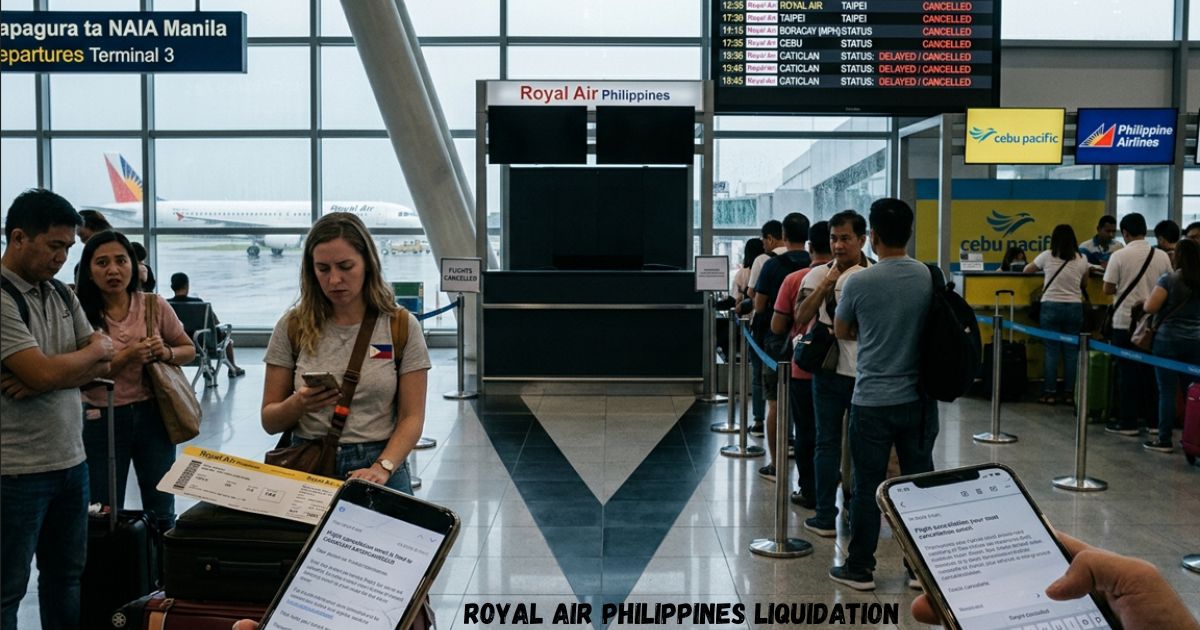
Anyone holding Royal Air tickets faces an unforgiving situation: all flights stand cancelled, no rebooking gets offered, and refunds stay slow and uncertain while the Royal Air Philippines liquidation proceedings run their course.
Higher Fares and Lost Direct Connections
I have seen this pattern before with other failed carriers, and it always plays out the same way. Replacement seats on overlapping routes start firming up in price as displaced passengers compete for inventory, and niche leisure connections, especially the Taipei to Boracay route, lose their direct service, pushing travelers onto longer, multi-stop itineraries through Manila or Cebu. The shape of the failure echoes other recent groundings across the sector, including ex-Spirit Airlines pilots who were hired to ferry a grounded Airbus fleet into long-term US desert storage after that airline’s own collapse.
2026 is shaping up as a difficult year for thinly capitalised operators, and the immediate problems stack up fast for passengers: rebooking is simply not offered, refunds get delayed or never arrive, and travelers must book new flights with other companies, often at higher prices on short notice. Niche leisure routes like Taipei-Boracay have lost direct connections, forcing longer journeys with stopovers that add hours to what used to be a simple hop.
Immediate Steps for Individual Bookers
If you are one of the affected fliers, act like a travel manager would. Individual bookers need to act quickly: when a refund fails to materialise, passengers paying by credit card should pursue a chargeback through their issuer rather than wait.
Check whether corporate travel insurance or personal travel insurance includes airline insolvency cover, because that protection is not standard across all UK products, and rebooking sooner matters since demand on parallel Manila routings and Cebu routings is already lifting fares.
Managing Risk During the Royal Air Philippines Liquidation
Organisations weighing risk in volatile markets should lean on the same broader counsel we gave in earlier guidance: Brits should favor stable destinations as flight disruption headlines keep rising, and that advice applies with renewed force during the ongoing Royal Air Philippines liquidation. Travelers are advised to contact their credit card company and request a chargeback if money is not refunded, and to confirm whether travel insurance actually covers airline bankruptcies before assuming it does.
From experience, waiting rarely pays off in situations like this. It is recommended to book alternative flights as soon as possible, since demand on affected routes is expected to increase the longer the liquidation drags on, and every day of hesitation tends to cost more once fares start climbing across the region.
Financial Liabilities and Strategic Lessons
Step back, and Royal Air’s failure reads as the first airline bankruptcy of 2026, a signal that the regional Asia-Pacific market remains uneven no matter how strong the headline growth numbers look. As reported by outlets including The Mirror, the collapse has left thousands of passengers stranded mid-itinerary, while corporate filings cited by industry observers suggest liabilities running to several billion pesos against assets worth only a fraction of that amount.
For travel buyers, the practical lesson stays familiar no matter how many times it repeats: scrutinise the financial health of any niche carrier holding material chunks of your itinerary, and diversify routings into the Philippines’ main hubs rather than betting on a single thin operator. Confirm that travel insurance written into corporate policies truly covers insolvency rather than only delay and cancellation, because the fine print matters far more once a carrier actually goes under.
Vulnerability of Tourism-Dependent Carriers
The collapse of Royal Air Philippines stands as one of the first airline crashes of 2026, and it says a lot about continued volatility in regional air traffic. It exposes the vulnerability of smaller companies that stay dependent on tourism, especially when that tourism can vanish within a single policy cycle. Travelers and analysts alike should treat this as a case study rather than a one-off surprise.
From Cargo Hauler to Bankrupt Budget Carrier
Royal Air Philippines launched in 2002 as a cargo airline and charter airline, moving freight and private charters around the Philippines and Southeast Asia. For 15 years, it quietly operated in that niche without much mainstream attention, until 2017 brought its pivot to commercial passenger flights through fresh commercial passenger licensing, followed by an inaugural passenger flight in 2018 between Cebu and Macau.
Expanding Routes and Chinese Ownership
Domestic routes expanded quickly to Caticlan, the gateway to Boracay island, plus Tagbilaran on Bohol island, Puerto Princesa on Palawan island, San Vicente, and the major city of Cebu. International expansion followed the same script, chasing Chinese and Korean tourists through routes to Taipei, Taiwan as the primary focus, plus Quanzhou, China, Hong Kong, Seoul, South Korea (later phased out), Phnom Penh, Cambodia, and Hanoi, Vietnam (also eventually phased out).
Geopolitical Tensions and Collapsing Traffic
The unraveling started when geopolitical tensions killed Chinese tourism: Philippines-China relations deteriorated sharply across 2024-2025 amid South China Sea territorial disputes, and Chinese tourists, the primary customer base, simply stopped visiting the Philippines.
The numbers back this up plainly, moving from 100,323 international passengers in 2023 to 116,324 international passengers in 2024, a bit of modest growth, before crashing to only 51,764 international passengers across January-September 2025, a 56 percent collapse that no airline can absorb quietly.
Royal Air CEO Eduardo Novillas put it plainly in a letter to travel agents dated December 22, 2025, telling business partners that local interest had gone low to obscure, and that they would hear from Royal Air once that interest turned healthy and heightened again. Domestic traffic evaporated at the same time, sliding from 104,473 domestic passengers in 2023 to just 38,845 domestic passengers in 2024, a 63 percent decline, as Philippine Airlines and Cebu Pacific, larger, better-capitalized carriers, aggressively expanded fleets and routes and pulled travelers toward established brands.
Operational Chaos and Crushing Competition
Operational problems mounted too: in the weeks before the January 4 shutdown, social media filled with complaints about flight delays, hours-long waits, entire days lost, last-minute cancellations, passengers stranded at airports, disrupted itineraries, connections missed, trips ruined, and poor customer service through unanswered emails and unreachable phone lines. The bitter irony is that recruitment advertisements for pilots, flight attendants, and ground staff kept running right up until the end, hinting at either organizational chaos or outright deliberate deception.
Competition crushed them in the end. Royal Air entered commercial passenger service in 2018 with just 4 aircraft, while Philippine Airlines ran an 80+ aircraft fleet across an extensive domestic network and international network as a Star Alliance member with real global partnerships and strong brand recognition, and Cebu Pacific matched it with a 75+ aircraft fleet, a low-cost leader position, aggressive route expansion, and deep financial backing. A 4-plane fleet simply couldn’t compete against rivals offering more flights, better schedules, and superior reliability at comparable or lower fares.
Rising Costs Sealing the Royal Air Philippines Liquidation
Rising costs and declining revenue finished the job: volatile fuel costs, rising jet fuel prices, general inflation, operational expenses, currency fluctuations, a weakening Philippine peso, and climbing maintenance costs on an aging A320 and A321 fleet all piled up.
Without economies of scale, financial reserves, a diversified route network, corporate travel contracts, or loyalty program revenue, the math simply stopped working revenue plummeted, fixed costs stayed high, and the Royal Air Philippines liquidation became inevitable.
FAQs
1. What caused the Royal Air Philippines liquidation?
The liquidation was triggered by severe financial distress, an abrupt flight shutdown, dropping regional tourism from China and South Korea, and heavy low-cost market competition.
2. What happens to existing flight bookings when an airline collapses?
All flight reservations are instantly canceled. Passengers become unsecured creditors, making direct airline refunds slow and uncertain.
3. What is the fastest way to get a refund for a grounded flight?
Filing a credit card chargeback through your bank for non-rendered services is the fastest option. Alternatively, check if your travel insurance covers airline financial failure.
4. What happens to an airline’s planes during insolvency?
The fleet is grounded. Liquidators return leased planes to aircraft leasing companies, while owned planes and assets are liquidated to pay prioritized corporate debt.
5. How do passengers file a refund claim following the Royal Air Philippines liquidation?
Passengers can register as unsecured creditors with the liquidator, but because these claims are paid last, travelers are strongly advised to pursue bank chargebacks first.