

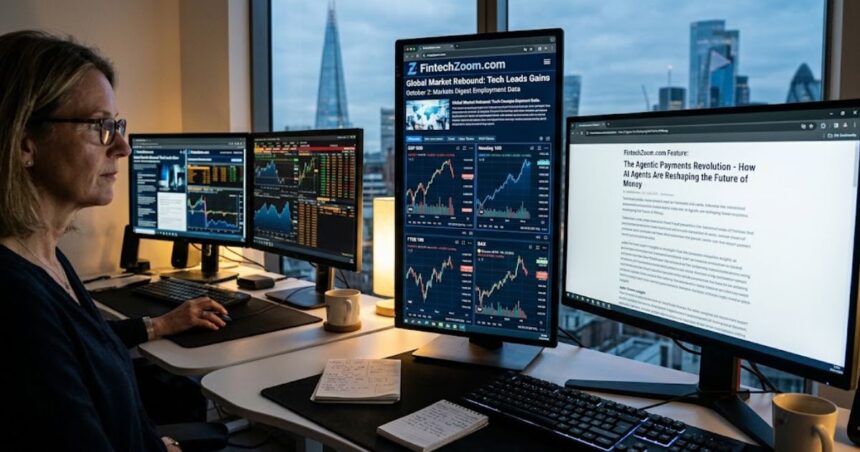
I have followed financial markets for years, and one lesson stuck with me: costly mistakes usually start with old news. In 2025, markets move fast, and crypto volatility can shake a portfolio in minutes. That is why FintechZoom.com became my daily hub, and I watch Bitcoin there first thing every morning.
In October, I followed Markets World Indices closely. On Oct. 2, weak employment data and payroll data pushed investors to cut their bets on a rate increase from the Federal Reserve. Wall Street reacted fast, and technology stocks led the gains.
FintechZoom.com Your Trusted Source for Real-Time Financial Insights
U.S. equities and European equities bounced back that day, while Asian markets looked mixed. Japanese benchmarks, Indian benchmarks, and Australian benchmarks all slipped. I saw these price movements on my screen long before my friends did.
On September 17, this London digital publication released a feature article on agentic payments. AI assistants now do more than answer questions, because AI agents follow instructions, respect limits, and finish purchases. A shopper no longer needs to click buy, so software can start transactions, and consumers, merchants, and banks must adjust the payments stack.
I like how FintechZoom.com covers the future of money with accuracy and expert analysis. Its user-friendly tools help traders, enthusiasts, and fintech startups make informed decisions in real time. My trading improved once I treated it as one of the trusted platforms and a reliable source for finance, cryptocurrency, stock markets, financial news, and financial technology.
What Makes FintechZoom.com Stand Out?
The agentic payments guide explains AI agents in plain words. Unlike subscriptions and autopay, this new kind of automation lets an agent search, decide, and buy. The technology relies on tokenized cards, virtual cards, spending mandates, and machine-readable checkout.
The article also covers consumer shopping, business procurement, and cash management. It asks tough questions about liability and chargeback rules, and it warns about fraud threats like prompt injection and fake merchant sites that fool AI buyers. Old consumer protection rules may struggle to keep up, so fraud prevention needs a fresh plan.
The guide also teaches designing for trust through transparency, human approval checkpoints, and instant credential revocation. It predicts how agent-to-agent commerce and regulation may grow over two to three years. Judie Simms, the Finance Editor, says AI agents are a new kind of customer, and that changes checkout design and fraud prevention across financial transactions, payment systems, and the future of trust.
As a tech enthusiast, I love the fintech revolution, where startups build blockchain-powered payment solutions and big firms test AI-driven models. FintechZoom.com gives fintech innovations a full section, so I learn about Web3, decentralized finance, and the future of banking without surface-level reporting. That depth sets it apart from many other sites.
Real-time finance news matters, because instant updates prevent missed opportunities and unnecessary losses. When a central bank announces a policy shift or a company posts earnings, I read the banking news and global markets coverage right away. The site covers stocks and forex well, and it keeps ads and opinion pieces from burying the story.
Its crypto coverage goes beyond Bitcoin and Ethereum to DeFi, NFTs, altcoins, and blockchain projects. Price trends, expert predictions, and market analysis sit in one place, so I separate hype from real chances. That habit protects my profit and loss, because I judge hype vs opportunities every day, and volatility punishes weak strategies in financial markets.
The Future of Finance & Crypto News Why Platforms Like FintechZoom.com Are Essential
FintechZoom.com plans a new series on the trends that shape financial technology. The first piece covers agentic payments, and upcoming features will cover stablecoins in cross-border payments, embedded finance, deepfakes versus digital identity verification, and open banking. You can read the full article right now.
The complex financial world keeps changing as blockchain, AI, and Web3 reshape how people trade, invest, and use a bank. Platforms that offer fast reporting, unbiased reporting, and insightful reporting matter more than ever. I trust FintechZoom.com as a leading resource for finance and crypto news, because it follows technological shifts and emerging trends, and it hands me tools for new challenges.
What an Index Actually Measures
An equity index squeezes many listed companies into a single number, and that discards information. Two indices from the same country can move in opposite directions on one day. An index can hit a record high while the median company sits far below its peak.
Capitalisation weighting and market-capitalization weighting give each firm power based on its total market value. The S&P 500, Nasdaq Composite, FTSE 100, and DAX use this method. So five hundred companies can act like twenty, because the largest constituents carry most of the weight.
Price weighting looks only at share price, so a firm with high share prices and modest market value pushes harder than a bigger rival. The Dow Jones Industrial Average and the Nikkei 225 work this way, and the method has no statistical justification, because it survives on tradition. Price-weighted indices differ from equal weighting, where equal weighted versions give every stock the same say and show whether market strength is broad or narrow.
Country labels mislead people. The FTSE 100 is London listed, yet it has revenue earned abroad and leans on energy, mining, banks, and consumer staples, so it acts as commodity exposure and currency exposure more than a view of the British economy. The DAX is industrial and export heavy, so it follows global trade and manufacturing demand.
The CAC 40 favors luxury goods and aerospace. The ASX leans on mining and banking, and the Nasdaq 100 shuts out financial companies and loads up on technology-related businesses. This sector exposure means bond yields, oil prices, and interest-rate expectations hit each index differently after economic news.
Currency adds another twist. Exchange rates shape headline index returns, so a gain in local currency may not help investors who count in dollar, euro, or sterling. I always check benchmark construction first, because the divergence nearly always traces back to it.

FintechZoom.com Global Market Overview Stocks Rebound Across Regions
The Nasdaq ended near its record level, but weekly performance stayed mixed. The S&P 500 lost 0.3%, the Dow fell 1.3%, and the Nasdaq gained 0.5%. Technology shares and financial shares told very different stories.
In Europe, the DAX rose 1.17% to 25,231.20, and the CAC 40 gained 0.79% to 7,897.19. The Euro Stoxx 50 added 1.02% to 6,238.50, while the FTSE 100 finished 0.32% higher at 10,461.95. That rebound helped Europe recover from a bond-driven decline.
Asia moved in different directions. The Nikkei 225 fell 0.94%, the ASX 200 dropped 1.22%, and the NSE Nifty 50 and Nifty 50 declined 0.88%, but the KOSPI gained 0.46%. The Hang Seng fell 2.6%, its biggest daily drop since March, as thin trading met China’s Golden Week, and several Asian indices stayed under pressure.
Global Indices, Yields, and Diversification
Government bonds saw fresh selling. U.S. Treasury yields fell after the jobs report, then climbed, so borrowing costs stayed high. The soft data still cut Fed tightening bets and calmed volatile sessions, as tracked by market updates on FintechZoom.com.
The S&P 500 holds five hundred large companies that a committee picks, with a profitability requirement. The Nasdaq Composite holds thousands of shares, while the Nasdaq 100 takes the hundred largest non financial names. The Dow holds thirty companies, and the Russell 2000 follows two thousand smaller companies, which shows domestic economic health and credit conditions.
The STOXX Europe 600 spans seventeen countries and mixes large capitalisation, mid capitalisation, and small capitalisation firms. The eurozone has the Euro Stoxx 50. In Asia Pacific, the Nikkei 225 reacts to the yen, because a weaker currency lifts exporters, while the Hang Seng blends China news with global mood and the Shanghai Composite tracks mainland listings in a unique regulatory environment.
This tour touches Japan, Australia, India, South Korea, Hong Kong, Germany, France, Britain, the United States, and Europe. It shows why weighting, sector composition, and currency exposure matter before you judge any index. I always ask how much exposure I really have before I act.
Why Traders and Investors Rely on FintechZoom.com
Why do I trust FintechZoom.com? I wanted a trusted financial news source that avoids sensationalism, speculation, misinformation, and generic headlines. A misleading headline can force split-second decisions, so I value fact-checked reporting, verified sources, and transparency. I also compare FintechZoom.com with Bloomberg, Yahoo Finance, and CoinDesk, and it often gives me faster updates while staying up to date and well-researched.
Its popularity comes from speed, accuracy, and unbiased reporting. Credible analysis and actionable news build its reliability. Its engaged audience includes beginners, individual traders, institutional investors, fintech professionals, financial analysts, entrepreneurs, and businesses.
Interactive Market Tools and Analysis on FintechZoom.com
I lean on interactive market tools every day. Live tickers, live charts, live price charts, stock and crypto price charts, and calculators help me on a volatile trading day. I use FintechZoom.com to visualize data, follow Bitcoin’s movements, and minimize risks, while alerts warn me about market movements.
Expert analysis & opinions come from analysts and industry experts who explain macroeconomic factors, stock earnings, and market predictions. Educational content eased my learning curve, and it still explains complex financial concepts, emerging technologies, and trading strategies. I also read crypto prices and crypto reports to watch the digital asset space.
Streamlining Daily Market Research with FintechZoom.com
The site works like a toolkit. Traders use alerts, investors use research and stock market insights for long-term portfolio planning, and fintech startups spot market opportunities through its engaged audience. That mix keeps me coming back. Subscribing to daily updates brings me breaking news first. I bookmark my favorite categories and follow trend analyses, expert opinions, and crypto reports.
This workflow streamlined my daily routine a lot. FintechZoom.com is my daily financial news hub and my partner in a busy market. Reliable reporting, comprehensive coverage, and powerful tools serve fintech enthusiasts, traders, and investors alike. If you want to trade smarter and stay ahead of the curve, make FintechZoom.com part of your day.
Frequently Asked Questions (FAQs)
1. What is FintechZoom.com?
It is an online financial news and technology platform that provides real-time updates, market analysis, and insights on stocks, cryptocurrencies, banking, and global economic trends.
2. Is it a trading or stockbroking platform?
No, it is primarily an informational and analytical site. You cannot buy or sell assets directly on the platform; trading must be done through a separate broker or exchange.
3. What markets and topics are covered?
The platform covers major market indices (like Nasdaq and Dow Jones), individual stocks, cryptocurrencies (like Bitcoin and Ethereum), digital payments, forex, and general business trends.
4. Is the content free to access?
Yes, most of the financial articles, news reports, and general market data are freely accessible to readers.
5. How can users benefit from using FintechZoom.com?
Investors and readers can use FintechZoom.com to stay informed on fast-moving financial trends, monitor market movements, and research digital asset news before making investment decisions.