

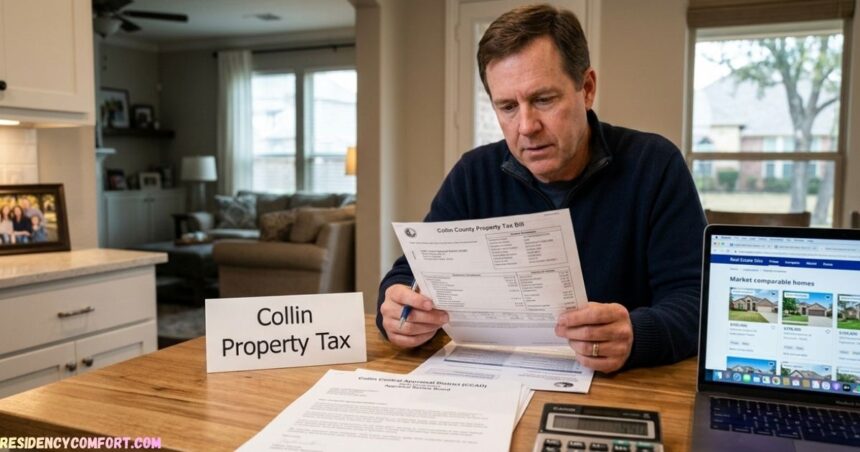
Collin Property Tax refers to the annual property tax bill paid by homeowners and property owners in Collin County, Texas covering fast-growing cities like Plano, Frisco, McKinney, Allen, and Wylie in the Dallas-Fort Worth area.
Collin Property Tax A Homeowner’s Real Look at Rising Bills
Collin County sits proudly in the Lonestar State, right in the middle of the growing Dallas-Fort Worth area, and anyone who owns real estate here already feels the weight of climbing property taxes. I’ve watched homeowners across Plano, Frisco, McKinney, Allen, and Wylie open their tax bills and wonder how their home values jumped so fast, while nearby Dallas, Tarrant, and Denton counties push even more residents toward Collin’s booming commercial sector.
Every property owner holds a constitutional right to question their valuation, apply for exemptions, and walk their own appeal journey through the appraisal district when the numbers feel wrong.
This growth story stretches beyond single homes too, since empty land, businesses, and everything with a market value feel the same pressure from DFW expansion. Many taxpayers accuse the Collin Central Appraisal District, known simply as CCAD, of leaning on rising values as an excuse for over taxation, and that frustration has pushed more people toward filing a formal protest or joining property tax appeals with firms like O’Connor.
Between the 2025 appraisal cycle and the upcoming 2026-27 fiscal year, Texas homeowners are learning fast that taxable value, tax rate, appraisals, and even the separate bill from Collin College all shape the final number on their doorstep.
Key Takeaways
Fast population growth keeps pushing appraisal increases across every corner of Collin County, and that pressure lands squarely on property tax bills sent out by the county, cities, school districts, and special districts alike. Taxing authorities rarely single out one home, yet similar homes sitting in the same high-value neighborhoods can end up assessed differently, which is exactly why an unequal appraisal argument holds real weight once you sit down with CCAD.
Why Collin County Appraisals Keep Climbing
Over the last decade, property values across Collin County have shot upward, fueled by strong population growth and heavy residential development in Plano, Frisco, McKinney, Allen, and Wylie. Buyers moving into Texas created real buyer demand, tight housing inventory, and rising sale prices, and once a subdivision shows a jump. This system leans on market data, neighborhood sales, valuation models, and general property characteristics rather than a personal visit to every home, so even when the Texas housing market cools, appraisal values and home prices tend to hold onto prior appreciation, keeping market value and property tax appraisals stubbornly high across the whole market area.
Why Mass Appraisal Doesn’t Always Get It Right
Mass appraisal systems exist to process hundreds of thousands of properties quickly, but speed often creates inaccuracies inside the appraisal process itself. A single valuation model rarely captures deferred maintenance, tired aging systems, cracked foundation issues, outdated interior finishes, missing updates, or awkward location disadvantages, and those gaps matter even when two houses share identical square footage.
Appraisal districts assign appraised values and market values based on broad components rather than true condition, so a home’s real price on the open market can sit far below its official number, and this kind of overvaluation, along with unresolved functional obsolescence, hits owners in higher-value neighborhoods hardest through inflated annual property taxes.
What Makes Up Your Collin County Property Tax Bill
Your property tax bill is the result of multiple overlapping taxing entities working together. Collin County government covers county operations, courts, roads, and public safety, while your local city government handles municipal services such as police, fire, parks, and public works. Additional layers include the school district for public education, the community college district for Collin College, and special districts for utility and local improvement services. Because of these distinct layers, cities like Plano, Frisco, McKinney, Allen, and Wylie each have a slightly different combination of taxing jurisdictions.
How Your Final Tax Bill Is Calculated
Each entity sets its own individual tax rate, which combines to form your overall Combined Tax Rate. This rate is multiplied by your property’s Taxable Value to calculate the total amount owed ($Taxable\ Value \times Combined\ Tax\ Rate = Final\ Tax\ Bill$). While property owners can apply exemptions to reduce their taxable amount, the starting appraised value remains a critical factor meaning even strong local infrastructure spending will not lower your bill if the underlying property valuation stays too high.
The Difference Between the Collin County Tax Assessor and CCAD
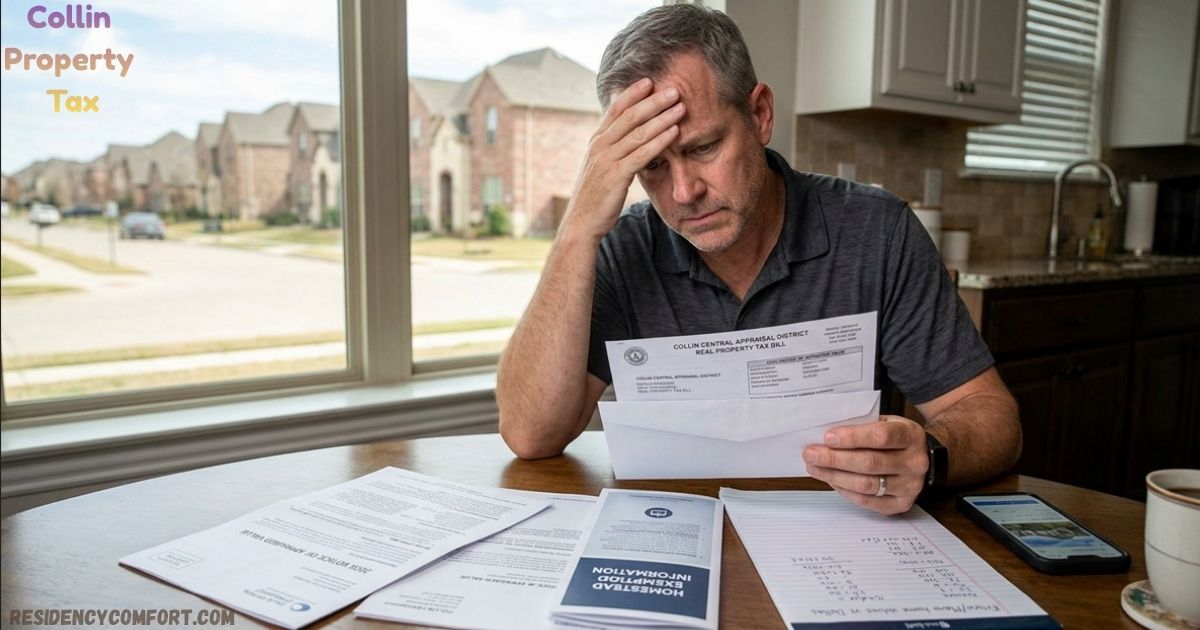
People often confuse the Collin County Tax Assessor with the office that actually sets home values, but the tax assessor only collects property taxes, processes vehicle registrations, and manages other tax-related services for homeowners. The real market value comes from the appraisal district, meaning the Collin Central Appraisal District, or CCAD, which runs the entire appraisal process and approves exemptions. So when you want to file a protest against your number, you head straight to CCAD instead of the assessor’s counter, and that one distinction saves a lot of wasted phone calls.
Exemptions Worth Applying For
Filing for the right exemptions stands out as one of the smartest moves any owner can make against a heavy Collin County property tax burden. The Collin County Homestead Exemption applies to qualifying homeowners who live in the property as their primary residence, and because home values run high across much of Texas, that single filing often unlocks real tax savings for homeowners who take the time to apply.
Collin County 2025 Property Tax Protest Results and Homeowner Savings
Numbers from the 2025 cycle tell the real story of how hard Collin County homeowners pushed back through appeals. CCAD flagged 22% of single family homes as overvalued homes, a real improvement from 28% recorded back in 2024, right after total value for the county jumped 4.9% to reach $196.96 billion. That spike shrank by 0.9% once protest filings landed, and homes priced between $500,000 and $750,000 carried the biggest share at $65.86 billion, trimmed by 0.5%, while the $250,000 to $500,000 bracket followed close behind at $55.88 billion after its own 0.5% cut, and homes near $1 million settled at $33.03 billion after a 0.7% reduction.
Clients who trusted O’Connor with their case saved 1.4% overall, including a strong 1.2% cut on homes in that busy $500,000 to $750,000 range, adding up to $59.52 million in combined savings, proof that a well-built protest genuinely moves the needle.
The gist
During an Aug. 25 board meeting, the Collin College board of trustees kept its tax rate steady at $0.081220 per $100 valuation, the same number the college has held since 2022 according to official Collin County documents. Thanks to newly constructed property across the county, property tax revenue for 2026 should climb by about $7 million even though the rate itself never moved, and among every community college in Texas, this stands as the third lowest tax rate on record. For the average value home in Collin County, now sitting near $592,948 according to the Collin County Appraisal District, the yearly property tax bill tied to Collin College comes out to roughly $481.59.
Diving deeper
The same board of trustees also signed off on the FY 2026-27 budget, which lays out revenue just over $455.4 million, split between $322.8 million in unrestricted funds, $93.1 million in restricted funds, and $39.5 million moved through interfund transfers. On the other side, expenses climb close to $460.8 million, leaving the college with a net negative budget and a shortfall near $5.4 million, an improvement from earlier budget projections that once pointed toward $8 million.
Collin Property Tax Relief Through Budget Trimming
Irby credited the smaller gap to a leaner operating budget across the district, along with several positions that the administration placed on hold or closed entirely after further review. That kind of careful trimming from Collin College staff shows how tightly connected everyday choices are to the final Collin property tax numbers taxpayers see on their bill.
FAQs
1. How is my collin property tax calculated?
Multiply your home’s taxable value (market value minus exemptions) by the combined tax rates of your county, city, college, and school district.
2. What exemptions lower property taxes in Collin County?
- Homestead Exemption: Reduces school district taxable value.
- Over 65 / Disabled: Adds extra deductions and freezes school tax rates.
- Disabled Veteran: Cuts taxes based on VA disability rating (up to 100%).
3. How do I protest my home’s appraisal?
File a protest online with the Collin Central Appraisal District (CCAD) by May 15.
4. When are property taxes due?
Bills arrive in October and must be paid by January 31 to avoid late fees starting February 1.
5. Is there a cap on my collin property tax appraisal increase?
Yes, but only if the property qualifies for a Residence Homestead Exemption.