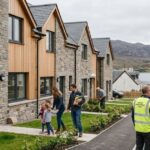

When people hear the word treehouse, they picture a wooden hideout, but three very different apartment projects show how far the idea has travelled. One compelling example is the Treehouse Apartments model pioneered by the Treehouse Foundationa nonprofit organization with 501(c)(3) status founded in 2002. They opened Treehouse Easthampton in 2006 as an innovative intergenerational community designed specifically for families, children, and youth touched by foster care. The Case Report on these Treehouse Apartments describes 60 affordable homes situated on a peaceful cul-de-sac with greenspace, a playground, and a staffed community center where more than 100 people across the lifespan meet every day.
Intergenerational Living and Modern Urban Designs: The Rise of Treehouse Apartments
Parents and caregivers raise their kids next to adults over age 55, so the neighborhood welcomes anyone who has reached 55 years of age and wants aging in place. This innovative approach to Treehouse Apartments rests on intergenerational living, affordable housing, support services, and community building, and the team shares what it learns openly. It also studies hard topics such as siloed funding, property maintenance, generational differences, evaluation, and expansion plans.
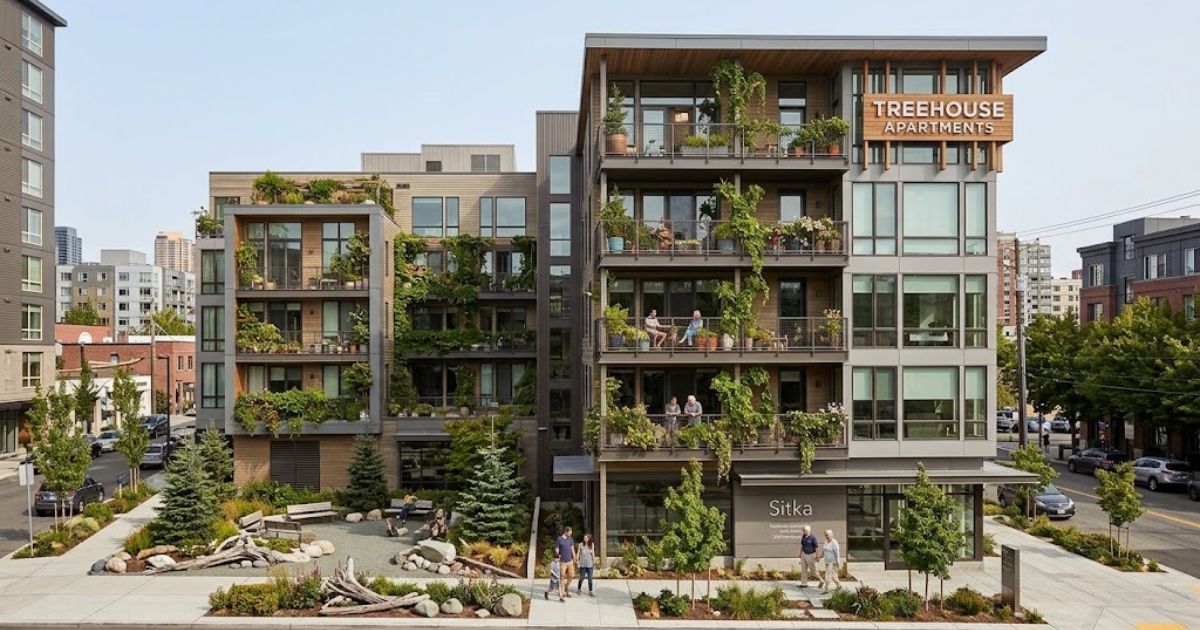
In Seattle, strong job growth pushes housing demand, so developers compete hard, and each team asks how to build memorable unique spaces that beat the competition. Vulcan Real Estate answered with Sitka, a seven-story mixed-use project featuring Treehouse Apartments styled living with 384 residential homes, 33,345 square feet of residential amenities, and 3,143 square feet of retail. Their answer shows how a big city project can still feel personal.
In Iowa, Council Bluffs turned an 8-1/2 acre property into The TreeHouse Project, officially the 34th St & 1st Ave Redevelopment, a transformative development showcasing new concepts for Treehouse Apartments that aim to revitalize public spaces, lift the city’s image, improve quality of life, and honor the community’s commitment. Schemmer, Confluence, and LundRoss supply the architectural design and engineering design. Together they give the site a plan that looks ahead.
Housing Design, Layout & Amenities
Treehouse communities work because the layout pushes interactions between community members, staff, and neighbors of all ages. Treehouse Easthampton gives older residents 48 one-bedroom cottages and gives families 12 townhouses with three to five bedrooms, and accessible designs support persons with disabilities and aging in place. That mix builds a multigenerational, generative neighborhood where people offer and receive support every day.
At Sitka, visitors notice the Pacific Northwest feel right away, because the San Juan Island-inspired courtyard copies the region’s natural beauty. The urban forest motif includes driftwood, Sitka spruce trees, benches shaped like canoes, a bubbling pond, and stepping stones, much like a pearl within an oyster. Select ground-floor units add individual decks made for waterfront days.
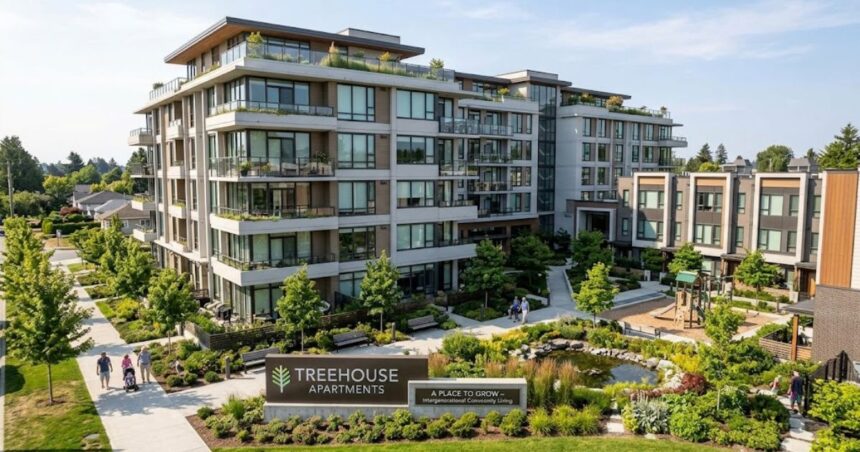
The TreeHouse project in Council Bluffs follows three phases that push urban renewal and economic stimulation. Phase 1 builds two attached four-level apartment buildings and 20 three-level townhomes, all identical in design, and Phase 2 repeats that plan with two additional four-level apartment buildings and 18 townhomes. Phase 3 splits in two: Phase 3.1 brings two attached three-level apartment buildings, while Phase 3.2 adds two single-story commercial buildings, one joined to the apartment building from the earlier step.
The healthy housing features include indoor fitness amenities, common kitchen facilities, bike trails, community gardens, and rooftop entertainment patios. These features aim to create a vibrant and sustainable community environment. A strong design ties every piece together.
Community, Vision & Sustainability
At Treehouse Easthampton, regular activities and events such as group meals, recreational programs, volunteer opportunities, and a community newsletter build a sense of community for residents of all ages. The community center sits a short walk from every home, so people drop in often. The goal is stable loving homes with emotional support, social support, academic support, and developmental support for children and their families, plus a dynamic community for older adults with social connections, purposeful engagement, and aging in place.
Internal data (Homestead 2019) shows higher high school graduation and college or vocational training attendance, along with lower rates of arrests and less teen parenting, compared with foster youth nationally. Most young residents reached permanency and got adopted. The neighborhood also keeps a low resident turnover rate, which says a lot about how people feel there.
Sitka stands at 1255 Harrison Street in South Lake Union as part of a trio of full-block mixed-use residential projects with Alley24 and Stack House. Each award-winning building has a singular character that adds vibrancy, and they share sustainable design features like the Swale on Yale, cross-block alley connections, and curated retail for an engaging pedestrian experience. Each one takes distinct design approaches to create memorable spaces.
Project Manager and Architect Michael Sinclair says biophilic design came first, with strategies to connect people with one another and the outdoors, from the parking arboretum to the grand outdoor staircase and many outdoor amenity spaces, all aimed at health and well-being. The City of Council Bluffs sees the First Avenue Corridor as a catalyst for residential and mixed-use development, since the former rail corridor, vacated in 2013, sits one block from West Broadway. It could become a multi-modal corridor that one day reaches Omaha, turning obsolete property into high-value community uses and bringing rejuvenation, neighborhood connectivity, and private investment toward a vibrant and sustainable community environment.
Challenges
The Treehouse Foundation works inside complex systems like foster care, affordable housing, and mental health, and it serves residents across the life course, so growing pains and unanticipated issues show up. Program staff, leadership, and residents all face challenges. In Seattle, the big challenge was how to stand out in the crowd with memorable unique spaces.
The Treehouse Intergenerational Community Model
The model has cousins: Hope Meadows opened in 1994 in Rantoul, Illinois; Bridge Meadows opened in 2011 in Portland, Oregon; and New Life Village opened in 2012 in Tampa, Florida (Beato 2013, Schubert 2025). All of them lean on one theory: people need a community to thrive. Treehouse answers silos of care, the lack of collaboration between professionals and agencies that shape a child’s well-being, and it pushes back on age-segregated communities and age-restricted communities by building a true intergenerational community.
Children in foster care often face worse outcomes in education, jobs, income, housing, health, substance abuse, and criminal involvement (Gypen et al. 2017). The retention of foster families depends on the quality of experiences in the foster care system and on their relationships with professional support staff (Gouveia et al. 2021), and the families caring for them feel that daily. Meanwhile, many older adults struggle to afford housing and face social isolation (Donovan & Blazer 2020, Fenelon & Mawhorter 2021).
Treehouse hires paid staff and runs formal and informal programming to create both a sense of community and a physical community, aiming for positive outcomes for everyone. Youth find acceptance and belonging and build resilience, while parents get connection, formal and informal support, housing stability, and service stability, and many older neighbors act as honorary grandparents. Older adults join a dynamic community, meet peers, and find a sense of purpose and meaning (Belluck 2007), while staff run after-school programming, case management, family support, and trainings.
Affordable Housing
At Easthampton, Beacon Communities, the housing partner, supplies below-market rent to income-eligible residents. The project keeps all housing for older adults and half of the townhouses for families subsidized. This is hard work, because it blends multiple sources of support from levels of government.
At the federal level, Section 8 vouchers run through local public housing agencies to help renters in privately owned housing, while Low-Income Housing Tax Credits and the HOME Investment Partnerships Program use state implementation. The state adds its own Massachusetts Low-Income Housing Tax Credits, the Affordable Housing Trust Fund, the Housing Stabilization Fund, and the Community-Based Housing fund, all listed by the Executive Office of Housing and Livable Communities 2026. Affordable units serve people earning 30% to 60% of area median income, adjusted for local housing costs.
Easthampton sits in the Amherst Town-Northampton Massachusetts Metropolitan Statistical Area, where the 2026 median family income for a family of four is $124,400, according to the U.S. Department of Housing and Urban Development. Future communities in planning and development stages, including Treehouse at Olmsted Village in Boston, follow the same partner approach. Each one starts with an affordable housing partner.
Supportive and Educational Services
Afterschool programs teach social and emotional learning, run a youth leadership program, and offer trainings on trauma along with case management. Older residents often volunteer for one-to-one tutoring. On-site staff point people to resources and supports, handle referrals, and help fill out applications.
Navigating Siloed Public and Philanthropic Funding and Expectations
The biggest operating complexity is financing, because funding mechanisms usually serve siloed populations and single age groups, a pattern that Generations United and The Eisner Foundation described in 2019. Whether in Massachusetts or elsewhere, siloed funding squeezes affordable housing projects that support foster youth. Rent payments go straight to the housing partner for upkeep, so the Treehouse Foundation chases grants and philanthropic support to pay its team.
Overcoming Funding and Policy Challenges at Treehouse Apartments
State funding covers youth and family support workers, but it skips older residents who need help with employment, health, and aging in place. Changes to state or federal policies would let case workers support the whole life course and ease funding barriers across the Treehouse Apartments community. Housing policies also stop the group from requiring that residents come from the child welfare system or that older residents act as active volunteers, so Treehouse Apartments at Treehouse Easthampton now works with its housing partner, hires fundraising staff, and renews its focus on community engagement.
Frequently Asked Questions
1. What amenities are included at Treehouse Apartments?
Residents enjoy a modern fitness center, rooftop lounge, high-speed internet, pet-friendly spaces, and dedicated resident parking.
2. What floor plan options are available?
We offer a variety of layouts, including spacious studio, one-bedroom, and two-bedroom units designed for modern living.
3. Are pets allowed in the community?
Yes, our community is pet-friendly! We welcome both cats and dogs with standard pet policies and minor deposit guidelines.
4. How do I schedule a tour or view available units?
You can easily schedule an in-person or virtual tour through our online portal or by contacting the leasing office directly.
5. How do I apply for a home at Treehouse Apartments?
You can submit an application directly through our website by selecting your preferred floor plan and completing the online form.