

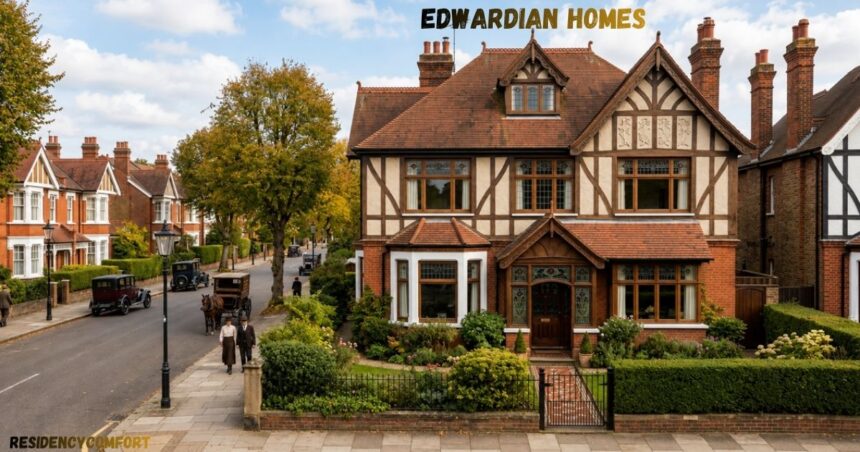
The Edwardian period began right after Queen Victoria passed the throne to her son, Edward VII, and this short stretch of time changed the face of Britain forever. Cities grew fast, and the suburbs filled with fresh garden suburbs like Dulwich, Blackheath, and Hampstead Garden Suburb, where Sir Edwin Lutyens shaped some of the finest edwardian homes of the age.
The Evolution of Edwardian Homes
His work at Great Dixter, finished in 1912, and Folly Farm, built alongside Gertrude Jekyll that same year, still stand as proof of his skill.Unlike the cramped terraces of Victorian houses packed into city streets, these new builds had a broader footprint.
Families enjoyed spacious rooms, wide hallways, grand staircases, and larger windows made from cheaper glass, often shaped into bays with decorative upper panes. Since most owners no longer kept live-in help, basement kitchens and attic bedrooms disappeared, and middle classes without servants filled these shorter, brighter homes instead.
The Architectural Details of Edwardian Houses
Front gardens became common too, since people wanted privacy and separateness from their neighbours, and many added carved wooden porches near the entrance. The interior details stayed wonderfully eclectic, mixing Tudor and Gothic touches through half-timbered exteriors and detailed mouldings, while also borrowing the calm brightness of Georgian interiors.
The Arts and Crafts movement from the 19th century left its mark too, and you’ll often spot William Morris style patterns, stained glass windows with small panes, and Art Nouveau floral flourishes on tiles and glass near the front door.
The Rise of Neo-Baroque Architecture and the Commuter Housing Boom
This building boom also gave rise to Edwardian architecture in its grander form, often called Neo-Baroque, which spread through the British Empire during the Edwardian era between 1901 and 1910, and even up to 1914. Beyond the public buildings, this style touched middle-class housing too, blending easily with relaxed Arts and Crafts architecture. A real housing boom swept through the home counties as families wanted country houses near railway stations, making the daily commute to the city simple and quick.
Description and Characteristics
Edwardian architecture stripped away much of the heavy, ornate styling of Victorian architecture, though one branch held onto grandeur: Edwardian Baroque architecture. The Victorian Society still protects buildings raised between 1837 and 1914, treating them as one connected story.
Architects pulled inspiration from two clear sources, earning this style the nickname Wrenaissance, blending ideas from France in the 18th century with the work of Sir Christopher Wren in England during the 17th century, rooted firmly in English Baroque.
Sir Edwin Lutyens carried this forward through the 1910s and 1920s, calling his approach the Grand Style, even though many call the whole period oddly retrospective given how it ran alongside Art Nouveau.
Builders leaned into heavy rustication, especially near ground level, often stretching into the voussoirs of arched openings copied from French models. Rooftops carried domed corner rooftop pavilions beside a taller central tower, giving each building a lively rooftop silhouette.
Baroque Details and Interior Design Trends
Designers also borrowed Italian Baroque touches, like exaggerated keystones, segmental arched pediments, sturdy columns, engaged blocks, and block-like rustication around window surrounds. Some buildings added colonnades of paired columns in the Ionic order, alongside domed towers echoing the Royal Naval College in Greenwich.
A few even mixed in Dutch gables, taken from Norman Shaw’s Piccadilly Hotel in London. Indoors, lighter colour choices took over, with softer wallpaper and curtain designs replacing busy patterns, while rooms held less clutter, and ornaments sat grouped together rather than scattered everywhere, even as gas and electric lights reduced worries about soot buildup on walls.
Three inspiring Edwardian houses from our archive
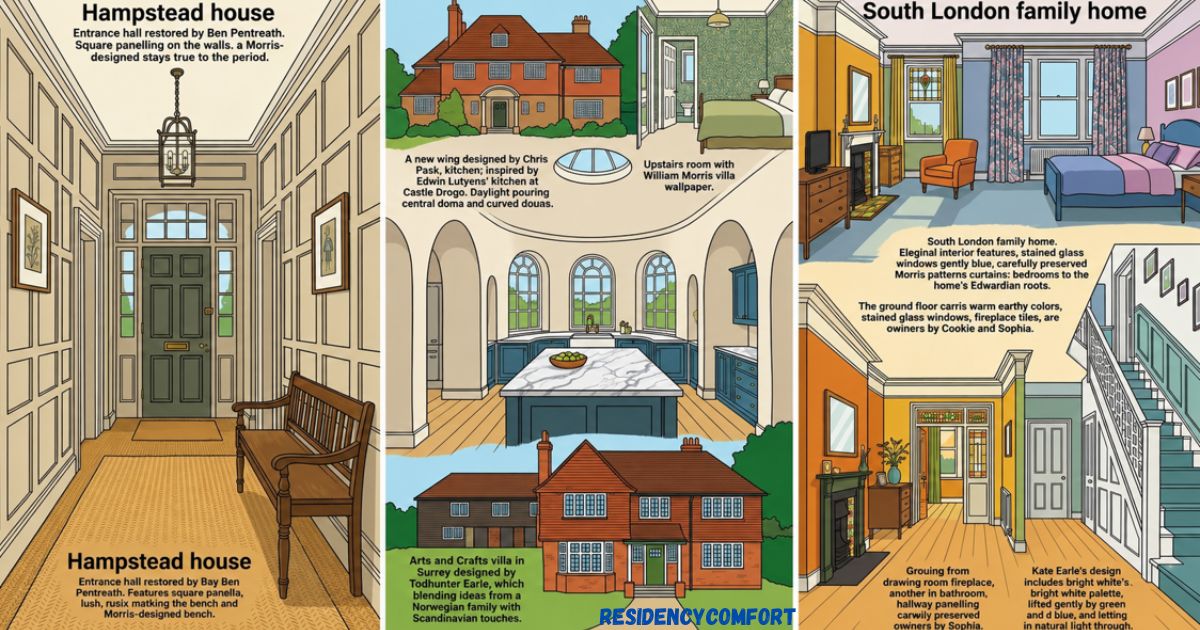
A beautiful Hampstead house restored by Ben Pentreath shows how careful renovating can bring back original panelling and its turn-of-the-century charm. The home doesn’t stick strictly to one look; while clear Edwardian and Arts and Crafts styles shape the interiors, some rooms borrow freely from the early 20th century, the 1960s, and the 1970s.
The square panelling in the entrance hall stays true to the period, paired with natural materials like rush matting on the floor and the seat of the Morris-designed bench.
Lutyens-Inspired Architecture and Arts and Crafts Villas
A new wing, designed by Chris Pask of Charlton Brown Architects, pays tribute to Edwin Lutyens’ famous kitchen at Castle Drogo in Devon, completed in 1930. Daylight pours through a central dome and curved windows set into arched walls, lighting up a striking marble-topped island, while upstairs rooms glow with William Morris wallpaper.
Another standout, an Arts and Crafts villa in Surrey designed by Todhunter Earle, blends ideas from a Norwegian family with touches of Scandinavia, thanks to this country-house specialist at Todhunter Earle Interiors, perfectly capturing the spirit of beautifully crafted edwardian homes.
Elegant Interior Features and Historic Preservation
Rich architectural details fill the home, from the fireplace in the drawing room to another in the bathroom, alongside panelling in the hallway and a graceful staircase with a latticework balustrade. Kate Earle balanced it all with a bright white palette, lifted gently by green and blue, letting natural light shine through.
Down in south London, a colourful Edwardian family home caught the eye of Architectural Digest, where owners Cookie and Sophia kept original picture rails, stained glass windows, and fireplace tiles once part of the kitchen floor, hand-laid again during the construction process.
Bold Color Palettes and Room Division
They weren’t afraid of bold colour either, splitting the home cleverly between floors. The ground floor carries warm earthy colours like oranges, yellows, and greens, soft tones suited to daytime living, while upstairs shifts into a cooler colour spectrum of blues and pinky purples for the bedrooms. Even with all this colour, Morris pattern curtains in one of the bedrooms still nod proudly to the home’s Edwardian roots.
Quality Craftsmanship and Spatial Innovation in Edwardian Homes
Mark Rimell from the National Country House Department often describes this as a truly brilliant period for construction, where the Edwardians built solid country homes filled with light and airy rooms, with detailing far ahead of its time. Suburban houses sat on wide plots, offering larger rooms, clever double-aspect living spaces, and large hallways that made daily life feel easy and open.
Privacy mattered greatly too, so front gardens stood between the home and the street, even though many have since become driveways, while generous back gardens added extra breathing room.
The Enduring Appeal of Quality Construction and Country Living
This period styling still appeals to modern families chasing flexible living spaces and bright living spaces today. Away from the city, the country house life thrived among the professional classes, who dreamed of their own version of Howards End, close enough to a railway station for quick trains into the city.
Out in the countryside, London sits surrounded by homes with landscaped gardens and high boundary hedges, offering a secluded retreat from modern life.What keeps these homes so loved comes down to strong British building standards.
They were well designed, built using high-quality materials, which means today’s buyers often get a true period property without facing the heavy maintenance costs that haunt some older properties.
How to spot an Edwardian home
The Edwardian period lasted only nine years, stretching from 1901 to 1910, yet its architectural style carried on until around 1920, a decade after Edward VII’s death. Because servants’ quarters were rarely needed anymore, the cramped attic rooms and cellars common in the Victorian era gave way to large elegant rooms instead. As Mark often explains, Edwardian design pulled from many places at once, mixing the symmetry of the Georgian era with the high ceilings typical of the Victorian period, plus playful flourishes borrowed from the Arts and Crafts Movement.
Still, what truly defines these homes is a strong sense of space and natural light. From the outside, you’ll notice steep-pitched roofs, with chimneys placed part-way down the roof, sitting directly above the fireplaces below. Dormer windows with pointed barge-boards often mark rooms tucked into the loft-space, now used for proper accommodation.
Grander homes sometimes lean into Mock-Tudor styles, giving these grander country houses a part-timbered exterior that hints at an older age. Many front doors also carry Art Nouveau stained glass, paired with elaborately carved porches that still turn heads today.
Distinctive Edwardian Locations and Historic Residences
You’ll spot Edwardian properties scattered through the suburbs of most cities, though some real gems hide out in the quiet countryside. Wormley Hill House, set among mature gardens, sits close to Broxbourne station, giving residents fast trains straight into London. Surrey holds its own collection too, mixing grand country houses with elegant family homes, including a lovely Guildford property first built for the Pilkington family back in 1904.
Notable Regions for Architectural Study and Conservation
White Lodge, a carefully renovated home, keeps its original period features alive, especially the high-ceilinged rooms and light-filled reception rooms, all wrapped in peaceful landscaped gardens near Newbury. London’s garden suburbs, including Hampstead Heath, Blackheath, Dulwich, and Richmond, remain some of the best places to study Edwardian architecture up close.
St Albans also deserves a mention, since fast population growth during the nineteenth century triggered its own housing boom of Edwardian builds. Down in East Sussex, Lewes offers charming examples too, like a semi-detached house sitting proudly within a protected Conservation Area in Wallands.
Investing in Edwardian Homes and Essential Maintenance
Edwardian homes generally stand as a sound investment due to their strong building standards and lasting quality materials, even at their age. That said, buyers should stay alert to a couple of things. Many of these homes have shallow foundations, leaving them open to ground movement caused by large trees, stubborn shrubs, or blocked drains nearby.
Rising damp rarely causes trouble in these homes, but proper care still matters. Owners should always ventilate the property well to stop condensation from building up indoors. It helps to check that air bricks haven’t been buried under garden landscaping works, and that fitted insulation in the roof doesn’t block natural airflow through the eaves.
The Enduring Value of Edwardian Homes
Modern buyers looking to invest in these light-filled period properties will find that edwardian homes offer an unmatched combination of historic character and contemporary living potential. Their generous footprints, wide hallways, and expansive gardens make them ideal for modern family life, while their solid British construction ensures long-term structural integrity. By preserving original details like stained glass, carved porches, and ornate mouldings—and maintaining proper home ventilation owners can enjoy the unique elegance of this golden architectural era for decades to come.
FAQs
What highlights an Edwardian exterior?
Bright red brickwork, carved timber porches, and large bay windows that maximize natural light.
What is the main feel of the interior?
A sense of spaciousness and airiness driven by high ceilings and sun-drenched rooms.
What defines Edwardian decor?
Fresh simplicity using soft pastel colors, light woods, and artistic stained glass for a clutter-free environment.
How do they differ?
Victorian homes are narrower, darker, and highly formal. Edwardian homes offer a wider, more functional design focused on bright and airy living.
How are they modernized today?
Through heritage preservation blending soulful period features with contemporary open-plan living and antique charm.