


Every homeowner deserves a clear guide through the maze of property paperwork, and I always tell friends who are selling their home that keeping title deeds, title documents, and every scrap of paperwork in one bundle saves real confidence on closing day. Whether you are remortgaging, handling legal matters, or simply using documents to prove house ownership status, your property lawyer and your seller’s lawyer will ask questions, run searches, and hand over a comprehensive report that becomes your title register.
A Simple Walk-Through of How Homeowners Prove House Ownership and Property Rights
This official file serves as your ultimate proof of property ownership, so don’t leave those documents buried in a drawer. I’ve watched clients face frustrating delays simply because their lawyer or property solicitors couldn’t find the right owner on file in Scotland or anywhere else, which is exactly why treating your home ownership papers with care, and knowing when to buy back time by sorting your ownership proof early, prevents a scramble tomorrow.
What Are Title Deeds to Prove House Ownership?
Tracing the History of Property Records
The old Register of Sasines recorded every transfer of ownership in Scotland on paper records, complete with maps, boundaries, and a full description of land naming the legal proprietor and each previous owner before the property changed hands again. Honestly, trying to prove house history and tracing a family home through those 19th-century entries feels like reading a small piece of history.
The Modern Digital Land Register
Everything changed in May 2012, when the computerised system we now call the Land Register of Scotland replaced those handwritten paperwork files with a national electronic property registration run by a statutory corporation under the banner of Scottish Land Registration. This system gives each building and plot an official record that shows the title number, the owner’s name, the title plan, and the exact area of property and property lines involved.
This official record now stands in for the old contracts of sale, conveyancing records, mortgage details, mortgage repaid notes, and legal descriptions that a title deed solicitor once had to chase down page by page. While a mortgage lender or lender may still hold a loan file for the current owner, or a document listing legal paperwork and rights over the land, you rarely need paper copies anymore because the digital registry works perfectly to prove house ownership, with everything digitally recorded and easy to check for both current and previous owners.
Who Holds the Deeds to Prove House Records?
Digital Storage at HM Land Registry
Since 1990, HM Land Registry has kept registered land records for England and Wales stored digitally, and the numbers back this up: the Land Register now covers 26.5 million properties, roughly 89% of all land in these two countries. Because of this, most homeowners can pull up their official documents, check boundaries, and use these online files to prove house title details through an online portal for a small fee rather than dig through a safe place at home.
Handling Unregistered Land and Older Papers
If your home counts as unregistered land, though, you’ll rely instead on physical property deeds, old conveyances, and transfers signed by a previous owner, usually kept by your solicitor, your lawyer, or a mortgage company rather than any centrally held database.
North of the border, Sasine registration once served the same purpose before the Land Register of Scotland introduced a digital title and a computerised record for every registered title documents file.
Whether your mortgage lenders or a single mortgage lender holds your paperwork from before the year 2000 or the Land Registry holds it today, the title register, the title deeds, and your property details together give you real proof of ownership over your property, backed by mortgage security on record if a loan is still active.
How to Check the Register to Prove House Rights
Searching the Online Databases
Curious whether your house is on the books? Start with the online search tool at HM Land Registry, type in the address, and check whether your property shows as property listed in the Land Register. If it does, your ownership details, name of owner, and legal description sit safely digitally stored rather than scattered across old paper, making it incredibly straightforward to prove house registration status.
Order an official copy of the title register or a map showing boundaries, conditions, and any restrictions, and this single official document works as your confirmation of registration, giving you irrefutable proof of ownership without chasing anyone else.
Checking Older Scottish Records
This is especially true if a mortgage lender holds a mortgage on the property or the mortgage paid off date needs confirming, along with checking rights, the land itself, any original title deeds, and other title documents that back up your claim.
Checklist of Documents That Prove House Ownership
Core Title and Financial Documents
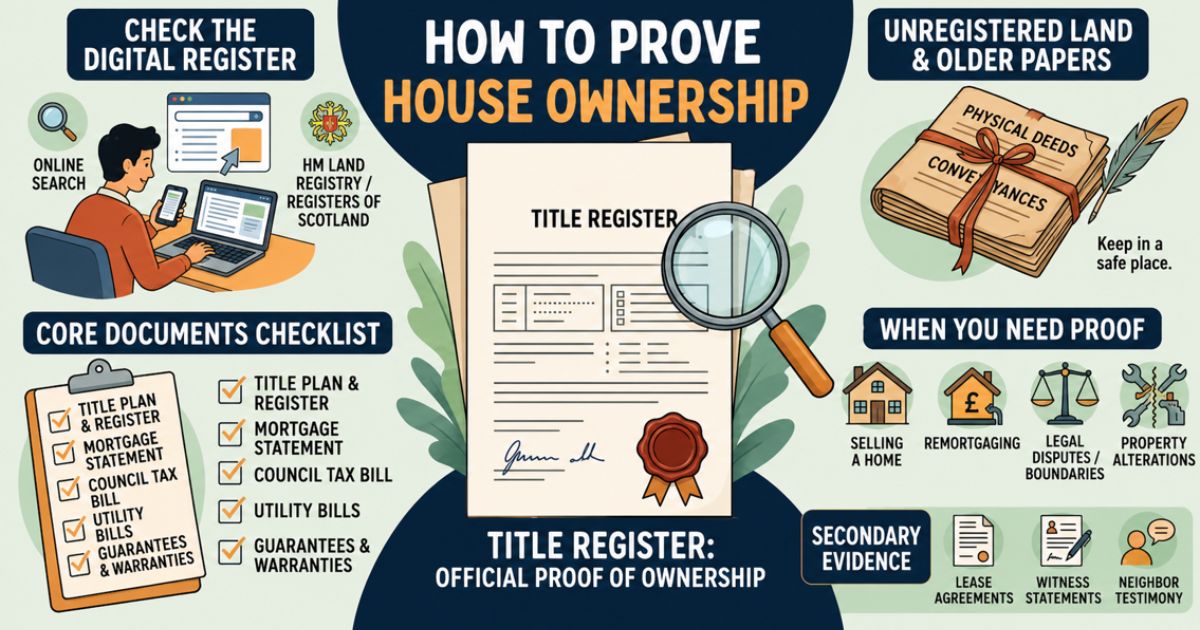
Before you sell, build yourself a proper checklist: pull your title register and title plan from HM Land Registry for a small fee, since these give the strongest legal proof and proof of ownership for registered properties. You can back that up with a recent mortgage statement showing your financial responsibility, council tax bills, and utility bills as supporting evidence to further prove house occupancy and ownership.
If your paperwork goes back further, gather the sale contracts, conveyancing documents, and deeds from previous transactions, plus the original Property Information Form, original guarantees, and any new build warranty documents such as a 10-year cover policy from NHBC or Zurich, which protects a lender and a buyer alike.
How to Prove House Ownership Without Physical Deeds
Relying on the Digital Register
Losing your physical deeds is scarier in theory than in practice, so stop panicking the moment you realise your original title deeds or property deeds have gone missing. If your property sits registered with HM Land Registry, the Title Register alone counts as official proof of ownership and full legal ownership no paper is required to prove house title ship.
What to Do for Unregistered Land
If you’re still unregistered, though, or your home falls under unregistered land, chase your solicitor, your bank, or the mortgage lenders and mortgage lender involved, since a mortgage taken out before the year 2000 was often held with mortgage security attached until the loan repaid date, which is exactly where lost deeds tend to resurface.
When no one can find the file at all, apply for First Registration using a Statement of Truth instead of waiting through more delays, and this route quietly restores your claim and allows you to prove house ownership without dragging out the process.
Buying a Property: The Registration Process to Prove House Title
Conveyancing and Lodging Documents
Buying a home in Scotland runs through a clear registration process: your property lawyer raises questions, runs searches against the seller’s lawyer, and gathers the property documents for the property into one comprehensive report before the purchase completes. Once the transaction is settled, your solicitor lodges the documentation with the Registers of Scotland, and your name appears as the registered owner in the Land Register, updating the Land Registry records that matter most whenever you later sell property.
The Shift Away from Paper Deeds
You won’t receive an old paper deeds bundle or even a single piece of paper, since a copy from your solicitor now carries the same legal status and works as proof of title. The whole point of registering ownership is that whether the file was once unregistered or already registered, your lawyer handles the backend system so you don’t have to chase physical deeds yourself to prove house legal standings in the future.
When Do You Need to Prove House Ownership?
Sales, Remortgages, and Legal Disputes
You’ll need to verify ownership more often than you’d think: selling property brings in buyers who want their solicitors to check the title register and title deeds before financing goes through, while remortgaging or arranging a secured loan means lenders demand the same documents to approve a remortgage or equity release. A legal dispute over a boundary line, an inheritance issue, or a straight claim of ownership can also drag you into legal battles, and only solid Land Registry records protect your legal rights and your legal ownership when things turn tense.
Property Alterations and Transfers
Making changes to a home, whether that means renovations, planning applications, or land subdivisions, usually needs sign-off from a local authority or planning department, and any restrictions or covenants on the property can cause delays if you skip that step. The same goes for transferring ownership through gifting, adding a co-owner, or handling divorce and inheritance, since none of it moves forward without clear proof of ownership to officially prove house equity transfers.
Gathering Secondary Evidence to Prove House and Land Ownership
Proving you own a plot starts with checking whether the land registered shows up at HM Land Registry, and if it’s still unregistered, dig out any title deeds or historical purchase paperwork you can find. To fully prove house and plot boundaries when official deeds are sparse, old lease agreements, council tax records, and witness statements from neighbours who’ve watched the land use continue over a long period all add real weight to your claim. Put together, this evidence rarely leaves anyone in doubt.
FAQs
Can I use the official portal to prove house ownership for free?
You can view a basic property summary for free on GOV.UK to check the tenure type. However, to officially prove house ownership, you must pay a £7 fee to download the official HM Land Registry title register.
Which documents do I need to download to prove house boundaries?
You will need to request the official title plan and title register through a Land Registry search. Together, these digital documents provide the legal clarity needed to safely prove house borders and ownership details.
Who do I call if I cannot find the deeds to prove house registration?
If your property isn’t showing up online, look up the official Land Registry contact number on the GOV.UK website. The support team can guide you through older, unregistered records to help you secure the paperwork required to prove house status.
Should I use third-party websites to get documents that prove house details?
No. Independent sites often charge heavily inflated fees for the exact same data. To protect your hard-earned money and sensitive personal data, only use the official HM Land Registry portal to get the deeds that prove house ownership.
Will a mortgage statement alone prove house ownership?
No, a mortgage statement only proves you have a loan secured against the property. The only legally binding way to prove house ownership to buyers or authorities is by retrieving the official deed from the live Land Registry database.