


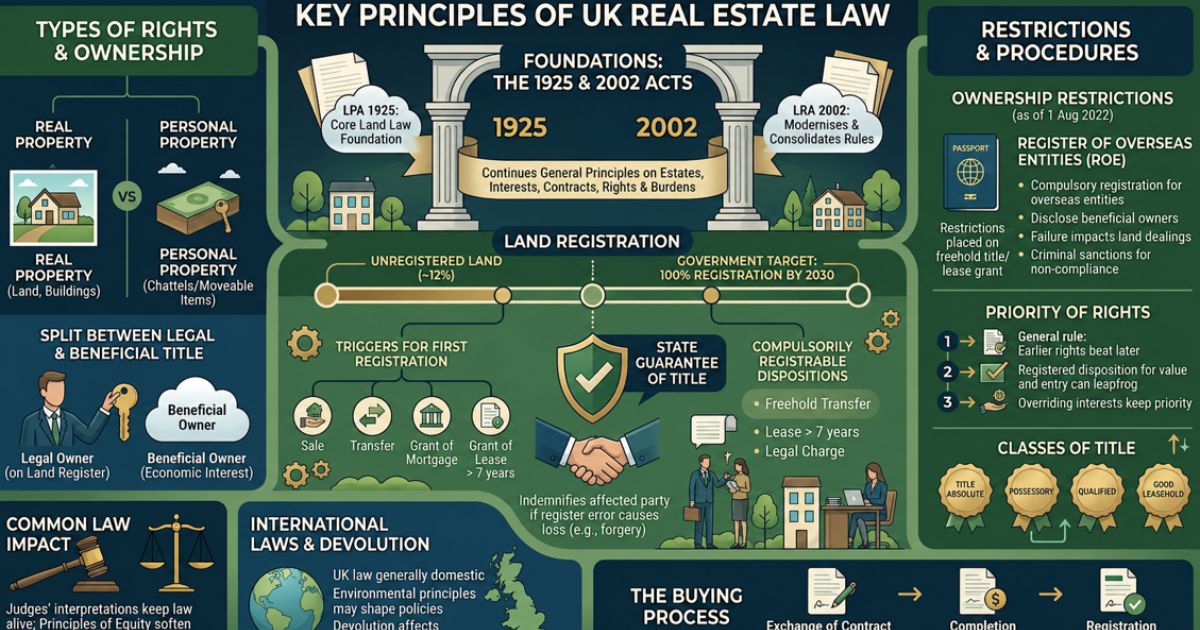
The Law of Property Act 1925 built much of the foundation of the land registration regime, while the Land Registration Act 2002 came later to modernise and consolidate the older rules found in the 1925 Act, its accompanying regulations, and other legislation. These reforms did not throw out the pre-existing real estate law; instead they kept the general principles about contracts, estates, interests in land, rights, and burdens that still guide everyday practice and the ownership of land today, and this is a topic within Real Estate Law I have watched change first-hand while helping clients through legislation updates.
Education and Training in Real Estate Law
For anyone thinking about studying this area further, a short course can help. A distance learning programme in Real Estate Law opens for booking in October, with a full enquiry line ready for anyone who wants to book a place before the nine-week period begins. Students usually find a course through an online learning platform, then follow links to a page where they can discuss materials with tutors during live webinar sessions, some of which run on campus as well as through distance learning mode.
Courses such as Real Estate Economics and Valuation, Strategic Estate Management, Real Estate Investment and Development, Managerial Finance for the Built Environment, Sustainability in the Built Environment, and Real Estate Finance and Investment sit alongside the law modules, and a January intake (January 2023, for example) lets people broaden knowledge using fresh learning materials they can search for online.
Distinction Between Real and Personal Property
Before going further, it helps to know the difference between two kinds of ownership. Under British common law, real property covers land, buildings, and anything permanently fixed to the ground, while personal property the American term for what English lawyers might call chattels covers items that can move.
The line between the two matters when disputes arise over crops, minerals, oil, gas, or even the flow of water in a stream, since a change like damming a river can shift who controls that resource. Whether someone is buying and selling land, renting it through renting agreements, handling the transfer of land, or working on new developments, the owner of land needs to understand where Real Estate Law ends and personal property begins, right down to the earth itself.
What Is the Impact of Local Common Law?
Judges in England and Wales do far more than apply written rules; their work of interpretation keeps modern real estate law alive. Common law built through courts is continually developing, and every new precedent shapes how Real Estate Law legislation gets read in practice. Alongside strict legal rules, principles of equity step in to soften harsh outcomes, so the application of law to any property dispute usually blends statute with case-made rules built up over centuries.
Are International Laws Relevant ?
Under modern Real Estate Law, UK law generally treats property matters as a question for domestic jurisdictions, meaning international laws and international agreements rarely override local legal formalities, though environmental principles agreed at an international level can still shape policies at home. Because of legislative devolution, powers over real estate transactions are partly ring-fenced to different parts of the UK, so requirements can vary depending on where the property sits, and any repercussions of ignoring EU legislation or wider international law must be checked carefully rather than assumed.
Restrictions on Ownership by Particular Classes of Persons
Under contemporary Real Estate Law, not everyone can simply buy or sell land without meeting extra checks. Since 6 October 2020, and more firmly after the Economic Crime (Transparency and Enforcement) Act 2022 came into force on 1 August 2022, overseas entities must join the register of overseas entities (ROE) at Companies House before they can deal with UK land, and this compulsory registration regime demands prescribed information about registrable beneficial owners and managing officers.
A person must normally be age 18 to hold a legal owner role outright, and every applicant must avoid giving false information, misleading information, or deceptive information, since criminal sanctions apply to non-compliance, and details are meant to be verified independently under an annual updating requirement. T
he Land Registry places a restriction on freehold land titles and on the right to grant lease where an entity has failed to register, which affects any chargee trying to enforce a charge, any lessee taking a disposition, and any trustee connected to non-UK resident trusts, while the Trust Registration Service, UN sanctions lists, UK tax rules, and corporate power questions under Part 1 ECA 2022 all sit in the background none of this depends on nationality, since both EU and non-EU buyers face the same title registers checks, and a corporate entity that ignores failure to register rules for seven years risks losing its ability to deal with the asset at all.
Real Estate Law Rights
This part of the guide looks at what kinds of claims a person can hold over land, and how those claims differ from simple agreements between parties.
Types of Rights Recognised in Real Estate Law
Under traditional Real Estate Law, some claims are purely between two people rather than binding on the land itself agreements for lease and agreements for sale are examples of a contract that a buyer might later challenge, while other equitable rights and ownership rights need proper documentation to count as rights over land rather than a private promise. England and Wales recognise several distinct rights over land. Freehold and leasehold remain the two main legal rights, alongside commonhold, options, prescriptive rights built up through long period of use, and legal charges secured by deed.
Divergence Between Land and Building Rights
In Real Estate Law, ownership of the ground and ownership of what stands on it do not always match. Leasehold interests and freehold interests can co-exist on the same site, with a building belonging to one party for the period of lease while the freehold land underneath belongs to another, and this divergence only resolves at termination of lease.
Split Between Legal and Beneficial Title
England and Wales also separate legal title, which sits on the land register, from beneficial title, which reflects the true economic interest. A trust can hold legal owner status while beneficiaries’ interests sit behind it, and the Land Registry will note a restriction to protect third parties dealing with the property, with beneficial ownership information now required for overseas entities through the ROE. There have been ongoing proposals to bring more of this beneficial interest picture into the open register, though a full split remains part of the system for now.
Is All Land Required to Be Registered?
According to historical records in Real Estate Law, roughly 12% of land in England and Wales still counts as unregistered land, and the government has set 2030 as a target date for 100% registration. First registration is usually triggers by a sale, a transfer, or a grant of mortgage, and certain grants such as a grant of lease for more than seven years also force an owner onto the Land Registry system.
Yes once a title sits on the register, the state stands behind it. If mistakes in the registered title cause loss, whether through forged documents or wrong search results, the Land Registry will indemnify the affected party and recover payments from anyone at fault, giving real comfort to third parties relying on the record.
What Rights Are Compulsorily Registrable?
The Land Registration Act 2002 lists which dispositions must go on the land register. A transfer of freehold land, the grant of lease for over seven years, and the creation of a legal charge all count, and first registration becomes compulsory within a specified period after the deal. Skipping registered land rules means the legal interest never passes properly, leaving only an equitable claim against the dishonor, and priority among competing buyers depends heavily on getting this step right.
What Rights Are Not Required to Be Registered?
Some interests stay off the main register yet still bind buyers. Overriding interests, short leases, contracts for sale, and rights of persons in actual occupation fall into this category, alongside minor interests protected only by a notice or restriction, an interest under a trust of land, and other equitable interests with a term under seven years.
Probationary Periods and Classes of Title
When land moves from unregistered to registered land, the Land Registry may grant one of four classes of title depending on the strength of the evidence supplied with the application.Some of these classes can later upgrade once a requisite period passes without challenge.
When Does Title Transfer to the Buyer?
Buying land is a two-stage process. Exchange of contract commits both sides and shifts risk, but transfer of ownership both beneficial ownership and the formal transfer of legal ownership only happens once payment of purchase price is made and the registration requirement is satisfied, so completion and registration do not always land simultaneously for the prospective buyer navigating Real Estate Law, even though the whole point of buying and selling land is a clean handover.
How Do Rights Obtain Priority in Real Estate Law?
Generally, earlier rights beat later ones, but the register changes that default. Priority of rights for registered land usually follows the date of creation, yet registrable dispositions made for value and entered as a notice can leapfrog an earlier unprotected claim, while overriding interests keep their priority regardless of what the register shows. Navigating these rules is a fundamental aspect of managing property transactions under modern Real Estate Law.
FAQs
What is real estate law?
It is the legal framework governing who can own, use, and transfer land or buildings, covering everything from family homes to commercial skyscrapers.
What is conveyancing?
Conveyancing is the specific legal process of transferring the legal title of a property from a seller to a buyer.
When should I instruct a property lawyer?
You should contact a solicitor as soon as your offer on a house is accepted. This ensures they can begin reviewing title deeds and drafting contracts immediately before any money changes hands.
What is the most critical check a lawyer performs?
Verifying the legal title. They ensure the seller actually owns the land, has the right to sell it, and that no outstanding debts or hidden charges are attached to the property.
How much do real estate lawyers earn in the UK?
Salaries typically start around £20,000 to £40,000 for newly qualified solicitors and can exceed £120,000+ for experienced corporate partners.
How much do real estate lawyers earn in the UK?
Salaries typically start around £20,000 to £40,000 for newly qualified solicitors and can exceed £120,000+ for experienced corporate partners.