

SF property tax is the annual tax that owners of land and buildings in San Francisco pay to the city and county, based on the assessed value of the property. It is one of the city’s main sources of revenue and helps fund schools, public safety, transit, and other local services.
How to Lower Your SF Property Tax Bill in 2025
If you are a homeowner in San Francisco, you probably feel your SF Property Tax bill every year. Property values swing with market trends, and plenty of San Francisco County owners worry about overpaying in 2025. A few smart tax strategies, like checking for over-assessments, filing appeals, and using relief programs, can reduce your bill, so start by reading your assessed value and your assessments closely.
The rules sit inside the California tax code. The Real Property Transfer Tax Ordinance carries a short title, and it draws its authority from the Revenue and Taxation Code, Division 2, Part 6.7, and Section 11901. Every seller should also learn which exemptions apply before closing a deal.
Mayor Daniel Lurie and Supervisor Bilal Mahmood announced a November ballot measure that would tax foreclosed commercial buildings. They want foreclosures by hedge funds, corporate lenders, corporate capital, and other financial institutions to pay like any other seller, which could raise $200 million over three years. That money would ease the budget deficit, refill city coffers, and help the community, while Lurie says the plan makes the system simpler and fairer and gives investment and downtown recovery the consistency and certainty they need.
Transfer Tax Rates (Tax Imposed)
The transfer tax hits every deed, instrument, or writing that moves lands, tenements, or other realty inside the City and County of San Francisco. When an owner granted, assigned, transferred, or conveyed property and it became vested in a purchaser, the city treats that as a moment when real estate changes hands. The tax imposed depends on the consideration, which means the value of interest at the time of sale.
The lien and any encumbrances still on the property stay in that number. A deal above $100 and up to $250,000 pays $2.50 for each $500 or fractional part. A deal from $250,000 up to $1,000,000 pays $3.40, and the entire value counts, so even the first slice gets the higher charge.
Once a sale passes $1,000,000 and stays under $5,000,000, the charge climbs to $3.75. Between $5,000,000 and $10,000,000, it jumps to $11.25, and between $10,000,000 and $25,000,000, it reaches $27.50. At $25,000,000 and above, buyers and sellers face $30 per $500.
In plain percentages, the transfer-tax rate sits at 5.75 percent for properties worth over $10 million and 6 percent over $25 million. That tax rate explains why big deals get so much attention. Sellers of foreclosing properties do not pay it today.
Exemptions and Exceptions
Government buyers pay nothing. When the United States, any agency or instrumentality, a state, a territory, or a political subdivision acts as the exempt agency and is acquiring title, Section 1105 wipes out the tax. Homeowners can also earn a partial exemption of one-third, which the code also writes as 1/3.
That break applies to a residence when the transferor installed an active solar system, finished seismic retrofitting, or added earthquake hazard mitigation after January 1, 2009. The Assessor must approve an exclusion from reassessment under Revenue & Taxation Code § 73(b) and § 74.5(b). The savings never exceed the transferor’s cost, and multi-family residential properties qualify too.
Section 1104 says an instrument to secure debt carries no tax. Section 1106 protects conveyances that carry out a plan of reorganization under Title 11 of the United States Code, or a change in identity, form, or place of organization. Those deals escape the tax only when they happen within five years of confirmation approval or the adjustment.
Key Exemptions and Measures in SF Property Tax Regulations
Section 1107 covers a special case under SF Property Tax regulations. When the Securities and Exchange Commission issues an order under Section 79K of Title 15, tied to the Public Utility Holding Company Act of 1935, the code exempts the transfer. The definition comes from Section 1083 of the Internal Revenue Code of 1954, and the property ordered to be conveyed must appear in that order.
The city also gave foreclosed properties a special pass back in 1984. Mahmood says that pass has cost billions of dollars in potential revenue, and the ballot measure would end it. The measure spares single-family homes, condos, and small properties with fewer than five residential units, because he does not want to punish people foreclosing on a home while they are in debt and distress.
Requirements for Recording and Paying SF Real Estate Transfer Taxes
Article 12-C borrows its terms from Sections 6.2-2 of the Business and Tax Regulations Code. Every document that needs recordation must show the Assessor’s parcel number on the face of the document. It must also show the situs and the street name and number.
A domestic partnership follows Chapter 62 of the Administrative Code and Division 2.5 of the California Family Code. Partners prove it with a Declaration of Domestic Partnership filed with the County Clerk or another public official who handles registration. That proof matters when a transfer touches a couple’s property.
Section 1103 sets the payment rules. The tax becomes due and payable when someone delivers the deed, and it turns delinquent after 30 days. The County Recorder accepts partial payments, but any unpaid balance draws penalties and interest under Section 1115.2, and the office applies money to administrative collection costs first.
Valuation Methods and Partnership Transfer Rules for SF Real Estate
Section 1108 deals with every partnership that counts as a partnership for federal income tax. A continuing partnership under Section 708 of the Internal Revenue Code of 1986 triggers no levy when owners shift interests and the group keeps the property. A termination works differently, because the code treats it as a sale at fair market value, yet the city collects one tax only, and it still taxes any realty sold under Section 1114(b).
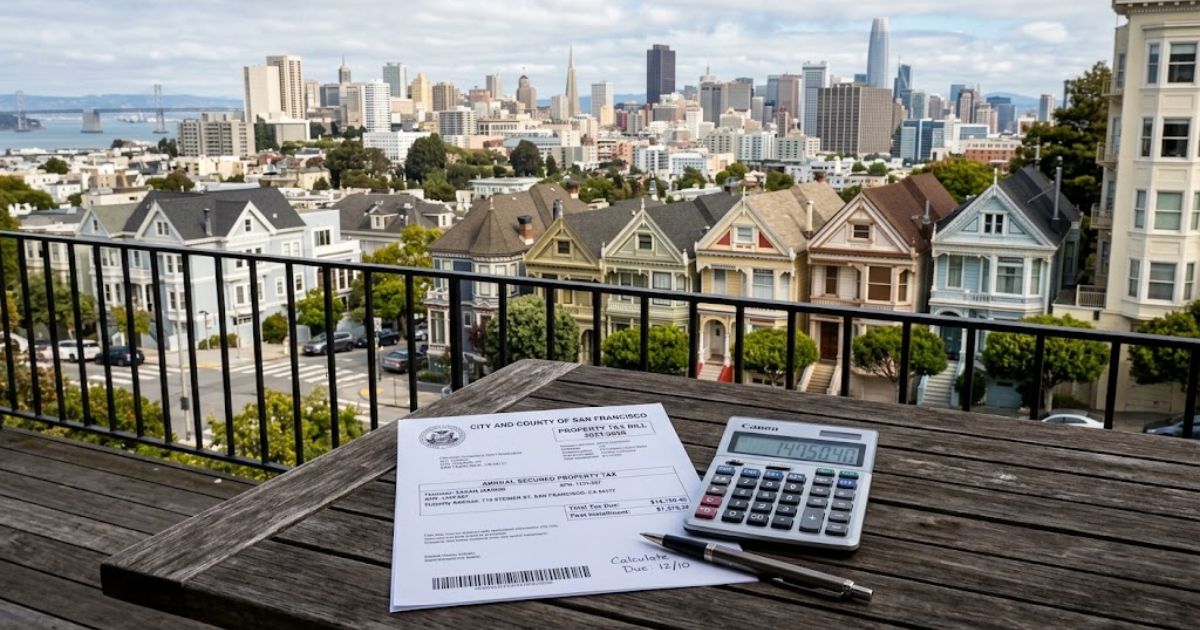
The Assessor-Recorder’s Office sets your assessed value with standard appraisal methods. It weighs location, square footage, improvements, and overall condition. I always tell owners to compare those four items against their own house first.
The cost approach adds up the replacement cost, including land, labor, materials, and soft costs like architectural fees, then subtracts depreciation. The income approach fits income-generating properties such as commercial real estate, hotels, and apartments. It looks at return on investment, operating expenses, financial risk, and maintenance.
Appeal Opportunities and Market Approaches to Lower SF Property Tax
The market approach suits residential properties best. It lines your home up against comparable properties that recently sold on the open market. If the numbers look off, you can act on it to potentially lower your SF Property Tax obligations.
You get two opportunities to ask for a reduction when you think your value is too high as of January 1. You can file the appeal yourself or hire a third-party expert to do it. Remember that you cannot fight the tax rate, only the value it applies to.
Now look at the BUILD Act, a jobs and housing bill that would have made the transfer-tax rate cut in half. The controller’s office said it would cost $400 million, and critics warned of a budget hole. Lurie and Mahmood shelved it for now.
Political Initiatives and Proposed Reforms Impacting SF Property Tax Revenue
Their Foreclosure Tax now sits in front of voters, and the timing matters. Proposition D, which targeted overpaid CEOs, failed to pass and cost the city another revenue opportunity, further shaping discussions around SF Property Tax revenue strategies. Mahmood made revenue priority number one, though he still calls the cut the right policy to spur development and create jobs.
The Board of Supervisors shows wide support. Matt Dorsey, Myrna Melgar, Chyanne Chen, Shamann Walton, and Alan Wong are co-sponsors, and the measure should qualify for the ballot in November.
FAQs
Q1: How is the SF Property Tax rate determined for San Francisco homeowners?
A: SF Property Tax is calculated based on the property’s assessed value (typically the purchase price adjusted annually for inflation up to 2% under California’s Proposition 13) multiplied by the total local tax rate, which usually sits around 1.18% to 1.2% plus voter-approved local bonds.
Q2: When are San Francisco property tax payments due each year?
A: Annual bills are split into two equal installments. The first installment is due on November 1 (delinquent after December 10), and the second installment is due on February 1 (delinquent after April 10).
Q3: Does buying or renovating a property trigger a reassessment?
A: Yes. Under California law, purchasing a new property or completing major construction/renovations causes the county assessor to reassess the property to its current fair market value.
Q4: Are there any property tax exemptions or relief programs available?
A: Yes. The Homeowners’ Exemption reduces your assessed value by $7,000 if the property is your primary residence. Seniors, disabled individuals, and veterans may also qualify for additional relief programs or tax postponement options.
Q5: How can property owners pay or appeal their SF Property Tax bill?
A: Payments can be made online via the San Francisco Treasurer & Tax Collector portal, by mail, or in person. If you believe your property’s market value has fallen below its assessed value, you can file an assessment appeal with the Assessment Appeals Board between July 2 and September 15.