

Fire damage restoration covers every step between the fire department’s departure and a livable building. Crews start with an initial assessment, then handle water extraction, soot removal, smoke removal, deep cleaning, and structural repairs. Most providers describe the work in that same order.
Resto Pros lists five steps: emergency response, water extraction and drying, smoke and soot removal, deep cleaning and sanitization, and structural repairs. The final step aims to return the property to its pre-loss condition. Knowing this sequence helps you spot a quote that skips the damage assessment.
Types of Damage and the Role of Professional Fire Damage Restoration
A fire leaves three main problems: structural damage, smoke damage, and firefighting water damage. Soot damage adds stains and acid etching on top of those. Each problem needs a different fix, so a good provider separates them in the written estimate. Residue type changes the cleaning method, so ask which kinds a crew has handled. A kitchen fire leaves protein residue, wood and paper leave dry soot, and synthetic materials leave oily residue that smears when handled wrong. Acidic soot begins to cause discoloration and staining within hours, according to 911 Restoration. Comprehensive Fire Damage Restoration addresses each of these specific damage types to properly clean, mitigate, and restore the property.
How Does Milwaukee Winter Change the Emergency Response?
Milwaukee winter turns a damaged building into a freezer once the heat escapes. An open structure loses heat fast, and burst pipes add a second water problem. Crews respond with board-up, roof tarping, and temporary heat before any cleaning starts, so drying can begin safely.
A garage fire that spreads inside or a roof collapse leaves the house open to snow and arctic air. Firefighting water runs through the floor system into basements, and wet framing and insulation invite mold growth. According to 911 Restoration, mold can start within 24 to 48 hours, so dehumidification and structural drying start early.
How Do Crews Remove Smoke Odor for Good?
Crews combine odor control, odor mitigation, and deodorization with air scrubbing after they clean the source. RestoPros names thermal fogging and ozone chambers among its odor methods. The cleaning comes first because smoke odor lives inside smoke residue and soot residue.
Smoke travels through wall cavities, attics, closets, and ductwork far beyond the room that burned. A crew that treats only visible surfaces leaves hidden spaces behind, and the smell returns on the first humid day. Ask whether the plan covers HVAC systems and whether air scrubbers run at the end.
What Equipment and Checks Should a Fire Crew Bring?
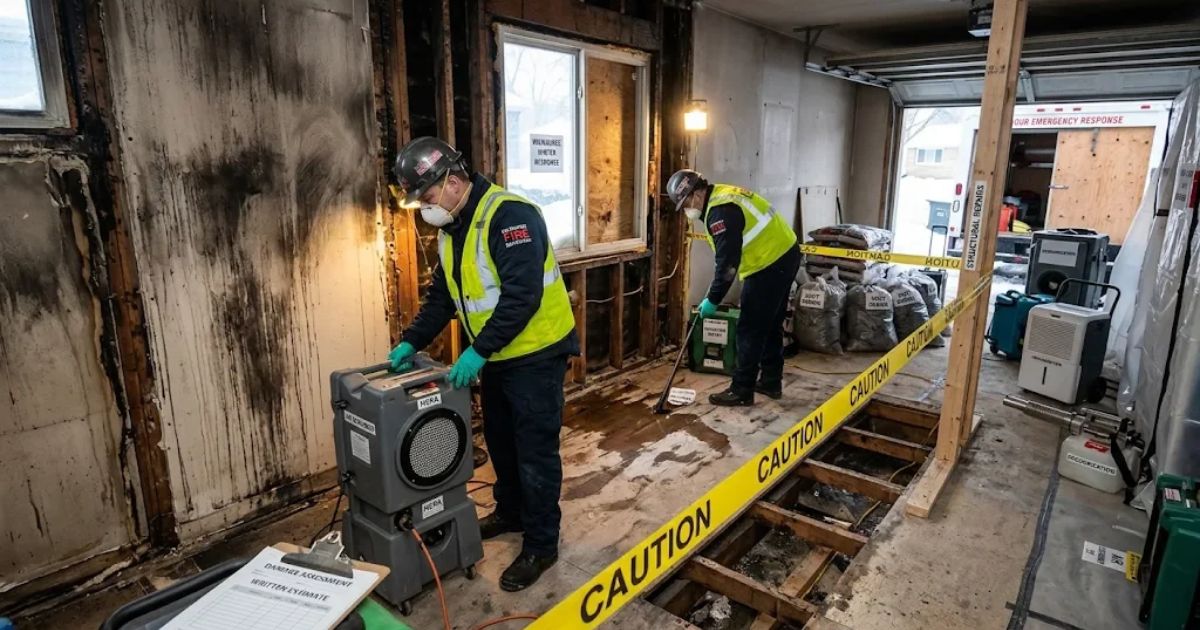
Look for moisture meters, thermal imaging, containment equipment, and disinfection equipment on the work truck. 911 Restoration lists these tools for its Milwaukee crews. Together they let a crew find wet materials, seal dirty zones, and protect air quality during cleanup.
Surface testing comes before cleaning, because specialized cleaning techniques differ for each residue. Crews wear protective gear, run industrial-grade dehumidifiers for moisture control, and use freeze-drying for wet paper. Ask what restoration equipment a provider owns and how it handles contamination, hidden moisture, and lingering smoke.
Which Parts of My Building Do Restoration Crews Repair?
Crews repair walls and ceilings, flooring and subfloors, cabinets, kitchens, and the HVAC systems that carry smoke. When damage runs deep, demolition removes ruined material before reconstruction begins. 911 Restoration states that its own crews handle both phases in Milwaukee.
Charred drywall, framing, and insulation lose their strength and usually need replacement. Crews also check grout and fixtures, appliances, windows and doors, roof sections, and exterior walls for smoke and heat damage. Porous items such as carpet and carpet pad and upholstery often hold odor, so crews replace the worst of them.
What Can Restoration Crews Save After a Fire?
Crews often save salvageable items such as hardwood furniture, metal items, and glass and ceramic, because those materials resist soot. Contents cleaning handles clothing and textiles, rugs, and other personal belongings. Results depend on heat exposure, smoke, water, and response speed.
RestoPros says paper items like documents and photographs sometimes survive through freeze-drying, while electronics need a specialist’s inspection first. Crews rarely save charred materials, mattresses and pillows, or food, medicine, and cosmetics, and soaked upholstered furniture fares badly. Ask for a contents inventory so you know what the crew cleaned, kept, or discarded.
What Should I Do Before a Restoration Crew Arrives?
Stay out of the building until fire department clearance confirms safe re-entry for everyone. Then take photos, call your insurance carrier, and phone a restoration provider the same day. Do not run the heating system or ceiling fans, because they spread soot, and do not wipe soot with household cleaners.
Burned buildings hide safety hazards, including weakened structural integrity and electrical risks. Soot also carries harmful chemicals, and firefighting chemicals can linger on surfaces. Wiping soot yourself can smear it and cause lung and skin irritation, so leave cleanup to trained crews.
How Does a Fire Damage Insurance Claim Work?
You open an insurance claim with your carrier, and an insurance adjuster reviews the loss. The claims process moves faster with damage documentation from your restoration company. Each brand in this article says on its website that it helps with insurance paperwork.
911 Restoration uses direct insurance coordination, which covers photos of damage, a written scope of work, and a room-by-room scope for the adjuster. Your homeowners insurance policy sets the coverage limits for structure and contents coverage and additional living expenses, while sewer backup coverage needs a special endorsement. RestoPros adds that you, not your insurer, pick your contractor of choice.
What Should I Look for in a Provider?
Look for 24/7 emergency service, IICRC-certified technicians, and licensed, bonded, and insured status. A stated 45-minute typical arrival gives you a concrete response benchmark, and 24-hour restoration matters most overnight. A professional restoration team with certified professionals can also explain each step in plain terms.
A good provider serves home and business owners alike, from residential fire damage restoration to commercial fire damage restoration. For office and warehouse properties and schools, fast work helps you minimize revenue loss and secure reduced downtime. Any commercial property also gains from local reconstruction crews who repair the building without subcontractors.
Which Brands Should I Compare for Fire Damage Restoration?
Compare 911 Restoration of Milwaukee, Reynolds Restoration Services, and RestoPros side by side. Each brand offers the services listed on its own website, so confirm details there before you call. Only the 911 Restoration page I reviewed names Milwaukee and its neighborhoods directly.
911 Restoration lists board-up, roof tarping, contents cleaning, and reconstruction from its Whitefish Bay office. Reynolds Restoration Services serves Central Pennsylvania, Philadelphia, Baltimore, and the DC metro area, and its menu also lists mold remediation and odor mitigation. RestoPros describes emergency response, water extraction, and storm damage restoration, and its site offers an office locator.
Which Milwaukee Neighborhoods Can a Local Crew Reach?
911 Restoration lists Whitefish Bay, Shorewood, the East Side, Riverwest, and Downtown Milwaukee on its fire damage page. The same page names the Third Ward, Walker’s Point, Wauwatosa, and West Allis. It also covers Glendale, Brown Deer, Sherman Park, and Northwest Milwaukee.
I checked service areas because travel time matters more than any tagline. If your address sits outside a listed area, call and ask for an arrival estimate first. For Reynolds and RestoPros, check the coverage and locator pages on their sites to confirm whether they reach Milwaukee.
Why Use This Site to Find a Provider?
This site gathers what each provider’s own website states, so you compare services, response claims, and credentials on one page. You skip the work of opening and decoding every company site. Your time stays with the decisions that matter, such as who answers first.
While reading the three pages, I noticed that only one gave a specific arrival time and only one focused on Milwaukee. A side-by-side view saves you phone calls during a stressful week. Use this site to shortlist providers, then call them and verify every detail yourself.
FAQs
How Long Does Fire Damage Restoration Take?
A small kitchen fire may need only a few days of cleaning and deodorization. A larger fire with structural damage moves into demolition and reconstruction, which can take several weeks or more. Materials and permits set the schedule, so ask for updates at each stage.
Does Insurance Usually Pay for Firefighting Water?
911 Restoration says water used to fight a fire normally belongs in the fire claim. Your homeowners insurance policy still controls the details, so confirm your coverage limits with your carrier early. Ask your provider for a written scope of work to support that conversation.
Can Smoke Odor Disappear Completely?
In most cases, yes, once crews remove the soot residue causing it. Crews then rely on air scrubbing and deodorization, and they replace stubborn materials, such as some insulation, that still hold odor. Ask your provider which materials it expects to replace before work begins.
Does My Insurer Choose the Restoration Company?
No, insurers may recommend contractors, but you make the final choice. RestoPros states that every homeowner may hire any contractor they trust, so compare providers before you accept a referral. Your insurance adjuster will still review the work, so keep copies of every estimate and message.
Where Can I Find the Right Restoration Provider?
Start on this site, where you can compare fire damage restoration providers by services, response claims, and credentials. Then call two or three companies, ask about 24/7 emergency service, and confirm every service on the provider’s own website. Visit this website today and shortlist a fire damage restoration provider before the damage grows worse.