

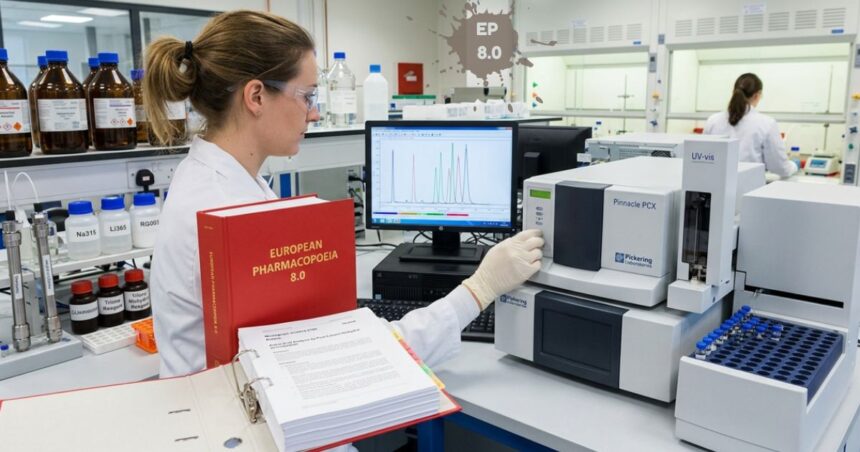
The European Pharmacopoeia sets the qualitative composition and quantitative composition rules that medicines must meet, and it lists the tests a lab runs on substances and materials used in production. I like to describe EP 8.0 as a rulebook that follows a drug from raw powder to finished box. It covers active substances, excipients, and preparations of chemical origin, animal origin, human origin, or herbal origin, plus homoeopathic preparations, homoeopathic stocks, and antibiotics, and it stretches into dosage forms and containers too.
Framework and Member States under EP 8.0
Under the auspices of the Council of Europe, the book grew out of the Convention on the Elaboration of a European Pharmacopoeia, recorded in the European Treaty Series, and later updated by a protocol that governments across Europe signed. 37 member states put their names on it, among them Austria, Belgium, Bosnia and Herzegovina, Bulgaria, Croatia, Cyprus, Czech Republic, Denmark, Estonia, Finland, France, Germany, Greece, Hungary, Iceland, Ireland, Italy, Latvia, Lithuania, Luxembourg, Malta, Montenegro, Netherlands, Norway, Poland, Portugal, Romania, Serbia, Slovak Republic, Slovenia, Spain, Sweden, Switzerland, the former Yugoslav Republic of Macedonia, Turkey, Ukraine, and the United Kingdom.
Volumes 1 and 2 make up the EP 8.0 release, known widely as the 8th Edition, and the publication grows over time through non-cumulative supplements that stay valid for the whole duration of the edition, released in 2013, 2014, and 2015, while a cumulative list of reagents lands in 8.4 and 8.7.
Role of Amino Acid Analysis in Identification and Purity
Amino acids analysis earns its keep in a few clear ways, and I lean on it constantly during identity checks. Identification tests on biopharmaceutical active ingredients, including peptides and proteins, rely on amino acids composition analysis to confirm a batch is what the label says it is.
The same technique flags impurities through related substances determination on active pharmaceutical ingredients, known as APIs, and their intermediates, since free amino acids often point straight to a manufacturing slip.
Beyond that, single amino acids quantification and total amino acids quantification show up in drug products, and this stretches to markers determination inside complex matrixes such as phytopharmaceuticals, where plant extracts hide real chemical complexity.
Monograph Requirements in the EP 8.0 Standard
Several Ph. Eur. monographs have already folded the amino acid analysis method into their pages, built around post-column ninhydrin derivatization as the required analytical procedure for the determination of ninhydrin-positive substances, and I expect additional papers to land in the upcoming months under EP 8.0 updates.
The named monographs include Cysteine HCl Monohydrate (01/2014:0895), Isoleucine (07/2013:0770), Leucine (07/2013:0771), Lysine HCl (07/2013:0930), Serine (01/2014:0788), Proline (01/2014:0785), Threonine (01/2014:1049), Valine (01/2014:0796), and Arginine (07/2014:0806). Each code tells a technician exactly which rulebook page to open, and that small detail saves real time on a busy bench.
Hardware and Column Configurations for EP 8.0 Compliance
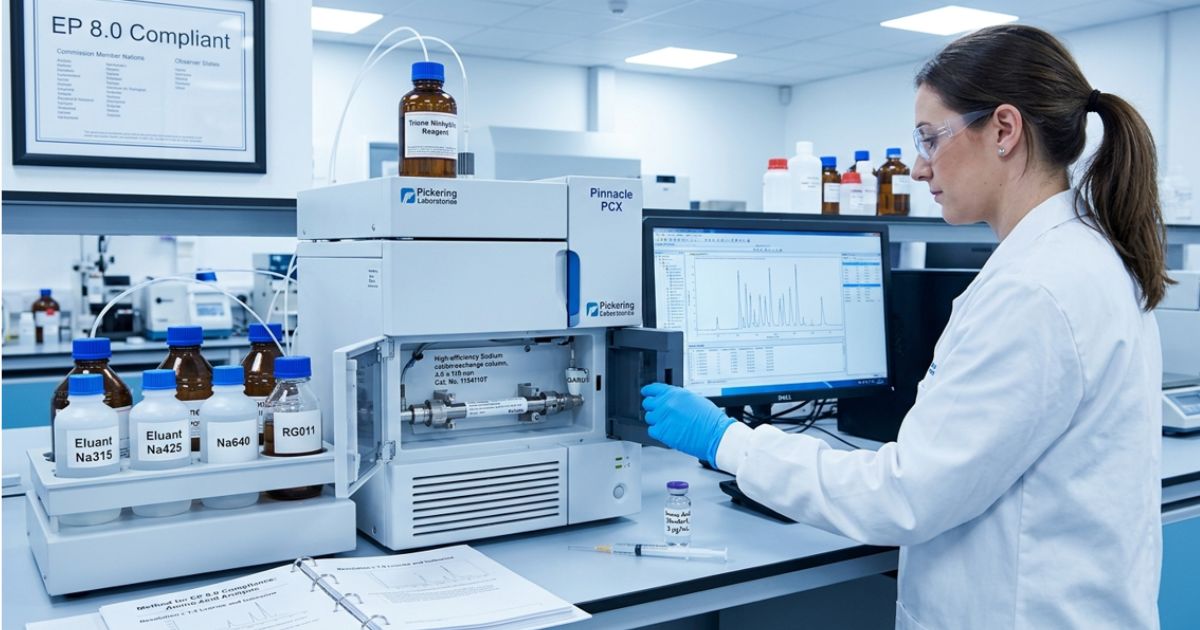
Pickering Laboratories Inc. built a complete solution for amino acids analysis that lines up with EP 8.0 guidelines, and I have run their setup often enough to trust it. Their Pinnacle PCX works as a post-column derivatization instrument, paired with analytical columns, GARDs, buffers, and Trione Ninhydrin reagent, and the instrument handles column temperature gradients that allow modified conditions along with improved run times and cleaner amino acids separations.
The application note behind these methods was tuned to meet system suitability requirements written into the Pharmacopoeia methods, and every Pharmacopoeia monograph spells out how to prepare the test solutions and reference solutions for a given amino acid, feeding percentage contents, impurity levels, and other parameters of system suitability.
A Resolution of 1.5 is required between the Leucine and Isoleucine peaks, and while Sodium-based methods and Lithium-based methods work for most amino acids, Cysteine only behaves under a Lithium-based approach, since Sodium-based methods give shorter run times everywhere else. Figure 1 shows a Sodium chromatogram built from 3 µg/mL standards with a 50 µL injection, and Figure 2 shows the same idea using alternative amino acids.
Core Bench Equipment Required for Workflows
A basic bench setup covers most of this work. A Quaternary HPLC pump, an autosampler, and a UV-vis detector form the core, and the Pinnacle PCX post-column derivatization system sits right beside them to finish the job.
Analytical Columns and Eluant Specifications
For Sodium-based methods, the kit calls for a High-efficiency Sodium cation-exchange column sized 4.6 × 110 mm, listed under Catalog Number 1154110T, run with Eluants named Na315, Na425, Na640, and RG011. For Lithium-based methods, swap in a High-efficiency Lithium cation-exchange column sized 4.6 × 75 mm, under Catalog Number 0354675T, and pair it with 1700-1125, Li365, Li375, and RG003. Figure 3 shows a Lithium chromatogram built from reference solutions used for Cysteine analysis, again at 3 µg/mL with a 50 µL injection.
Post-Column Reagents for EP 8.0 Workflows
The Trione Ninhydrin Reagent ties the whole system together, and I rarely swap it for anything else once a method is validated. Pickering Laboratories methods ship as ready chemistry kits that bundle the analytical column, GARD, buffers, and reagents needed for amino acids analysis, and every kit parts can be ordered individually if a lab only needs a refill.
Reach out by contact for any questions about this application. Figure 4 shows a Lithium chromatogram built from amino acids analysis using EP 8.0 methods, again at 3 µg/mL with a 50 µL injection, and the maker keeps updating its methods as new monographs get released, with the newest methods and chromatograms available through support@pickeringlabs.com for the latest methods.
Full Member Nations of the Commission
The European Pharmacopoeia Commission draws its members from a long list of nations: Bosnia and Herzegovina, Bulgaria, Croatia, Cyprus, Czech Republic, Denmark, Estonia, Finland, France, Germany, Greece, Hungary, Iceland, Ireland, Italy, Latvia, Lithuania, Luxembourg, Malta, Montenegro, Netherlands, Norway, Poland, Portugal, Romania, Serbia, Slovakia, Slovenia, Spain, Sweden, Switzerland, the former Yugoslav Republic of Macedonia, Turkey, Ukraine, and the United Kingdom, alongside the European Union itself as a full member.
International Observer States and Global Reach
A separate group of countries sits in as Observers rather than full members of the European Pharmacopoeia Commission, and this list stretches well beyond Europe’s own borders: Albania, Algeria, Argentina, Armenia, Australia, Brazil, Canada, China, Georgia, Israel, Madagascar, Malaysia, Moldova, Morocco, Republic of Belarus, Republic of Guinea, Republic of Kazakhstan, Republic of Singapore, Russian Federation, Senegal, Syria, Tunisia, and the United States of America, plus the WHO, the World Health Organization, which tracks the work from a global public health seat.
Technical Development and Modernization Highlights
Work carried out under the P4 procedure kept moving through the 7th Edition, and by the time I started following it, 59 P4 monographs for chemical substances had already been adopted by the European Pharmacopoeia Commission. A pilot project on bilateral, forward-looking bilateral prospective harmonisation of active substance monographs paired the commission with the USP, and this work already produced 4 harmonised monographs.
Because the P4 procedure worked so well for chemical substances, the commission opened a matching P4-BIO procedure in 2009 for biological substances, built to keep pace with the rising count of biologically-derived active substances and biosimilars across the European market, and 2 monographs built under P4-BIO have already been adopted.
Impurity Control Strategies and Genotoxic Testing
Controlling impurities remains a real strength of this system in my view. Monographs pass through the Competent Authorities of each member states, and the impurity profiles built into them mirror the real, approved routes of synthesis used in practice, backed by a revision mechanism ready for newly-approved products that carry new sources or new routes.
The analytical methods written into these monographs stay robust and validated, grounded in collaborative laboratory testing, and they mirror regulatory practice by applying the ICH guideline Q3A R to pharmacopoeial substances.
The European Medicines Agency, or EMA, issued guidance on genotoxic impurities back in 2007, and that guidance drove a revision of the general monograph on Substances for Pharmaceutical use, numbered 2034, plus the adoption of 3 general methods built for genotoxic impurities.
Implementation of the 3Rs Principle in Testing
The commission also keeps pushing the 3Rs principle, meaning replacing, refining, and reducing animal use in testing, and I find this one of the more overlooked parts of the standard. It lined pharmacopoeial texts up with VICH Guidelines 41, covering the test for reversion to virulence, and VICH Guidelines 44, covering developmental safety tests, adopted in 2008, plus Directive 2010/63/EU from the European Parliament and the Council, dated 22 September 2010, on the protection of animals used for scientific purposes.
To stay aligned with European rules, the commission harmonised every veterinary vaccine monographs, even those covering species outside earlier guideline scope, and once harmonised, the safety tests and tests for increased virulence used during vaccines development became far more consistent.
Replacement of In Vivo Methods with Alternative Assays
The body keeps revisiting its general texts and monographs, and it revises and re-evaluates the role of animal tests wherever an alternative methods exists. The general monograph on Vaccines for veterinary use, numbered 0062, dropped the TABST, short for target animal batch safety test, except under particular circumstances handled on an ad hoc basis, and this deletion later applied to every veterinary vaccine across the board.
Animals no longer appear in testing tied to human blood and plasma products, and in vivo testing has given way to in vitro methods for both human vaccines and veterinary vaccines in many cases, with reduction and refinement strategies such as serology assays and single dilution assays covering diphtheria, tetanus, acellular pertussis, and rabies.
Process Analytical Technology and EP 8.0 Uniformity Testing
The commission adopted this update at its November session in 2012, and the General Notices will later reflect real-time release testing once that EMA Guideline clears. An optional Chapter 2.9.47, the Demonstration of Uniformity of Dosage Units, or UDU, using large sample sizes, can now stand in for conventional UDU testing under EP 8.0 guidelines, and the working party keeps weighing whether new general chapters are still needed.
FAQs
What is the EP 8.0 standard in pharmaceutical quality control?
EP 8.0 refers to the 8th Edition of the European Pharmacopoeia, an official compendium that outlines legally binding quality standards for medicinal products and drug substances across European member states.
What does the EP Grade designation signify for pharmaceutical raw materials?
EP Grade indicates that an Active Pharmaceutical Ingredient (API), excipient, or chemical reagent meets the strict purity criteria, impurity limits, and analytical specifications set by the European Pharmacopoeia.
How are European Pharmacopoeia monographs updated?
Monographs are regularly revised by the European Directorate for the Quality of Medicines (EDQM) to integrate advances in analytical chemistry, updated testing methods, and improved patient safety protocols.
What is the main difference between USP, BP, and EP?
While all three set regulatory guidelines for drug quality assurance, the USP (United States Pharmacopeia) governs the US market, the BP (British Pharmacopoeia) applies in the UK, and the EP (European Pharmacopoeia) serves as the harmonized supranational standard across Europe.
Why is compliance with EP 8.0 and subsequent editions mandatory for drug manufacturers?
Adherence to EP 8.0 and its updated revisions is legally required to ensure therapeutics, vaccines, and raw materials sold or imported into the European market maintain consistent potency, chemical identity, and overall public health safety.