

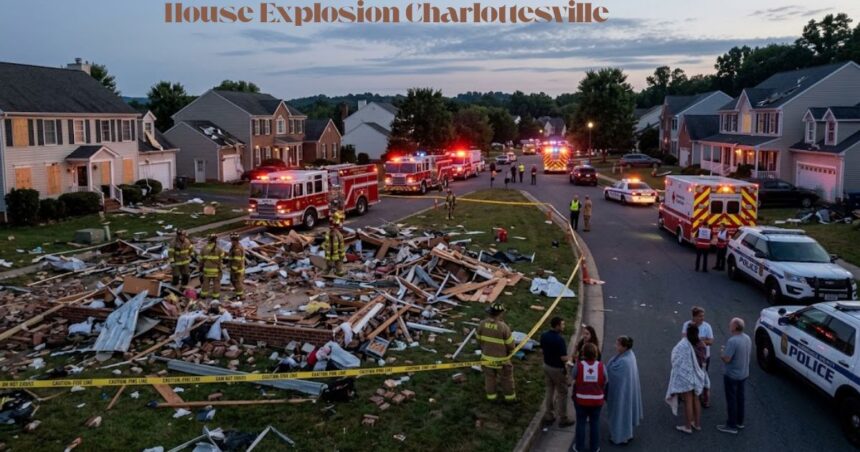
On August 19, a tragic house explosion charlottesville residents won’t soon forget changed life for an entire street. On Tuesday night, a gas explosion at 2331 Ferndown Ln. in the Glenmore subdivision of Keswick shook the ground for miles around. The blast left a leveled home, one person dead, and a man seriously injured.
Reports from CVILLE RIGHT NOW confirmed that a woman was killed, while a gravely injured man is currently recovering at the Evans-Haynes Burn Center at Virginia Commonwealth University. The Glenmore neighborhood is still trying to make sense of the tragedy as families across Virginia keep asking how a quiet evening could end so devastatingly.
Emergency Response to the House Explosion Charlottesville Incident
The house explosion charlottesville residents felt occurred around 6:00 p.m. on a Tuesday evening. The Albemarle County Emergency Call Center received multiple urgent reports, including one frantic caller who told the dispatcher that a house exploded and there was no house left standing. Albemarle County Fire and Rescue (ACFR) immediately dispatched emergency crews to the 2300 block of Ferndown Lane.
Albemarle Police and Fire Rescue crews reached the scene in about four minutes, finding a two-story home with a basement that had been completely leveled by the force of the blast. Chief Dan Eggleston confirmed during a press briefing on August 20 that first responders answered the call with exceptional speed.
Neighbors throughout Keswick and the Glenmore subdivision described the house explosion charlottesville area authorities responded to as massive. Residents more than half a mile away felt the ground shake, while the blast was heard up to 10 miles away. Firefighters stationed at Fire Station 2 reported feeling the shockwave before the emergency calls even began pouring in.
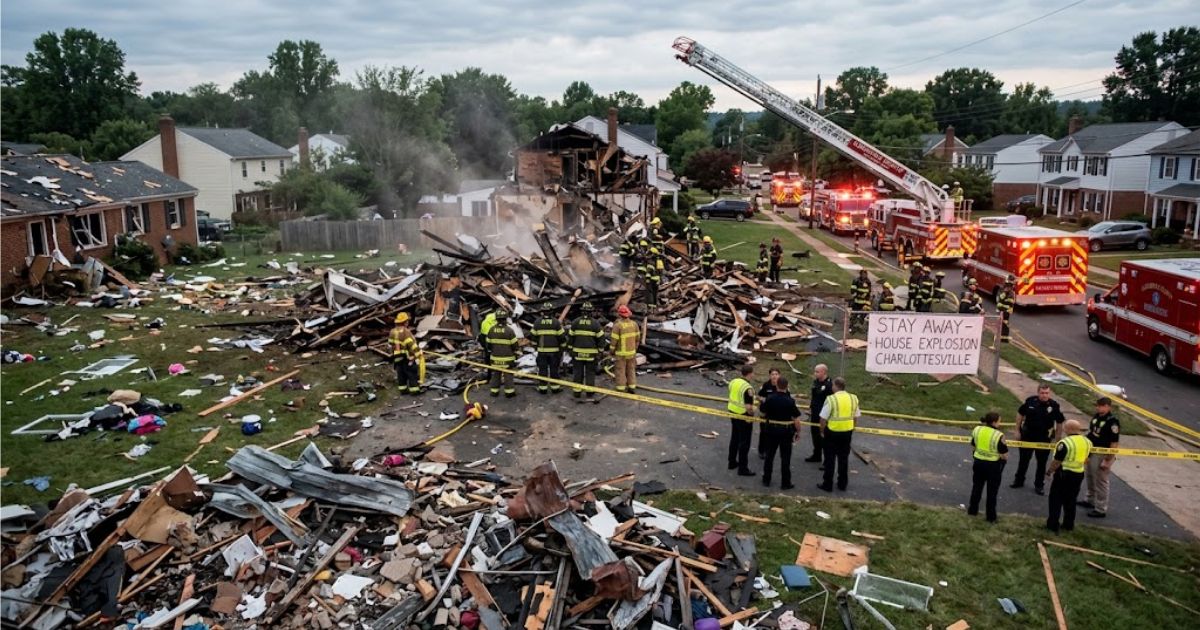
Debris flew across adjacent properties within a one-mile radius. Bricks, wood, and insulation covered yards and roofs. Early on, crews reported serious injuries, a suspected gas leak, and cause unknown, but they later confirmed no active gas leak at the site.
Victims of the House Explosion Charlottesville Tragedy
The medical examiner identified the woman killed in the house explosion charlottesville area authorities investigated as Justine M. Joscelyne, 76, of Keswick, Virginia. She was checking on the home for the owners when she noticed a gas smell. She tragically died in the blast, while the homeowners, who were not present that evening, remained safe.
Before the blast occurred, Joscelyne asked an adult male to assist her in locating the source of the leak. Chief Eggleston later confirmed during the press briefing that she simply wanted help finding the source of the gas smell before the situation worsened.
First responders found the two victims at the site and reported no additional injuries. Medics rushed the surviving male, who suffered severe burns, to the University of Virginia Medical Center (UVA Hospital). Doctors subsequently transferred him to the VCU Burn Center for specialized care, where police report he is in stable condition.
Homeowners, Damaged Homes and Red Cross Assistance
The blast hurt more than one house. Albemarle County Fire Rescue counted 12 homes with property damage, so a dozen homes nearby needed help. Eggleston warned that some structures may not be repairable.
The American Red Cross sent Red Cross staff to the neighborhood to aide the families. Jonathan McNamara, the Communications Director for the American Red Cross in Virginia, said his team stayed on scene with local officials. He promised to meet immediate needs for displaced residents and to offer services through its partners.
For people temporarily without a home, that support matters a lot. The 12 damaged homes in Albemarle County belong to regular homeowners, and after a home explosion, they need steady help. One bad evening can change a family’s plans for months.
Investigation and Cause
With investigations ongoing, the Albemarle County Fire Marshal’s Office leads the search for the cause. The Albemarle Fire Marshal looks at gas, appliances, and distribution systems, and the team also asks for video evidence. The Bureau of Alcohol, Tobacco, Firearms, and Explosives joined them.
Emergency responders evaluated the scene right away and kept the neighborhood blocked off. The Virginia Department of Emergency Management brought search dogs to look for other victims. Officials still list the cause of incident unknown, and they confirm no active gas leak.
ACFR finished its preliminary investigation on August 22 after checking 202 homes. Teams back on site ran structural assessments and handled debris cleanup. They also worked with affected neighbors to sort out property damage.
Official Statements
ACFR Chief Dan Eggleston made an August 20 statement that spoke straight to the Glenmore community. He called it a difficult time and promised to stand with them. His priority is twofold: protect the safety and stability of the affected homes and help the neighborhood recover.
At the press briefing, Eggleston repeated that Albemarle County Fire Rescue wants steady progress. Jonathan McNamara and the American Red Cross gave a matching message of support. Their words show how local agencies work side by side.
Community Impact and Medical Response to the House Explosion Charlottesville Blast
Ty Cooper, a local business owner, spoke to CVILLE RIGHT NOW after the house explosion charlottesville area residents witnessed. Sitting at the main security gate when the blast occurred, he described the sensation as feeling like slow motion, similar to a movie. He immediately drove to his business client’s home a few blocks away to check on the situation.
Upon arriving, Cooper saw insulation and other debris drifting down through the air despite there being no wind describing it as looking almost like snow. Within minutes, approximately 10 firetrucks arrived on the street. Another neighbor in Milton, located just over a mile away, also reported feeling the shockwave from the blast.
The transfer of the injured survivor highlights why burn-specific treatment is critical following such incidents. The UVA Medical Center holds Level 1 Trauma Center status from the American College of Surgeons a title it renewed on August 19 for the fourth time since 2015. That top-tier designation signifies comprehensive trauma care and regional leadership. Additionally, the center operates the DeCamp Burn & Wound Healing Center, equipped with six dedicated beds for treating moderate to severe burns and complex wounds.
The VCU Evans-Haynes Burn Center runs a 16-bed unit and ranks as the oldest civilian burn hospital in the country. It is also the only Level 1 Comprehensive Adult and Pediatric Burn Center in the state that the American Burn Association certifies. That makes it ABA verified for adult and pediatric burn care, a rare title that fewer than 50 hospitals hold as of 2024.
The ABA sets a tougher bar and charges a $6,000 reverification fee each year. The American College of Surgeons guide, Resources for the Optimal Care of the Injured Patient, says top centers are university-based teaching hospitals because they handle patient care, education, and research. They also drive trauma system development, regional disaster planning, and increasing capacity, and they keep improving trauma care.
Prevention and Medical Protocols Following the House Explosion Charlottesville Event
After natural gas incidents like the house explosion charlottesville community experienced, medical guidelines call for immediate referral to a specialized burn center. The mechanism of injury in these scenarios is uniquely complex, as the initial blast wave, flying structural debris, and physical displacement cause significant trauma alongside thermal burns.
The critical takeaway for every homeowner is prevention. If anyone detects a smell of natural gas, they should immediately leave the premises and call 911 from a safe distance. Following these simple steps costs nothing and can save lives, helping to prevent future tragedies like the house explosion charlottesville neighborhood endured.
FAQs
1. What caused the recent house explosion in Charlottesville?
Authorities are still investigating the exact cause, though gas leaks are among the most common factors in sudden residential structural explosions.
2. Were there any casualties or injuries?
Emergency services responded immediately to secure the scene, assess neighboring homes for damage, and treat any individuals affected by the blast.
3. How can residents check for gas leaks in their homes?
Listen for hissing sounds near gas lines, watch for rotten-egg odors, and install carbon monoxide and natural gas detectors on every level of your home.
4. What should you do if you smell gas in your house?
Evacuate immediately without turning light switches on or off, move to a safe distance outside, and call 911 or your local gas utility provider.
5. How can neighbors support those impacted by the house explosion in Charlottesville?
Local community organizations and relief groups often coordinate donation drives, temporary shelter, and emergency funds for affected families following a disaster.