


London property market has seen house prices grow just 10% between 2016 and 2026, far below the UK average of 41%, making it one of the weakest-performing capital regions.
Buyers, investors, and estate agents continue to monitor stagnation across the capital, where 14.8% of homeowners in 2025 sold for less than their purchase price, per Hamptons research.
Demand, long-term growth, and rental demand still attract foreign investors and domestic investors, though costs, tax pressures, and fiscal turbulence remain key challenges in this historically attractive market.
Property Market In London
The property market in London reflects deep income disparities, with house prices now 12 times earnings, up from seven in the early 2000s, placing enormous pressure on first-time buyers and renters.
Homelessness costs £5.5m a day, and record numbers of Londoners are living in temporary accommodation, highlighting the scale of the housing crisis as described by Rob Anderson of the Centre for London.
Businesses confirm that unaffordability is strangling growth, investment, and talent, making the housing system a critical concern for the capital’s economic future going into 2026.
Central London Property Market
The central London property market remains the focus of Gulf investors, with 29% of high net worth individuals from Saudi Arabia, Qatar, and the UAE investing in London property in the 12 months ending September 2025.
Lucian Cook of Savills noted that Middle East tensions could “enhance the UK’s safe haven credentials,” especially for an attractively priced prime central London market amid ongoing geopolitical uncertainty.
However, a rising tax burden is likely to temper values even in prime central London, where £5m homes in Westminster face significant annual proportional property tax PPT implications under proposed reforms.
The current London property market saw house prices fall 1.8% in 2025 per Land Registry data, with the average London price sitting at £542,304, 102% above the UK average of £267,957. Zoopla’s latest house price index shows annual price growth at 0% across London, while northern regions like the northwest (3.6%) and Northern Ireland (6.9%) outperform significantly.
Sales agreed are 1% higher year-on-year despite active buyers falling 10%, as home movers and first-time buyers targeting homes worth £10,000 more drive price inflation modestly upward.
A detailed analysis about this reveals that 60% of 2025 sales in London were flats, which suppressed average London prices due to their lower values compared to houses, per David Fell of Hamptons.
Floor space per person rose 30% between 2004 and 2023, but the top 20% of incomes gained a 27% rise versus just 6% for the bottom 40%, widening housing inequality significantly across the capital.
The RICSMarch report showed estate agents and surveyors in London growing more skeptical about house price growth, reflecting a fragile market even before Iran conflict disruptions hit mortgage rates.
London Property Market News
The latest news about this highlights that US-Israeli attacks on Iran on 28 February pushed the two-year fixed-rate mortgage from 4.83% on 2 March to 5.81% by 24 April, per Money facts.
Tom Bill of Knight Frank warned that buyers’ budgets would face pressure from elevated mortgage rates, though he acknowledged potential Bank of England rate cuts could revive activity later in the year.
The Renters’ Rights Act, effective from May, introduces new rules including limiting advance rental payments to one month and granting tenants pet permission rights, reshaping the rental demand landscape for landlords.
Market Forecasts & Predictions
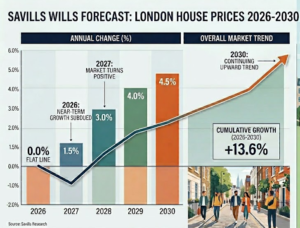
Its forecast from Savills projects house prices will flat line in 2026 before turning positive in 2027, continuing an upward trend through to the end of decade. Cumulatively, Savills forecasts London house prices will grow by 13.6% between 2026 and 2030, representing a gradual recovery for buyers, landlords, and investors in the capital.
The estate agent notes that while near-term growth remains subdued, the market fundamentals Including 2.7 Million Private Renters Support A Longer-Term Positive Outlook For This.
Central London Property Market Predictions
These predictions remain cautiously optimistic, with Lucian Cook of Savills suggesting Middle East tensions may boost the UK’s safe haven credentials for prime central London investment.
High net worth individuals from Saudi Arabia, Qatar, and the UAE surveyed via the Gulf Cooperation Council Investment Barometer by AlRayan Bank ranked London above New York (23%) and Paris (23%) for property investment.
Yet the proposed annual proportional property tax (PPT) and broader tax burden may temper values in central London, where a £5m home in Westminster would face £41,000 annually under Centre for London reform proposals.
London Property Market Forecast 2025
Its capital as the weakest-performing region, overtaking even the North East for homes sold at a loss. 14.8% of Londoners sold their property for less than they paid in 2025, per Hamptons research, as flat prices and stagnation dragged down the average London house price to £542,304.
Money facts data shows the two-year fixed-rate mortgage peaked at 5.90% on 12 April during 2025, adding further strain to buyers’ budgets and cooling sales activity.
London Property Market 2025
It was shaped by the Iran conflict, rising mortgage rates, the Renters’ Rights Act, and a continued overhang of flats accounting for 60% of all London sales.
Despite headwinds, 2.7 million private renters supported landlord returns, and rental yields of 5%–6% kept London on the radar of domestic investors and Gulf investors through September 2025.
London Property Market Forecast 2026
Its forecast 2026 points to a flat line in house prices, with Savills projecting no notable growth as elevated bank rate levels and mortgage rates continue to suppress buyer activity.
Zoopla data confirms annual price growth in London remains at 0%, with southern regions including the south east (0.8%) and south west (0.1%) also trailing northern regions significantly in 2026.
However, potential Bank of England interest rate cuts later in 2026 as suggested by Tom Bill of Knight Frank could reintroduce momentum, benefiting both first-time buyers and investors across the capital.
In this house, prices are forecast to flat line per Savills, yet the cumulative 13.6% growth projected between 2026 and 2030 offers cautious optimism for long-term investors and landlords.
The Centre for London reform proposals replacing stamp duty and council tax with PPT could release 79,000 homes annually and fund 106,000social housing and affordable homes over the next decade.
First-time buyers stand to save £8,593 across five years with no stamp duty, while private renters and social renters would save over £1,890 annually by eliminating council tax under the proposed PPT system.
London House Price Predictions For Next 10 Years
London house price predictions for next 10 years from Savills forecast a cumulative 13.6% rise between 2026 and 2030, reflecting gradual recovery after years of stagnation and decline since 2016.
House prices in London have risen over 200% since 2002, yet the ratio of prices to earnings now 12 times versus seven in the early 2000s signals deep structural affordability challenges ahead for first-time buyers.
The proposed PPT reform by Centre for London could reshape the next decade, funding 106,000social and affordable homes, releasing 79,000 homes annually, and enabling renters to more easily save a deposit for their first home.
Market Stability & Economic Outlook
Savills believes recovery begins in 2027, with steady house price growth building to a cumulative 13.6% by 2030, supported by improving mortgage rates and Bank of England rate cuts.
Lucian Cook of Savills and Tom Bill of Knight Frank both acknowledged that interest rate reductions could restore buyer confidence and drive sales activity, particularly in an attractively priced prime central London market.
Long-term resilience is underpinned by 2.7 million private renters, rental yields of 5%–6%, and sustained Gulf investors interest, all of which point toward a structured recovery.
Property Market London Crash
Fears of a property market London crash have been fueled by house prices falling 1.8% in 2025, the capital replacing the North East as the region most prone to homeowners selling at a loss.
14.8% of Londoners sold below purchase price in 2025, while the Iran conflict sent two-year fixed-rate mortgage rates from 4.83% to 5.81%, pushing the London market deeper into its “already fragile” state.
However, Savills, Knight Frank, and AlRayan Bank data collectively suggest a full crash is unlikely, with safe haven credentials, rental demand, and long-term growth fundamentals keeping this afloat.
Central London Property Market Crash
A central London property market crash scenario is tempered by strong Gulf investors demand, with 29% of high net worth individuals from the UAE, Qatar, and Saudi Arabia buying London property through September 2025. Lucian Cook of Savills suggested Middle East tensions paradoxically enhance prime central London’s appeal as a safe haven, though the rising tax burden including possible PPT reforms could tempervalues at the top end.
The RICS March report flagged skepticism among surveyors and estate agents about house price growth, yet rental yields of 5%–6% and strong international city status provide structural support against a deep central London crash.
Specific Property Sectors
London Property Market Flats
The flats segment of this has been a key driver of stagnation, with 60% of all London sales in 2025 comprising flats, which are cheaper than houses and have weighed down average London prices.
David Fell, lead analyst at Hamptons, noted that lukewarm growth in flat prices dragging down overall property prices has been a recurring trend since 2016, suppressing the house price index across the capital.
Floor space inequality is also acute in the flats sector, the bottom 40% of incomes saw just a 6% rise in space owned between 2004 and 2023, versus 27% for the top 20% of owner-occupiers.
London Flat Prices Trend
The London flat prices trend since 2016 shows persistent underperformance, with flat prices growing at a lukewarm pace that has consistently pulled down the average London house price well below the UK trajectory.
Land Registry data confirms house prices in London grew just 10% between 2016 and 2026 versus 41% nationally, with the dominance of flats in the sales mix 60% in 2025 being a structural contributor.
David Fell of Hamptons projects this flat prices trend will continue to suppress average London prices unless the composition of sales shifts meaningfully toward higher-value houses in the capital’s housing mix.
London Property Rental Market
London property market remains robust, with 2.7 million private renters across the capital per Barratt Homes, creating sustained opportunities for landlords despite increasing regulatory pressure.
Rental yields in London range between 5% and 6%, offering a strong return on investment for those adopting the Buy Refurbish Refinance Rent (BRRR) strategy, as highlighted by James Mulvaney of Clifton Private Finance.
The Renters’ Rights Act, effective from May, limits advance rental payments to one month and grants tenants pet permission rights, prompting some landlords to adopt a more cautious approach within the rental demand landscape.
FAQs Of London Market Performance & Trends
How did London house prices perform between 2016 and 2026?
They grew by just 10%, which is far below the UK national average of 41%.
Did many London homeowners sell at a loss in 2025?
Yes, 14.8% of London homeowners sold their properties for less than their original purchase price.
Why have average London house prices stayed so low?
Flats made up 60% of all London sales in 2025. Their lower market value dragged down the overall average house price index.
What is the London property market forecast for 2026 and beyond?
Prices are expected to flatline in 2026, but Savills predicts a cumulative recovery of 13.6% growth between 2026 and 2030.
Is a full London property market crash likely?
Unlikely. Despite a 1.8% price drop in 2025, strong rental demand and safe-haven foreign investments are keeping the market afloat.