

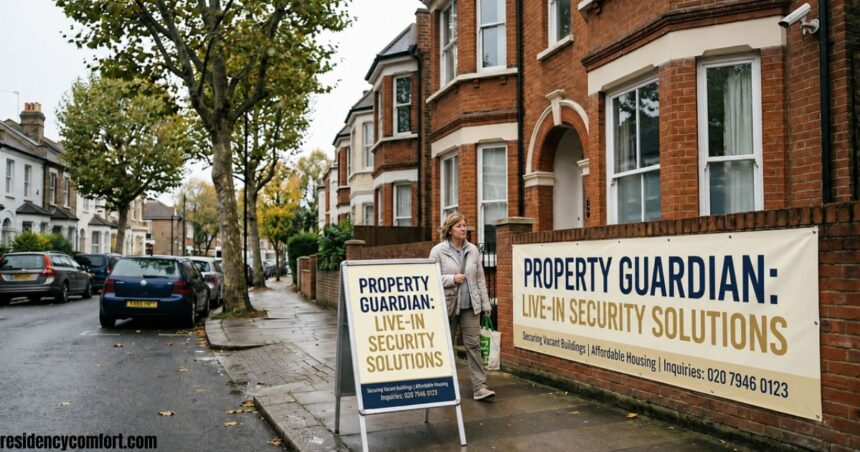
Across the UK, more people are turning to property guardianship as soaring rents and slipping homeownership push them toward creative housing choices. A property guardian is often described as a private individual who lives inside a disused hospital, an empty hospital ward, an old school, or another building that a landowner wants to protect until redevelopment begins.
The Rise of the Property Guardian in the UK
Many of these arrangements run on temporary contractual licence terms rather than full tenancy agreements, which is why a guardian’s licence agreements look so different from what a private renter signs. Shows like Channel 4’s Crashing, created by Phoebe Waller-Bridge, brought this alternative lifestyle into the public eye, though most guardians are not artists chasing adventure but students and key workers choosing this path for financial reasons rather than novelty. Instead of paying rent in the usual way, guardians pay occupation fees, and this cheaper rent is the biggest draw for anyone priced out of affordable homes and tired of privately renting at full market rates.
Legal Battles in Property Guardian Housing
The legal side of guardian life has been shaped by real court battles. In Global 100 Limited v Carlos Jimenez, the Upper Tribunal heard arguments from Martin Rodger QC, the Deputy Chamber President of the Lands Chamber, about whether guardians occupying a former office block in east London were living in a house in multiple occupation.
Similar legal complexities appeared earlier in London Borough of Southwark v Ludgate House Ltd ([2020] EWCA Civ 1637), where the Court of Appeal looked at rateable occupation and national non-domestic rates tied to vacant premises and disused premises held by a building owner. The case, catalogued under UKUT 50 LC, is now a reference point whenever a landowner hands over an empty property and questions arise about eviction, the right to repairs, or protection against squatters.
The Lived Reality of the Property Guardian
What this shows is that property guardian sits at the meeting point of law and lived experience. Guardians get accommodation at a lower cost than the ordinary residential letting market, but they trade away some security. The image of university-educated artists enjoying a rent-free adventure hides a harder truth: housing precarity is pushing ordinary people toward a housing solution that offers savings but little protection.
Understanding Your Property Guardian Agreement
Every agreement a guardian signs shapes what rights they actually hold. Property guardians almost always accept licence agreements, and this single choice changes how safe they feel in their own home. Renters with these documents do not enjoy the same rights as ordinary private renters, since a licence carries far less legal weight than a lease. Tenants, by contrast, receive stronger protection against sudden eviction exactly the gap that catches many new guardians off guard.
The Guardian Licence Framework
A licence usually means someone else controls the small print of daily life. If an agent can order moving between rooms whenever it suits the building, or if there is no agreement tied to one specific room, that is a clear sign of a licence rather than a tenancy. Many individuals entering property guardian also discover they pay no rent at all, just a fee, and giving up a private room without much notice is simply part of the deal they accepted.
Tenancy Rights vs. Property Guardian Licences
An assured tenancy looks quite different from a guardian licence. Anyone who has stayed in the same specific room for a long time, with a working lock on the door, is likely holding this stronger form of agreement rather than a simple licence.
Repairs, HMO Rules, and Eviction as a Property Guardian
Health and safety problems do not wait for paperwork to catch up, so any property guardian who spots unsafe electrics, exposed asbestos, or flooding linked to old pipes can report it straight to the council. Whether a licence or a tenancy applies changes who must act with a licence, the agreement itself usually says who handles smaller jobs, while a full tenancy places responsibilities for repairs firmly on the landlord.
A landlord holding a tenancy must keep the roof, electrical wiring, gas pipes and boilers, heating and hot water, plus walls, stairs and bannisters, and even external doors and windows in safe working order, and skipping any of these repairs can land them in real trouble.
Houses in Multiple Occupation (HMOs)
A property can count as an HMO the moment unrelated people share one roof without forming a single household. Shared bathrooms and kitchens are the clearest sign of this, and once shared facilities exist, a landlord picks up extra health and safety responsibilities that a normal single-family home would never require.
Eviction Rules for a Property Guardian
Eviction rules depend heavily on which paperwork a guardian actually signed. A licence often comes with a fixed term agreement, perhaps for 6 months or a full year, and during that fixed term a landlord cannot simply ask someone to leave early.
Once that period ends, formal notice is not always required, but the landlord must still request a court order before anyone is forced out, and skipping that step becomes illegal eviction, which the council can step in to challenge.
Guardians on a rolling agreement with no fixed end date are entitled to at least 4 weeks’ notice before a landlord even approaches the court. Tenants holding an assured tenancy face a different route: they receive a section 8 notice, usually triggered by missed rent payments, and the landlord still needs a court order if the tenant refuses to go, since a tenancy has no fixed term in the way a licence does.
Managing Deposits, Taxes, and Property Guardian Regulation
An assured tenancy legally requires the landlord to protect that deposit inside an official scheme, but a licence offers no such guarantee, leaving guardians to fight harder if the money does not return.
Paying Council Tax in Shared Spaces
Council tax bills can catch people off guard inside guardian housing. If the building qualifies as an HMO, the landlord may be the one legally responsible for the bill, so anyone unsure should simply ring the local council and ask directly.
Are Property Guardian Providers Regulated?
Not every operator plays by the same rulebook, which is why checking regulation matters before signing anything. Some property guardian companies belong to the Property Guardian Providers Association, known as PGPA, and agree to follow set safety standards as part of membership. Checking whether a company is registered before signing an agreement gives extra peace of mind, and if something goes wrong later, the PGPA redress scheme offers a route for filing a formal complaint.
Case Study: The Global 100 Limited v Carlos Jimenez Dispute
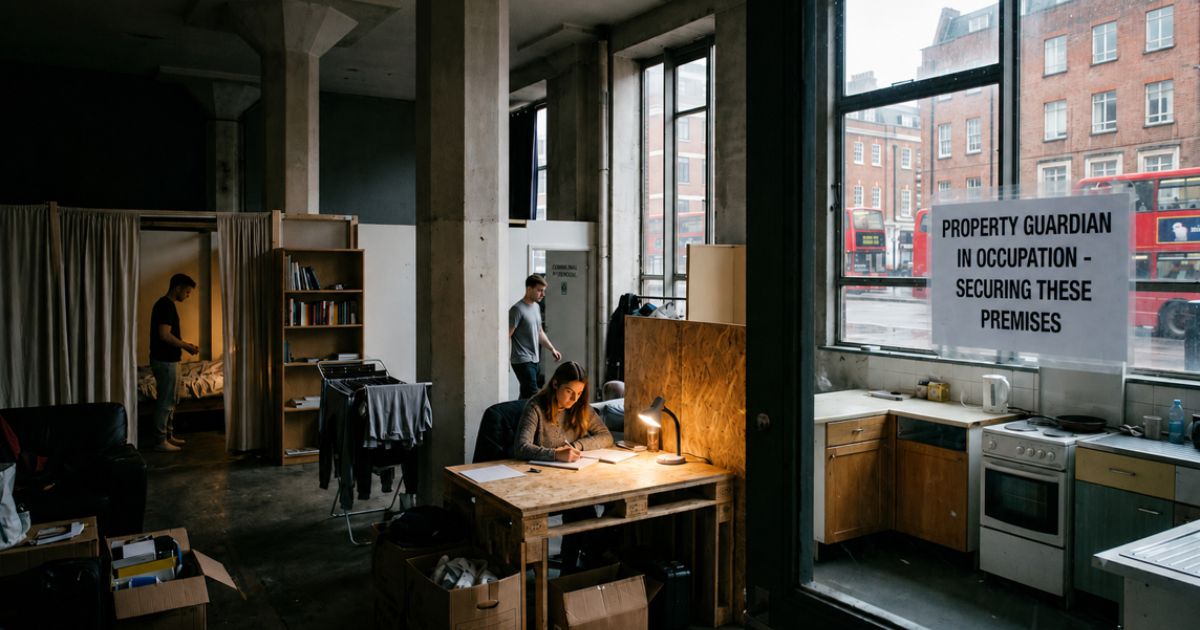
The case brought by Global 100 Limited, often shortened to G100L, against Mr Jimenez and fellow guardians remains one of the clearest legal tests of guardian housing in London. The dispute centred on the former Addison Lee building, a five-storey office block near Euston, where guardians had lived on the third floor from June to December 2020 and paid roughly £6,000 in fees. The First-tier tribunal first ruled that the property counted as an HMO and, because it was not licensed, this amounted to an offence, leading to a rent repayment order under the Housing and Planning Act 2016, which prompted G100L to appeal.
The Upper Tribunal Ruling
On appeal, the Upper Tribunal, guided by Mr Rodger QC, examined the standard test for an HMO set out in section 254(2) of the Housing Act 2004, including the tricky s.254(2)(d) wording about whether the accommodation counted as the guardians’ only or main residence and whether their occupation amounted to the only use of the space.
G100L argued there was an additional use: the delivery of guardian services and guardianship services under clause 4 of the Use of the Property section in each contract, which required guardians to sleep at the property, keep a guardian present for 1 hour in 24, stay at least 5 days a week, share occupation with others, and report any risk of damage or unwanted access without permission.
Why the Tribunal Rejected the Agency’s Arguments
The tribunal, drawing on the earlier Laleva ruling, cited as EWCA Civ 1835, accepted that guardians act somewhat like service occupiers, yet it still rejected G100L’s purposive argument for three reasons. First, it said the statutory regime exists to protect the general public, not just particular occupants, so the statutory context mattered more than private wording. Second, the agreements only permitted residential occupation, ruling out businesses or meetings on site.
Third, the tribunal treated any guardian duties as a mere by-product of living there, since basic amenities were shared, at least one guardian was paying rent, and the space failed the self-contained flat test because it was shared by a single household substitute of unrelated people rather than one family. The Court of Appeal had already touched similar ground, noting that guardians replace security personnel once a building sits empty, confirming that ordinary rent paid for shelter, not for guard duties, defines what guardians really are.
History and Business of the Property Guardian Industry
Property guardianship did not start in UK cities; it began in the Netherlands during the 1980s as an anti-squatting measure. The story really starts in Amsterdam during the 1960s, when students short of housing launched squat actions against a city that kept boarding up buildings meant for demolition, turning them uninhabitable rather than letting anyone move in.
That resistance grew into a full squatter movement counting roughly 20,000 people by 1980, and in response, property management agencies built a network known as antikraak, recruiting occupants for abandoned schools, leisure centres, monasteries, former police stations, and other empty sites.
These early guardians paid only utility bills, enjoyed almost no privacy or protections, and could face evictions with just two weeks’ notice, a stark contrast to modern anti-squatting strategies.
The Expansion of the Property Guardian Movement
The idea spread across Europe, reaching France, Germany, Belgium and Ireland before landing in the UK in 2001, where guardians settled into Scottish mansions, 14th-century charterhouses, Merseyside observatories, empty townhouses, office blocks and council buildings across Brighton, Bristol, Manchester and London.
Because reliable data on numbers is scarce, Government estimates from 2017 placed the guardian population at only 5,000 to 7,000, while figures from the Property Guardian Providers Association in 2019 suggested a far higher total near 60,000, and even today guardians pay below-market rent for vacant premises that would otherwise sit empty and unwatched.
FAQs
What does a Property Guardian do?
A Property Guardian provides live-in security simply by occupying an empty building. Your daily presence deters squatters and vandalism, and you report any maintenance issues like leaks.
How much can a Property Guardian save?
The monthly licence fee for a Property Guardian is typically 30% to 50% cheaper than standard market rent, making it highly affordable accommodation.
Does a Property Guardian have tenant rights?
No. A Property Guardian signs a Licence to Occupy rather than a traditional tenancy. This allows for flexible living, meaning the notice period to vacate is usually just 28 days.
Who qualifies to be a Property Guardian?
Most guardianship providers require a Property Guardian to be an employed adult (often 21+), with a reliable income, and no living-in dependent children or pets.
Are the buildings safe for a Property Guardian?
Yes. Whether a Property Guardian lives in unique commercial spaces or schools, the property management company must ensure the building meets safety standards with working hot water, heating, and kitchen amenities.