

The Isle of Wight rental scene has shifted significantly over the last two years, and the pace of change continues to catch many people off guard. Anyone holding a property to let IOW is dealing with new rules, higher holding costs, and a very different buyer market than in past years. This overview walks through what is happening across the local market in plain, straightforward language.
Property to Let IOW The Scale of the Shift Out of Private Renting
Across the Island, the private rented sector has historically accommodated around 18% of Island households roughly 15,000 families. However, nearly 5,000 properties have quietly disappeared from that pool since the pandemic.
At a national level, 26% of landlords sold at least one home in late 2024 (the highest share ever recorded), while a 5:1 ratio of owner-occupiers to new investors shows how far the market balance has tilted since 2021 when the ratio was closer to 1:1.
Two out of three rental properties sold end up with first-time buyers rather than new landlords. As a result, the housing register on the Island grew from 2,357 households in 2021 to 2,596 by 2024, with 240 Island households counted as homeless or in emergency accommodation by late 2025.
Selling a Property to Let IOW How the Legal Framework Has Changed
Island landlords previously viewed securing vacant possession before a sale as the only sensible route, but that instinct no longer aligns with the legal framework in place today.
No-Fault Evictions Abolished: Since 1 May 2026, Section 21 no-fault evictions have been formally abolished, converting existing Assured Shorthold Tenancies into Assured Periodic Tenancies.
Section 8 Requirements: Owners seeking an empty property must rely on statutory Section 8 grounds, providing a minimum of four months’ notice after a tenancy has run for at least 12 months.
Court Timelines: Ongoing court backlogs stretch timescales further, making an exit via vacant possession a lengthy legal process. For many owners, selling with tenants in situ offers the path of least resistance.
Managing a Property to Let IOW What the Empty Property Premium Means in Practice
February 2024 marked a pivotal change when the Isle of Wight Council introduced council tax premium powers. Leaving a property to let IOW sitting vacant during an extended void period now carries substantial financial consequences:
- 1 to 5 Years Empty: 200% Council Tax (double rate).
- 5 to 10 Years Empty: 300% Council Tax (triple rate).
- 10+ Years Empty: 400% Council Tax (quadruple rate).
A standard £2,000 annual bill rises to £4,000 the moment a property sits vacant past the first year. The council projects roughly £88,000 in additional revenue from standard void periods alongside £4,270,000 from the 100% premium applied to second homes. When combined with four-month notice periods and potential court waits, void council tax charges make tenanted sales financially favorable.
Investing in a Property to Let IOW Why the Buyer Pool Is Broader Than Expected
While owners often worry that a sitting tenant reduces buyer interest, that concern has largely proved unfounded in practice. Cash buyers and property investment firms actively seek well-maintained Island homes with reliable tenants paying market rent to secure immediate yields from day one.
According to the English Private Landlord Survey 2024:
- 45% of landlords own a single rental property.
- 38% hold between two and four properties.
Most landlords operate on a small scale and value speed and simplicity over prolonged open-market marketing. A swift tenanted sale avoids the prolonged loss of rental income that comes with trying to secure vacant possession.
What Tenants Seeking a Property to Let IOW Need to Know
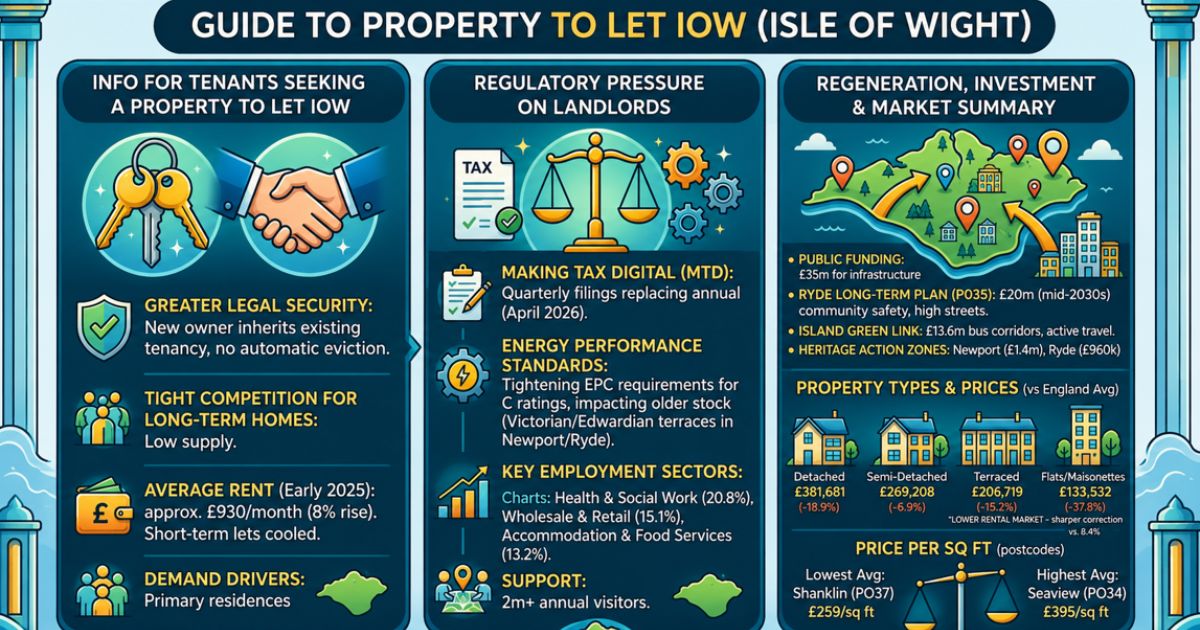
Tenants renting a property to let IOW now hold greater legal security. A property being put up for sale no longer triggers an automatic eviction, as the new owner simply inherits the existing tenancy agreement.
Competition for long-term rental homes remains tight across the Island. Although short-term holiday lets grew by 44% between May 2019 and May 2022, that market has cooled. Average Island rents rose by 8% to approximately £930 per month between 2022 and early 2025, keeping demand for primary residences high.
Regulatory Pressure Facing Landlords Today
Landlords and owners managing a property to let IOW face a steady stream of regulatory updates:
- Making Tax Digital (MTD): Introduced in April 2026, replacing single annual returns with quarterly filings..
- Energy Performance Standards: Tightening EPC requirements impact older stock, particularly Victorian and Edwardian terraces across Newport and Ryde that require upgrades to hit C ratings.
Key employment sectors on the Island are led by Health & Social Work (20.8%), Wholesale & Retail (15.1%), and Accommodation & Food Services (13.2%). Over two million annual visitors support hospitality jobs, concentrating workforce housing demand in and around Newport and Ryde.
Regeneration and Investment Across Newport and Ryde
Approximately £35 million in public funding is directed toward island infrastructure and heritage:
- Ryde Long-Term Plan for Towns (£20m): Funding running into the mid-2030s targeting community safety, high street renewal, and local connectivity in PO33.
- Island Green Link (£13.6m): Levelling Up Fund Round 3 grant funding bus corridors between Ryde and Yarmouth, the West Wight Greenway, and active travel routes in Newport.
- Heritage Action Zones (£2.36m): Split between Newport (£1.4m) and Ryde (£960k) via Historic England for shopfront restoration and reuse.
Property Types & Price Summary
- Detached Homes: £381,681 (18.9% below England average of £470,492).
- Semi-Detached Homes: £269,208 (6.9% below England average of £288,185).
- Terraced Homes: £206,719 (15.2% discount against England average of £243,788)—forms the core of the long-term rental market.
- Flats & Maisonettes: £133,532 (37.8% discount against England average of £214,563), seeing the sharpest annual correction (-8.4%).
Price Per Square Foot Breakdown Across Postcodes
Valuations per square foot across the twelve Island postcode districts range from affordable coastal areas to premium eastern villages:
- Lowest Average: Shanklin (PO37) at £259/sq ft.
- Highest Average: Seaview (PO34) at £395/sq ft.
What the Isle of Wight Data Tells Buy-to-Let Investors
For investors examining the local rental market, recent data highlights a clear split between central employment hubs with consistent year-round tenant demand and coastal postcodes dominated by second homes.
- Data Gaps in Coastal Postcodes: Seven districts PO32, PO34, PO35, PO38, PO39, PO40, and PO41 show no standardized rental yield data. These areas lean heavily toward second homes and vacation markets with low transaction volumes (as few as two sales per month).
- Licensing Requirements: The Isle of Wight does not operate a borough-wide or selective licensing scheme. Mandatory licensing only applies to larger Houses in Multiple Occupation (HMOs).
What Is Private Sector Leasing for a Property to Let IOW?
Private Sector Leasing (PSL) offers an appealing option for risk-averse owners or first-time landlords with a property to let IOW who want predictable income without the hassle of direct tenant management. Under this arrangement, the local council leases your property for a 3-year term, taking on the primary housing duty for the household placed inside and managing day-to-day tenant relations.
FAQs
How do I find a private Property to Let IOW with low upfront costs?
Look for listings that offer zero-deposit schemes or negotiate directly with private landlords. Searching for no-deposit private rentals helps lower initial moving costs through flexible tenancy terms.
What are the average rental prices when searching for a Property to Let IOW?
Prices vary by size and location, with budget-friendly flats starting lower and larger countryside homes costing more. Exploring affordable island accommodation outside peak tourist hubs yields the best rates.
How can I find direct private landlord rentals on the Isle of Wight?
Search local classifieds and property portals for direct private landlord rentals. Opting for private lettings directly through owners ensures direct communication and simpler lease terms.
How do I apply for council housing on the Isle of Wight?
Apply through the Isle of Wight Council’s housing register. Eligible applicants needing social housing or housing assistance can bid on long-term affordable local authority homes.
Where are the best areas for rural rentals on the island?
Look in West Wight areas like Brighstone and Freshwater, or central villages like Godshill. These spots offer charming farm cottages, countryside lets, and quiet homes surrounded by green space.