

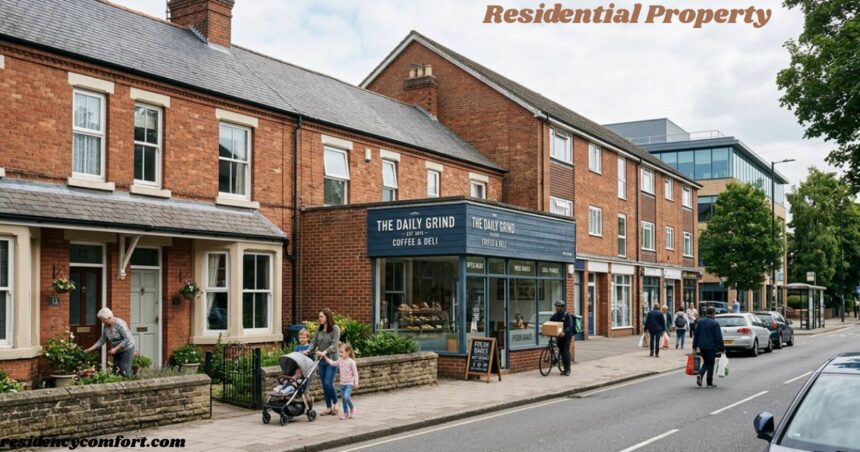
When you start a prospective purchase, the distinction between a home and a business space rarely crosses your mind, since the answer usually feels obvious. Yet in property law, this distinction carries real weight, and getting it wrong can cost money I’ve seen buyers get caught out by this more than once. This article looks closely at residential property and non-residential property, along with the grey areas that make the topic more unclear than most buyers expect.
Defining Residential Property vs Commercial Property Use
Buildings meant for dwelling purposes get treated very differently from buildings used for trade, and this split shows up again and again in frequently used legal terms. We’ll walk through the basic definitions, cover residential property types definitions, and touch on a piece of recent case law that changed how courts view this question.
Commercial properties and residential properties serve completely different audiences, and once you grasp these core differences, the significant gap in tax treatment starts to make sense. This guide is written to cut through the uncertainty and explain, in plain terms, how each type of building is defined, and why the label matters so much once you go through with a purchase.
What Defines a Residential Property?
A residential property is simply a place built for a household or an individual dweller to live in, and the law treats it as a dwelling the moment it’s fit to be lived in. Across the UK, and specifically in England, legislation sets out how this works, and the rules apply whether you buy houses, flats, or even smaller accommodation blocks.
If you view our homes at somewhere like Dunton Court apartments, you’ll notice that homes priced under £250,000 often sit outside the usual stamp duty bands, while anything above that figure moves into a higher tax bracket based on its value. Buyers who purchase more than five residential property units in one deal find that the whole portfolio gets treated as a non-residential transaction, which means the non-residential rates apply instead of the usual LBTT charge a quirk that surprises a lot of investors.
This isn’t limited to standard houses either; holiday homes, blocks built for school pupils, and housing set aside for army members all count as residential too, since they’re all built with people living in them in mind. Once a building qualifies, you can choose to rent it out or live in it yourself, but either way the land tax rules kick in the moment you complete the sale.
Defining Non-Residential and Commercial Space
On the flip side, a non-residential building is any space that isn’t built for human habitation, and this covers a much wider range of property than people usually assume. Think of offices, factories, shops, hospitals, prisons, hotels, and even empty plots of land waiting to be developed none of these count as somewhere to live, so they all fall under the non-residential label.
A Bed and Breakfast is usually treated the same way, as long as it stays open to guests all year round rather than closing down for parts of the year, which makes it a form of temporary accommodation rather than a home. Newer platforms like Airbnb blur this line a little, since short lets don’t fit neatly into old criteria, and courts haven’t fully settled how they should be classified.
Choosing to run a business from a non-residential building often works out cheaper too, because stamp duty rates for this category tend to sit below the non-residential LBTT rate applied to homes, and the overall purpose of building use is what decides which set of rules applies.
The Financial and Legal Impact on Residential Property Transactions
Go back to the turn of century and buyers barely worried about this issue, because homes and business premises were taxed in a fairly similar way, so the practical implications of the label were small. Everything changed once Stamp Duty Land Tax appeared in England and the Land and Buildings Transaction Tax followed in Scotland, and the government built two separate rates structures around residential and non-residential use.
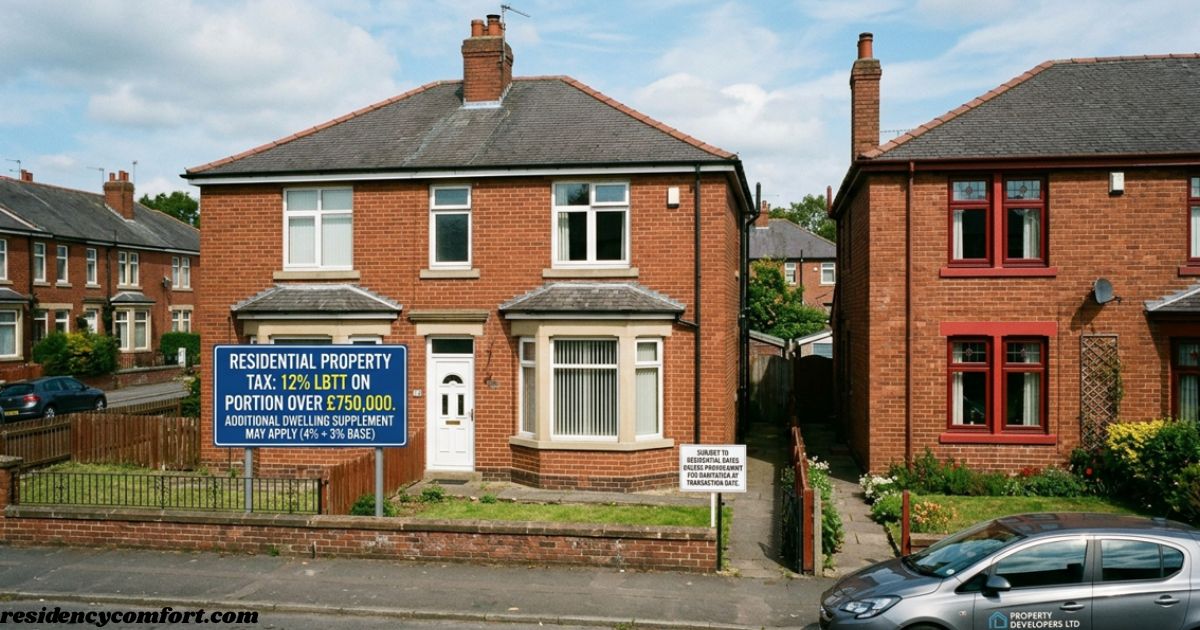
Under current LBTT rates, a commercial property sold for more than £750,000 gets taxed at 5% on the portion above that figure, but the same price tag on a home pushes the residential tax rate up to 12% instead a gap that makes the non-residential tax rate look very attractive by comparison. On top of that, since January 2019 the Additional Dwelling Supplement has added 4% on top of the usual 3% starting point, meaning additional tax often applies if the buyer’s only residential property isn’t actually the only one they own.
Tax Treatment and Legal Precedents for Residential Property Transactions
Legislation looks at the transaction date rather than former use or what the purchaser intends to do later, so a company buying a house with plans for stripping it down and converting it into a commercial premise still pays residential rates unless the developments are already finished by that point; the reverse is true too, since land bought for future housing stays under non-residential costs until building work has actually begun.
A recent case law dispute in England put this exact question to a tribunal, after tax authorities argued that a bungalow, simply because of its former use as a family home, should be taxed at residential rates. The tribunal disagreed, pointing to the condition of the building itself it had no heating system, no water pipes, and was full of asbestos and ruled that a property needs real facilities before anyone could call it fit to restore and live in.
Since this ruling only binds courts in England, the outcome for Scottish courts and tribunals remains open, though the overlap between English law and Scots law, plus the direction of Scottish government policy toward supporting developers who take on derelict buildings, suggests a similar result would likely follow north of the border. Even so, the decision leaves several questions unanswered and plenty of uncertainty for any purchaser working out their costs before signing anything.
Categorising Residential Property Types and Designs
Property law splits homes into quite a few categories, and each one comes with its own technical description. A flat counts as a self-contained premise built or adapted for living, divided horizontally from the rest of the block, and it must sit inside a building with at least two storeys, since flats depend on multiple storeys to make horizontal division possible. A maisonette takes its name from a French term meaning little house, and in Britain it usually describes a set of rooms spread across two levels with its own separate entrance, sometimes arranged as a split level layout rather than one flat floor.
The word bungalow actually comes from India and Bengal, and simply describes a low house built on one storey; the old case Ward v Paterson, decided in 1929 and recorded at 2 Ch 396, explains it further by noting that the walls, aside from any gables, should rise no higher than the ground floor, and the roof should start close to that same height a definition credited to Romer J. A chalet bungalow is a variation with extra rooms tucked into the roof, usually lit by dormer windows.
Primary Types of Residential Property Structures
Moving to bigger structures, a detached house is a stand-alone residential structure with no shared walls at all, while a semi-detached home shares one party wall with its neighbour, and the two properties often form a mirror image of each other’s layout. A link-detached home shares no direct wall either, but is usually joined to the next property by a garage instead.
Then there’s the terraced house, part of a row of houses that each keep their own frontage facing a public road; a mid terrace sits in the middle of that row, while an end of terrace sits at either end, joined to just one neighbour. A back to back property goes a step further, sharing walls at both the sides and the rear, leaving only a single external wall, or front wall, exposed at the front. Finally, a town house is simply a home spread across three floors, giving it a taller, narrower footprint than most of the other types listed here.
Comparing Residential Property vs Commercial Real Estate
Once you look past the definitions, the real-world differences between these two property types come down to purpose and use. Homes exist for individuals and families to live comfortably, while commercial buildings support business activities such as offices, retail spaces, and general industrial use. Ownership patterns differ too a family home is often owned outright by the people living in it, whereas commercial buildings tend to belong to companies or investors and get leased out under a formal tenancy arrangement.
When it comes to financing and investment, buying a home is usually simpler through traditional mortgages, and lenders generally treat it as a lower-risk investment; commercial deals, on the other hand, often involve complex financing, and while they can bring higher returns, they also carry increased risk.
Regulatory Standards and Market Dynamics for Residential Property
Regulations and maintenance obligations split along similar lines: homes must meet building codes built around safety and habitability for any residential property, while commercial buildings answer to rules covering business operations, health and safety, and accessibility for staff and visitors. Even the wider market dynamics pull in different directions residential property prices move with local housing demand, employment rates, and interest rates, whereas commercial values respond more to economic conditions, business growth, and simple location.
FAQs
1. What defines a residential property under UK law?
A residential property is any building or land used as a domestic dwelling, such as a house or flat, subject to residential Stamp Duty rates.
2. What is the majo difference among freehold and leasehold?
Freehold means owning the land and home outright forever, while leasehold grants ownership of the dwelling for a fixed term under a lease agreement.
3. What extra costs come with buying a home?
Beyond the purchase price, budget for solicitor fees, property surveys, mortgage setup fees, and Stamp Duty Land Tax.
4. How do commercial assets differ from residential homes?
Non-residential properties include offices, retail units, and warehouses, operating under different business rates and zoning laws.
5. How can buyers find affordable residential property?
Look into shared ownership, targeted fixer-uppers, or homes in up-and-coming areas to make entering the property market easier.