

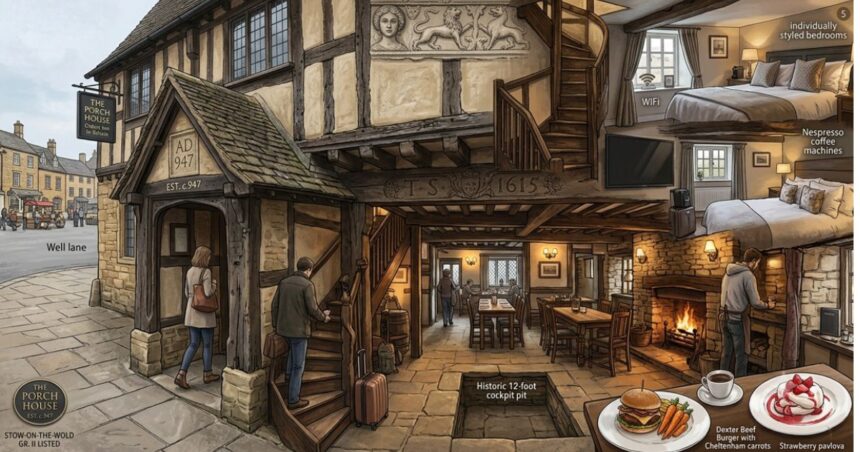
I still remember walking under the low oak beams on my recent visit to Stow-on-the-Wold, ducking my head as I stepped into a building that has stood since AD 947. The Porch House, sitting proudly on the historic market square of this highest Cotswold town, claims the title of the oldest inn in Britain, a fact even recorded in the Guinness Book of Records. Locals speak of AD 947 and 947 AD almost interchangeably, and whether the true date is 975 AD or AD 514, the sense of a long chequered history is impossible to miss.
The Historic Saxon Legacy of The Porch House
Built originally as a hospice by Saxon Duke Aethelmar, also called the Duke of Cornwall, this Grade II listed building grew out of a small Saxon community, and today its rustic atmosphere, roaring open fires, and twisting crooked staircases under low-slung ceilings still carry the weight of centuries. Even the bricks and 16th-century additions blend into what is simply known today as today’s building, once linked to the Royalist cause during troubled times.
The Ancient Origins of The Porch House
The Deep Saxon Foundations
The story of the inn does not begin and end with the Saxons. Records point to 987 A.D. and the Evesham Abbey, whose monks are believed to have used the building as a hospice, a place of protection during times when people still feared witches and evil forces. In the early 1970s, experts carbon-dated the timber used in the structure, confirming it was roughly 50 years either side of 1000 A.D., work carried out by a local carpenter named Jack James.
He examined the rear wall, where oak timbers measuring 9 inches, 5 inches, and 12 inches were fitted into a groove, with oak split laths plastered into the inside wall. Following the Dissolution of the Abbey in 1537 (some records say 1536), the property passed through many hands over 550 years, moving from a Saxon timber building into a proper stone house with a timbered roof, moulded edges, and shaped wind braces still visible in the roof space.
The Shellard Family and Centuries of Secrets at The Porch House
By 1586, the Shellard family entered the story, with Richard Shellard listed as a widow’s relation in a Will dated 3rd December 1608. His second son, Thomas Shellard II, and later Thomas Shellard III, a joiner by trade, carved his initials T.S. and the date 1615 into the property, which connects to the Shayler family name found on nearby Digbeth Street.
The elder son, John, is mentioned in records from 13th November 1630, when he was just 15 years old, and an inquisition from June 1639 and another from 1681 trace the younger brother’s claim to the estate. The building stood disused for a time, before becoming a Workhouse and House of Correction by 1712, and later, in the middle of 19th Century, it was split into two houses, one known as Holmlea. A stone canopy over the window and doorway on the western wall survived several rounds of modernisations, including work in the early 18th Century, before its conversion to hotel use in 1970.
Some historians link the site to the Knights Hospitallers, who protected travellers from evil spirits, while local legend also mentions a dog fighting pit on the grounds. During the English Civil War, 200 soldiers are said to have used the hotel, then linked with the name Eagle and Child, across the 13th century, 14th century, and 15th century, with fighting recorded as late as 1646.
The property later appears in licensed property records for 1891 and 1903, found in petty sessional divisional records, keeping alive a long-held tradition tied to Maugersbury and Stow. In 1976, a woman named Mrs Winnie Sadler found a muddy shoe, complete with a square toe dating to around 1600, hidden in a cupboard near an old fireplace, a small mystery that still delights visitors today.
The building’s five fireplaces, chimneys, and cellars were built from quarried stone, and during the 1939-45 war, the Army used the entry, bar, steps, cellar, and passage for storage. Researcher Ruth Stratton, along with historian Elizabeth Brookes, helped document how this timber-framed structure, sometimes called Tudor House, contrasts with its incongruously modern extensions added in the mid-1990s, all while under the name Athelmar or Aethemar, whose will proven dates confirm the founder’s legacy across five bays near Well Lane.
The Dark Echoes of Medieval Blood Sports
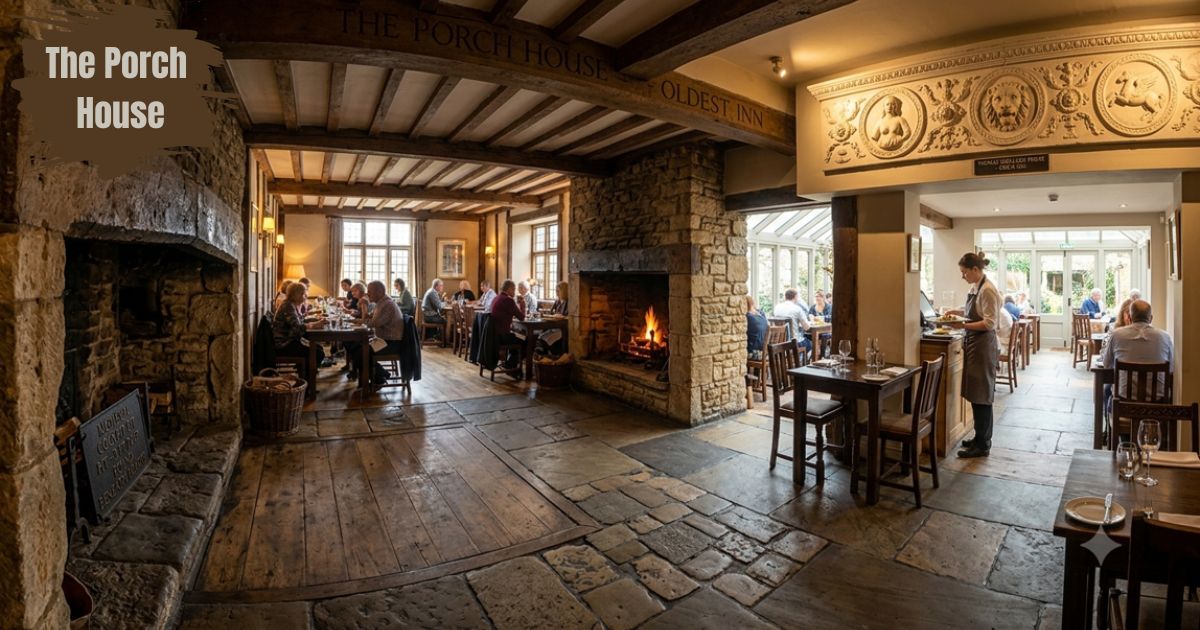
The historic dining hall inside the inn. Source The Porch House
Beneath the charm of the dining rooms lies a darker chapter. In medieval times, a twelve feet square area functioned as a cockpit, used for cockfighting, one of many blood sports practised at the inn alongside dog fighting and badger baiting. A three feet deep pit was found beneath the stone hearth, uncovered during alterations to what is now the restaurant.
The flue and corner near this space once connected to the original wooden building, long before the modern kitchen and recent extension were added. Carpenter Jack James, the same man who dated the timber, also examined this section of the medieval building, tracing its use through the inn’s 18th century and early 19th century history, when such sports were still common practice inside The Porch House.
Architectural Wonders Inside The Porch House
Upstairs, in a bedroom on the long room, a curious plaster frieze survives from the beginning of the 17th Century, believed to date to 1615 and credited to Thomas Shellard. This 17th-century artwork shows a torso, the head of a woman, and several mythical beasts, including winged horses, arranged in medallions alongside lions’ heads.
Some experts compare it to the houris frieze at nearby Chastleton House, suggesting both were cast from the same mould, possibly brought back from the crusades. Over time, alterations meant one piece removed from the design was lost when the space was divided into two rooms, though much of the original work remains carefully preserved within The Porch House for guests to admire.
Modern Comforts and Rooms at The Porch House
Guests today can choose from thirteen rooms, each offering WiFi and finished to a high standard following a sympathetically refurbished renovation completed in 2013. These thirteen individually styled bedrooms inside The Porch House include single rooms, twin rooms, and double rooms, each with a TV and a Nespresso coffee machine for quiet mornings.
Every stay includes a full cooked breakfast, a morning newspaper, and tea, coffee, and toast served in the rooms on request. Older records describe 13 en-suite rooms open to the public, while an earlier layout listed 16 bedrooms with shared basins, 8 shower units, and 5 bathrooms, plus two en-suite rooms, details that even appear in a 1974 sale listing.
Fine Dining and Local Gastronomy
The kitchen takes real pride in local produce and simple robust cooking, and having eaten there myself, I can say the award-winning restaurant lives up to its name, especially at the unmissable breakfast. Starters include pea puree, roasted sweetcorn, and blood pudding for £11, followed by mains such as chicken mushroom leek pie with crushed potatoes, glazed mixed beets, and Cheltenham carrots, or tender stem broccoli alongside the 8oz Dexter Beef Burger and chips for £15 to £16.
For dessert, the chocolate delice with pistachio crumb and candied orange, or the coconut puree, sits beside a British strawberry pavlova with Chantilly cream and strawberry puree for £6.50. Diners can enjoy the cosy authentic bars at The Porch House, complete with exposed stonewalls and log fires, whether they fancy casual dining or a proper sit-down meal, split between two buildings including a conservatory, bar area, dining room, and garden; guests simply walk in and choose a table.
Authentic Guest Experiences and Reviews
On TripAdvisor, one visitor called The Porch House a cracking place full of olde worlde charm blended smoothly with modern comforts. Reviews frequently mention warm rooms, cosy rooms, big beds, and fluffy beds, alongside excellent showers and reliable hot water. Guests praise the breakfast as fabulous, backed by excellent service that makes the stay feel like a perfect home away from home, especially for those staying two nights to visit the local heritage railway or attend the end of season gala near Hook Norton brewery.
The public rooms stay warm, well maintained, and spotless, and the bar offers a great selection of beers alongside solid restaurant food and service; one guest specifically recommended room 5 on the top floor of The Porch House for its comfortable feel, though small suitcases are advised given the flights of steep staircases and narrow staircases typical of such an old building, with soft pillows on every bed. The only common complaint concerns no parking, though street parking and a nearby car park near The Bell are just a short walk away.
The Rich Ownership Legacy of The Porch House
Current manager James Rogers previously worked at the Old Bell in Hurley, Berkshire, bringing experience to build the reputation of this five-star restaurant through a new menu of locally-sourced food and an updated wine list. The name Royalist Hotel once shared space with the Eagle and Child name and a gastro-pub identity, echoing sister properties in Henley-on-Thames under pub company Brakspear, which acquired The Porch House in July 2012.
Before that, Alan Thompson and Georgina Thompson took over in April 2000, bringing experience from their 755 Restaurant on Fulham Road in London, and launching a full renovation and refurbishment programme that saw the property reopened in September 2000 as a 12-bedroom hotel with restaurant, newly branded 947 AD, with an adjacent pub called Tavern as homage to the site’s 18th century roots; the eagle, child, and nest even formed the new logo. The property was sold in 2004 for £1.8m to Cheltenham-based restauranteur Peter Rowan, who transformed a building closed 16 years while its previous chef Alan worked in Australia.
Modern Value and News Archives of The Porch House
It went back on market within five months, finding new ownership at £1.85 million, around the same time the Raleigh’s Cross Inn in Exmoor National Park, Devon, saw its own 2013 revamp. Journalist Michael Young, writing for the Gloucestershire Echo, described the historic hotel’s new name as bringing new jobs, roughly 25 jobs, to the area. He traced the medieval timber frame of The Porch House back to 949AD as a grade-two listed building on Digbeth Street, where the TS 1615 inscription and a nearby mention of Thomas Shepam as benefactor still puzzle local historians.
FAQs
Is The Porch House haunted?
Yes, The Porch House is rumored to host paranormal activity. Legends tell of spectral guests in Room 5, and historic witch marks are carved into the fireplace to ward off ghosts.
What is the restaurant at The Porch House like?
The restaurant at The Porch House features a cozy dining room filled with historic charm and a roaring fire, creating a warm, deeply welcoming ambiance.
What is on The Porch House menu?
The menu at The Porch House offers comforting British gastropub dishes made with locally sourced, seasonal ingredients, from hearty fish pie to elegant culinary creations.
What do guest reviews say about The Porch House?
Reviews for The Porch House are filled with glowing testimonials praising the exceptional hospitality, cleanliness, and cozy, comfortable rooms.
Is there parking at The Porch House?
There is no on-site car park due to the building’s ancient history, but guests visiting The Porch House can easily find public street parking nearby for a stress-free arrival.