

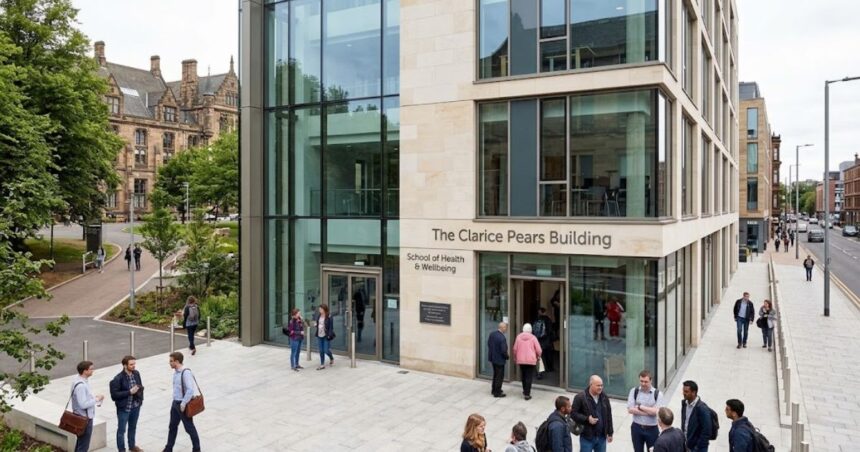
The Clarice Pears building in Glasgow began as a family gesture. The Pears Foundation chose to announce a grant of £5 million, a generous donation toward the construction of a new building for the University of Glasgow that would house the Institute of Health and Wellbeing and cost around £40 million in total. The brothers Mark, Trevor and David named it after their mother, Clarice Pears, who was born and raised in the city.
The Clarice Pears Building A New Era for Health & Wellbeing
Years later, the School of Health & Wellbeing moved into its new home at the Clarice Pears building, and the university officially opened it. Staff arrived from ten different places, or ten separate locations, and now share a single centre. This multidisciplinary centre in the Clarice Pears building on the Gilmorehill campus gives their research one base, and it aims to improve health and cut health inequalities.
1. Pears Foundation Donation and Funding
The Pears Foundation donated £5 million, and that grant became a key part of the funding for the construction. The expected cost of the new building ran in excess of £40 million, so the gift mattered a lot. The foundation’s three founders and trustees supported the plan because the donation would help house the Institute of Health and Wellbeing at the University of Glasgow, in a place named after their mother, Clarice Pears.
2. Building Name and Dedication (Why It Is Named After Clarice Pears)
A dedication like this carries real feeling. Mark, Trevor and David are the three founders and trustees of the Pears Foundation, and they named the building for their mother, Clarice Pears. She was born and raised in Glasgow, so the city holds a special place in the family story.
3. Purpose and Research Focus
The Clarice Pears Building gives researchers one place to do world-leading research instead of scattering across ten locations. Academics at the School once worked apart, and the single centre now helps them improve health and fight health inequalities. The Institute and its partners also build stronger research collaborations and engagement at local, national and global levels.
The experts inside cover public health, primary care, health economics, mental health, social sciences, clinical trials and health data science. The building lifts the School’s capacity for postgraduate taught and research study, which raises its profile across the sector. That stronger profile helps with the attraction and retention of high-calibre staff.
4. Location and Campus
The Clarice Pears building sits in the West End of Glasgow, adjacent to busy Byres Road. If you stroll along that street, you will pass the site of the former Western Infirmary, a place with a long health story. The University of Glasgow placed this multidisciplinary centre on its Gilmorehill campus as part of a £1 billion campus development programme, and the University keeps growing around it.
5. Collaboration and Partnerships
Good ideas rarely grow in isolation, and the Clarice Pears Building reflects that. Researchers meet through planned collaboration and informal collaboration, using shared social spaces and academic spaces that make chance chats easy. The calendar fills with joint seminars, workshops and knowledge-exchange sessions that feed research collaborations.
The building also gives the Institute and its partners a base for partnership working with external organisations, such as the NHS, government, the voluntary sector, industry, the private sector and other public sector bodies. This mix supports the translation of research into policy and practice, which creates real-world health impact. It also strengthens engagement at local, national and global levels as teams tackle health inequalities together.
6. Public Access and Community Engagement
The ground floor of the building is publicly accessible, so neighbours can walk in and look around. Residents can use the spaces for community meetings, and visitors can browse exhibition facilities that show what the teams study. These features boost public engagement, deepen wider engagement with science and support widening participation.
7. Quotes and Statements
Sir Trevor Pears called it a privilege to give his mother, Clarice Pears, her name on a fantastic building, because she felt deep pride in her Scottish roots. He also saw real resonance between the Institute of Health and Wellbeing and the family’s philanthropic goals. In his view the work stays applied and practical, and he hopes it keeps going from strength to strength.
Professor Jill Pell, the Head of the School of Health & Wellbeing at the University of Glasgow, felt delighted when her team could officially open the Clarice Pears building. She said the School has always faced the greatest challenges in society, across the UK and the world, and the new space helps staff tackle disease, improve health, boost wellbeing and reduce inequalities globally. She thanked the donors, above all the Pears Foundation and the Medical Research Council, whose generous support helps change lives through new research.
Mark Pears, a Trustee of the Pears Foundation, said he felt tremendously proud to officially open a building that carries the name of his mother. He explained that the School’s mission matches the foundation’s push to tackle issues that touch communities around the world. He plans to keep working closely with the university over the coming years.
Susan Simon, Director of Capital and Estates at the Medical Research Council, explained that the building shelters different groups of researchers and scientists who share one common goal: better human health, seen through different lenses than in other Institutes and Units. She noted that the design pushes interaction and collaboration, and that its position adjacent to other research facilities promises exciting new research. The MRC feels proud to play a part in this world-leading facility, and she expects the MRC/CSO Social and Public Health Sciences Unit to thrive in its new environment.

The Clarice Pears Building History and Legacy
The story behind the name goes back to 1933, when Clarice Pears was born. She grew up in a tenement flat on Lochside Street in Shawlands. Her parents, Abraham and Hannah Castle, raised her there, and her father worked in an electrical retail shop.
The Pears Foundation made its announcement on 21 November 2018, and the grant set the Clarice Pears building in motion. Almost five years later, the University of Glasgow officially opened the Clarice Pears building on Tuesday 12 September 2023, and the foundation shared the news on 13 September 2023. The School of Health & Wellbeing now calls the place its new home.
Research Themes at the Clarice Pears Building
Inside the Clarice Pears building, the School organises its work around three multidisciplinary research themes. One covers health determinants and inequalities, another uses data science and big-data analysis, and the third offers solutions-focused research that tests evidence-based interventions.
Frequently Asked Questions
Q1: Where is the Clarice Pears building located?
A: It is located at 90 Byres Road, Glasgow (G12 8TB), on the University of Glasgow’s Gilmorehill campus.
Q2: What is housed inside the facility?
A: It houses the University of Glasgow’s School of Health and Wellbeing, featuring research hubs, teaching spaces, and the public Byres Community Hub.
Q3: Are dogs allowed inside?
A: Yes, dogs are allowed on Level 1 in the main exhibition area on a non-extendable lead. Assistance dogs are permitted throughout.
Q4: Can public or community groups book meeting rooms here?
A: Yes, community groups can reserve event and meeting spaces through the Byres Community Hub on Level 1.
Q5: What are the general opening hours for the Clarice Pears building?
A: The building’s public and hub facilities are typically open Monday through Friday, from 8:00 AM to 5:00 PM.