

The best commercial roofing contractor in Detroit holds a license, carries insurance, and matches the roof system to your building. This guide compares each commercial roofing company across Metro Detroit and Southeast Michigan. It also summarizes what six contractor websites say about services.
What Is Commercial Roofing and Who Needs It?
Commercial roofing covers the installation, repair, and upkeep of roofs on non-residential buildings, mostly flat roofs and low-slope roofs. Offices and factories depend on it. A commercial roof system works in layers, so each layer affects the whole assembly’s lifespan.
Commercial and industrial roofing differs from home roofing in scale and materials. Ruff Roofers, a Maryland firm, sorts its gallery by roof type, including green roof projects. Detroit owners should expect that clarity from any commercial roofing contractor.
How Do You Choose a Commercial Roofing Contractor in Detroit?
Choose a contractor by checking credentials, roof system experience, service range, warranty terms, and references, in that order. A firm that fails the first check rarely improves on the others. Write down each answer so you can compare three bids.
Ask for a licensed, bonded and insured crew. Ask how many flat roof experts work in the Detroit office. Call references with similar buildings, because a school roof teaches little about a cold storage facility.
What Credentials Should a Roofing Contractor Show?
A credible contractor shows a state license, proof of insurance, and at least one trade or manufacturer credential you can verify. Examples on the six sites include NRCA membership, a BBB accredited listing, and manufacturer awards. Check each badge with the issuer.
Schena Roofing displays a GAF Master Commercial Roofing Contractor award and a Certified Environmentally Responsible Contractor badge. Paramount Roofing calls itself BBB accredited. Paramount’s roundup says Bruttell Roofing holds Duro-Last Elite Contractor status.
Which Roofing Systems Should a Detroit Contractor Install?
A Detroit contractor should install the main membrane families: TPO (thermoplastic polyolefin), PVC (polyvinyl chloride), EPDM (rubber roof), modified bitumen, and built-up roof (BUR) assemblies. Each suits a different budget and traffic level. Ask which system fits your deck best.
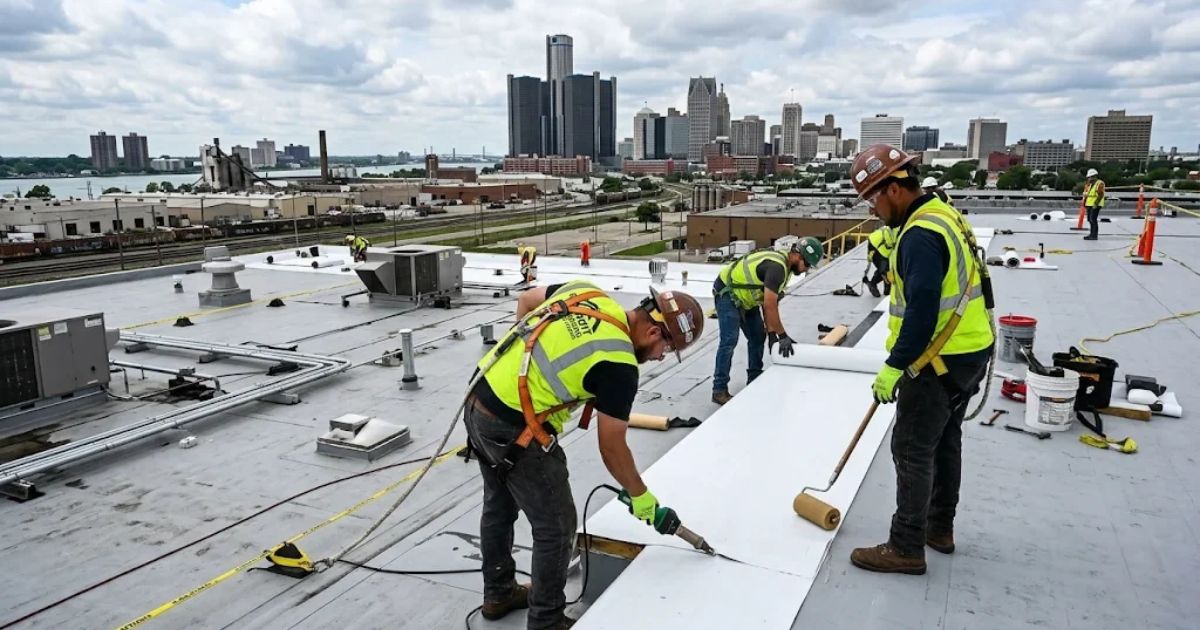
Crews install each single-ply membrane fully adhered or mechanically attached. Torch-down roofing joins SBS-modified sheets with heat-welded seams, while a tar and gravel roof layers asphalt, felt, and stone. RestoreMasters says TPO commonly runs 40 to 80 mils thick.
Which Services Should One Contractor Cover?
One contractor should cover roof inspection, roof repair, roof replacement, and preventive maintenance, so a single team owns the roof’s full history. Splitting those jobs across several vendors scatters records. Ask each firm to list its services clearly in writing.
Look for new construction roofing, roof installation, reroofing, a roof recover, and tear-off. Confirm emergency roof repair and 24/7 emergency service, because leaks ignore business hours. Ask for a roof maintenance program and a written roof warranty.
What Do Six Contractor Websites Say About Services?
Six contractor websites state their services in different levels of detail, and each brand offers the services listed on its own website. This guide repeats only what those pages confirm. Call the firm to confirm current offerings before you sign anything.
We read each page like a facility manager, comparing commercial roofing services line by line. Menu-only entries got extra scrutiny. The groups follow our source order.
What Do Ruff Roofers and Simon Roofing Offer?
Ruff Roofers lists commercial and residential installation, maintenance, and repair, while Simon Roofing lists repairs, restorations, replacements, and inspections. Ruff Roofers serves Maryland, so Detroit buyers can treat it as a model for clear galleries. Simon Roofing publishes a dedicated Detroit page.
Simon Roofing names emergency roof leak repair, preventive maintenance, laboratory testing, and roof asset management. Its Detroit page puts roof restoration first, describes a layover, and treats replacement as a last resort. It also lists a roof repair warranty.
What Do Paramount Roofing and CentiMark Offer?
Paramount Roofing says it specializes in EPDM, TPO, PVC, and modified bitumen roofing, and it offers commercial roof repair, replacement, and maintenance. CentiMark lists inspections, reroofing, new construction, repairs, and maintenance programs. Both firms serve the Detroit area from Michigan.
CentiMark adds 24-hour emergency roof repair, roof cleaning, rooftop snow removal, spray polyurethane foam (SPF), and a single-source warranty. Its green options include cool roof, daylighting, photovoltaic roofing, and garden roof designs. Paramount’s menu lists roof tarping and ice dam removal under storm damage.
What Do Schena Roofing and RestoreMasters Offer?
Schena Roofing lists inspections, leak repair, maintenance, flat roof repair and replacement, new construction, and sheet metal roofing. RestoreMasters lists emergency roofing, repair, maintenance, and replacement across many roof types. Schena Roofing works from Chesterfield, and RestoreMasters keeps a downtown Detroit office.
Schena Roofing lists roof coating systems, tear-off and recover, roof warranty services, and a customer portal. It adds architectural sheet metal, metal wall panels, copper roofing, slate roofing, tile roofing, and cedar roofing. RestoreMasters lists shrink wrap roofing, insurance claims assistance, a complimentary roof inspection, and tapered insulation with R-value.
What Problems Does Michigan Weather Cause on Commercial Roofs?
Michigan weather attacks commercial roofs through winter snow loads, ice dams, temperature extremes, wind, hail, and moisture. CentiMark’s page lists those stressors and counters ice dams with roof ventilation, heat cables, and snow guards. Name the stressor first, then choose the repair.
Freezing and thawing makes the roof membrane expand and contract, which starts roof leaks. Ice dams cause water intrusion into the roof deck and moisture and mold. Hail damage and wind damage then demand prompt storm damage repair.
Which Defects Should Inspectors Find First?
Inspectors should find ponding water, flashing leaks, roof punctures, blistering, and membrane failure first, because these defects signal coming leaks. RestoreMasters lists several of them as problems it solves. Photograph each defect so you can track changes between later visits.
Heat shrinkage, UV degradation, and corrosion age a roof quietly. Improper installation and inadequate maintenance appear on CentiMark’s damage list and cause premature roof replacement. Curb and penetration leaks threaten HVAC curbs, roof penetrations, and flashing.
How Often Should You Inspect a Commercial Roof?
Inspect a commercial roof twice a year, in spring and fall, and again after any major storm. The NRCA recommends this rhythm, and it catches problems before winter loads arrive. A written checklist keeps each visit consistent and easy to compare.
A roof maintenance program should include roof cleaning, drain and scupper cleaning, and curb reflashing, since clogged roof drains and scuppers cause ponding. Crews should bring photo documentation and use drone inspection. CentiMark offers a spring maintenance checklist, online roof evaluation tools, and digital roof management articles.
How Much Does Commercial Roofing Cost in Detroit?
Commercial roofing cost depends on roof area, system type, deck condition, insulation, access, and weather, so no honest flat price exists. None of the six websites publishes a price list. Request itemized bids that show materials, labor, and disposal separately.
Simon Roofing says restorations often cost 50 to 75 percent less than replacement, and Paramount Roofing warns that prices shift with local labor and materials. Treat both as starting points. RestoreMasters lists CapEx planning assistance.
Which Building Types and Detroit Suburbs Do Contractors Serve?
Contractors serve warehouses, manufacturing facilities, healthcare facilities, schools, municipal buildings, retail centers, hospitality sites, and property management portfolios. Ask for projects that match your building type and roof size. Specific references beat generic claims in every single bid you review.
Schena Roofing names Dearborn, Livonia, Warren, Sterling Heights, Ann Arbor, and Downriver, while Simon Roofing names Troy, Southfield, and Novi. Schena Roofing also lists historical preservation. Confirm coverage by phone.
How Do Safety and Sustainability Affect Your Choice?
Safety and sustainability affect cost, schedule, and liability, so ask about both before signing any contract. A contractor with written safety procedures protects your tenants and your insurance record. A sustainable roofing plan can also cut waste and energy use.
CentiMark publishes a roof safety resource. Schena Roofing lists energy-efficient roofing, and Simon Roofing says its reflective coatings lead to lower HVAC usage and reduced landfill waste. Put these claims in writing.
Why Do Manufacturer Relationships Matter?
Manufacturer relationships matter because the membrane maker often backs the roof warranty and trains the installing crew. Ask which manufacturers a contractor installs and whether its certifications remain current for your roof. Firestone, Carlisle SynTec, and Versico all make membrane systems.
Schena Roofing displays partners including Carlisle SynTec, GAF, Garland, Johns Manville, Siplast, Tremco, and Versico. RestoreMasters lists Owens Corning, CertainTeed, GAF, and Versico among its preferred brands. Paramount’s roundup adds that Bruttell Roofing installs Firestone products.
Why Use Our Site to Find a Commercial Roofing Contractor?
Our site gathers contractor details, roof system definitions, and service lists in one place, so you compare options without opening dozens of tabs. We record only what each contractor’s website states. You then call the firms that match your building.
Each profile points back to the contractor’s own website, where you can verify current services yourself. Verification stays quick and simple. Build a shortlist here, then request three bids.
FAQs
How Long Does a New Commercial Roof Take?
A new commercial roof takes several days to multiple weeks, according to CentiMark’s Detroit page. Building size, roof system, and weather drive that range. Ask your contractor for a written schedule that names weather delays, crew size, and daily cleanup.
Can a Coating Replace a Full Roof Replacement?
Yes, if the roof remains structurally sound. RestoreMasters lists silicone coating and acrylic coating options for roofs that leak from corrosion, age, or UV degradation. A written roof evaluation confirms whether your deck and insulation qualify, and records current conditions.
Do Contractors Install Metal Roofs?
Many contractors do, but not all of them. RestoreMasters lists a standing seam metal roof, stone-coated steel, and asphalt shingles among its systems, while Schena Roofing lists sheet metal roofing. Check each contractor’s list before you assume it installs your preferred material.
Where Should You Start Your Commercial Roofing Search?
Start with your roof’s age, system type, and leak history, then use our site to find a Detroit commercial roofing contractor that matches. Compare credentials, services, and warranties and confirm each detail on the contractor’s own website. Visit our commercial roofing pages to build your shortlist.