
The Lauriston Building stands at the center of a strange feeling where two timelines sit on top of each other as you walk down Lauriston Place in Edinburgh today. On one side stands the memory of a Victorian hospital complex, raised by architect David Bryce and opened in 1879, a landmark that served the city for over a century before it relocated in 2003.
The Modern Impact on the Lauriston Building
Around it, the wider Lauriston district grew into a home for charitable institutions and educational institutions, including George Watson’s Hospital, the Merchant Maiden Hospital, the Simpson Memorial Hospital, plus assorted schools and churches. On the other side of that timeline sits a much newer worry regarding the structural integrity of local healthcare infrastructure.
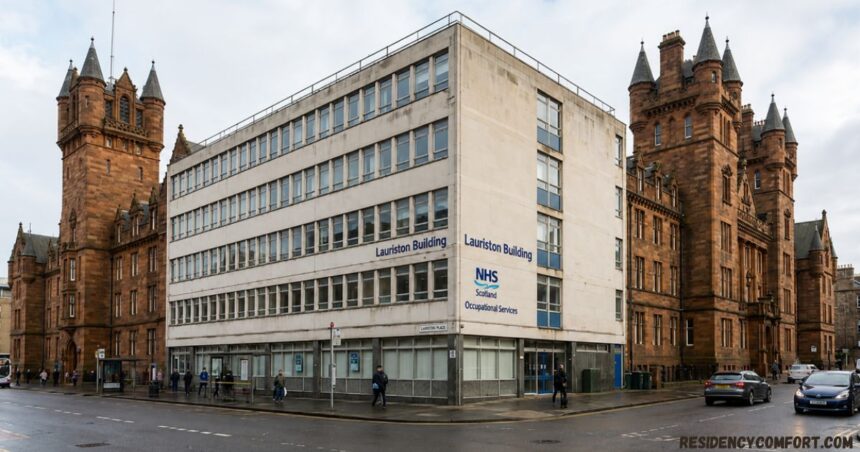
The modern Lauriston Building now usually points to a contemporary NHS facility standing near the former Royal Infirmary site, part of the wider NHS Lothian network. This modern health hub has come under the spotlight because of RAAC, short for Reinforced Autoclaved Aerated Concrete, an unsafe material now tying the structure to a genuine risk of closure. This construction material, once common, is now the subject that connects the old Royal Infirmary story to the present day
.History of the Old Royal Infirmary at Lauriston Place
Architectural Grandeur of the Original Site
David Bryce drew up the plans for the Royal Infirmary, and the foundation stone went in on 29 October 1879, laid earlier in October 1870 by the Prince of Wales. In its day, people called it one of the best-planned hospitals in Britain, built in the Scottish baronial style with an octagonal spire rising 134 feet, corbelled turrets echoing Holyrood and Falkland palaces, and a frontage stretching 480 feet along Lauriston Place.
Inside sat a surgical hospital and a medical hospital, along with wards, an operating theatre built for 500 students, a pathology department, a lecture theatre, a mortuary, laundry facilities, and a superintendent residence, all designed around the pavilion system for better isolation and air circulation.
Royal Inspections and the Quartermile Redevelopment
Queen Victoria herself inspected the site in 1881, and the grounds, once belonging to George Watson’s Hospital, could hold around 600 patients, well above the daily average the old NHS predecessor managed. Today the old grounds have been redeveloped as the Quartermile project, and part of that same ground now houses the University of Edinburgh’s Futures Institute. Architect David Bryce led the project from the drawing board, shaping the hospital’s grand design, while his nephew and partner, John Bryce, then carried the plans through to completion, seeing the work finished after Bryce’s death.
The Lauriston Building Today NHS RAAC Concrete Risk
Structural Challenges for the Lauriston Building
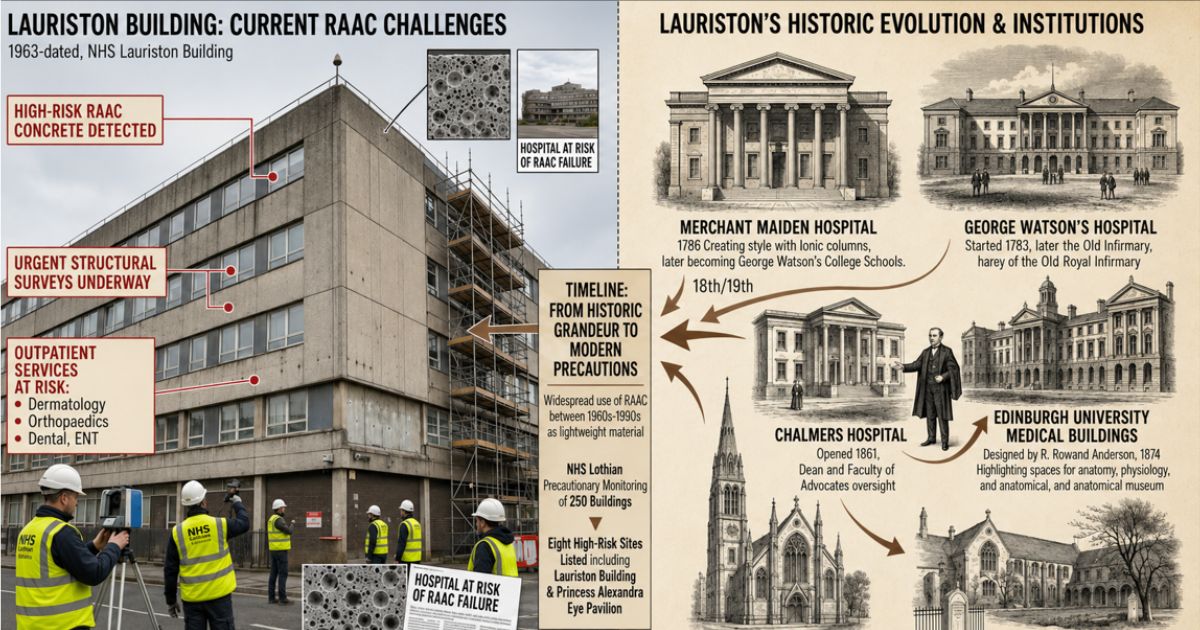
Between the 1960s and 1990s, builders across Britain used RAAC, a lightweight material and cheaper alternative to standard concrete, in roofs, walls, and floors. NHS Lothian now lists the Lauriston Building among eight high-risk sites, dating from 1963, still busy with outpatient services like dermatology, orthopaedics, dental services, and ear, nose, and throat care for thousands of patients every year. Fears grew after a school roof collapse in England, which pushed pupils at two Edinburgh schools into portable classrooms as a safety step.
Regional Precautionary Measures and NHS Surveys
Officials count 250 buildings as possibly affected, split into eight high-risk sites, 27 medium risk, and 12 low risk, and the list of high-risk spots stretches from Bonnyrigg Health Centre to Stoneyburn Health Centre, Tranent Medical Practice, Western General Hospital’s gas store, the link corridor and X-Ray area plus the Cullen/Rivers Centre extension at Royal Edinburgh Hospital, and the Princess Alexandra Eye Pavilion, itself dated to 1969 and already ruled no longer fit for purpose, with a replacement not due until late 2027, near Little France.
Surveys run by an independent contractor working with NHS Assure should confirm the structural health of the Lauriston Building, though most were set for November and December, prompting NHS Lothian to push for an accelerated timetable from both the contractor and NHS Scotland. Closure, whether full or through temporary structural supports, threatens to stretch already long waiting lists and waiting times even further, a point Edinburgh Western MSP Alex Cole-Hamilton of the Scottish Liberal Democrats has raised, calling on the Scottish Government for funding toward remedial works.
Deputy chief executive Jim Crombie has stressed the process stays precautionary, backed by an ongoing maintenance programme and monitoring, and not a response to any confirmed fault.
Other Historic Lauriston-Area Institutions
Evolution of George Watson’s and the Merchant Maiden Hospital
George Watson’s Hospital owes its existence to George Watson, a merchant whose bequest of £12,000 in 1723 paid for a home for decayed merchants’ sons, with the first twelve boys admitted in 1741 and sixty pupils enrolled soon after. Building work started in 1738 on land from Heriot’s Trust, and by 1870 the site had become Watson’s Merchant Academy, a day school, with the older building sold to the Corporation of the Royal Infirmary. Nearby stood the Edinburgh Royal Maternity and Simpson Memorial Hospital, named for Sir James Y. Simpson, built in 1878 at Lauriston Park, and the Sick Children’s Hospital charity at Meadow-side House on Lauriston Lane.
The Merchant Maiden Hospital, tracing back to a bequest by Mary Erskine under an Act of Parliament from 1702, moved into a new Grecian style building in 1816, designed by Mr. Burn with Ionic columns modelled on an Athens temple, costing about £9,000 and housing 80 girls by the time it opened in 1819. By 1871 the girls moved elsewhere, and the building became George Watson’s College Schools, teaching boys classics, modern languages, and sciences, with bursaries and foundationers supported by a committee of ladies.
Just along the road, Chalmers Hospital, funded by a plumber’s £30,000 bequest in 1836, opened in 1861 and treated 180 in-patients and 2,500 out-patients yearly under the Dean and Faculty of Advocates.
Faith, Learning, and University Expansions
Faith and learning both left their mark on the district too. The Gothic style Lauriston Place United Presbyterian Church rose on Portland Place in 1859, the same year a widow, Colonel Hutchison, built St. Catharine’s Convent in Lauriston Gardens in collegiate style, honouring St. Catharine of Sienna, with a thorn tree marking her grave. Meanwhile, from 1874, R. Rowand Anderson designed the Edinburgh University Medical Bu
ildings on Park Place and Teviot Row at a cost near £250,000, covering anatomy, physiology, surgery, chemistry, a portico, an anatomical museum, plus space for the University Library, medical faculty, governors, medical staff, general education, construction, maintenance, and even degree ceremonies.
Defining the Modern Lauriston Building
Historical Versus Modern Identity of the Lauriston Building
The answer changes depending on the era you mean. Historically, people used the term for the whole area around Lauriston Place, home to the old Royal Infirmary and a cluster of charitable institutions and educational institutions. Near the old Royal Infirmary site today, though, the Lauriston Building usually refers to an outpatient facility run by NHS Lothian. Every year, the Lauriston Building sees thousands of patients through its doors for outpatient clinics, running annually without pause. Patients come to the Lauriston Building for specialist dermatology, orthopaedics, and dental services, alongside general ear, nose, and throat care.
Structural Safety Realities of the Lauriston Building
Between the 1960s and 1990s, builders across the country turned to RAAC, or Reinforced Autoclaved Aerated Concrete, a lightweight material prized for being a cheap option during construction. The trouble is that RAAC can fail without warning, which is why NHS Lothian marked the modern Lauriston Building as one of eight NHS Lothian buildings under high risk of RAAC, and therefore under a genuine risk of closure. The old Royal Infirmary left its original site on Lauriston Place and relocated to Little France in 2003, transitioning the healthcare footprint away from the historic core, but leaving this modern outpatient facility behind to handle local care.
Frequently Asked Questions
What is the exact address of the Lauriston Building?
The building is located in the heart of the city at Lauriston Place, Edinburgh, EH3 9EN. It is situated close to The Meadows public park and the historic Quartermile area.
Is there parking available on-site for patients?
On-site vehicle parking is extremely limited at this location. Visitors are highly encouraged to use public transport (several local bus routes drop off right outside) or look for nearby paid street parking and local car parks.
How do I contact the Lauriston Building to confirm my appointment?
You can reach the central NHS Lothian switchboard by dialing 0131 536 1000. Simply let the operator know which specific department or outpatient clinic you are trying to contact.
Does the Lauriston Building provide dental and pharmacy services?
Yes, the building accommodates the Edinburgh Dental Institute for specialized oral care. While a primary pharmacy dispensary is located adjacent to the building at the Chalmers Dental Centre, there are also multiple independent chemists just a short walk away on the main street.
What other medical clinics operate inside the facility?
Beyond dental services, the Lauriston Building is a dedicated outpatient hub primarily hosting specialized clinics for Dermatology, Ear, Nose, and Throat (ENT), and Orthopaedics.