

My passion for train games goes back decades, well before I’d ever come across Terminus, and that history still colors how I evaluate any new release. The genre’s roots stretch back to 1829, the original 18xx title, put out by Francis Tresham in 1974, which gave players a way to connect locations with track long before anyone imagined taking that concept underground. The modern board game Terminus turns that old formula on its head by having players engineer a subway network for a nameless city. Debut designers Earl Aspiras and Tom Volpe built it for Inside Up Games, the studio also known for Earth. It’s a competitive, heavy action-selection game where winning terminus builds come down to sharp planning. My first impressions, which I’ve shared publicly, are strongly favorable thanks to the game’s clever twists.
The Dual Worlds of Digital Campaigns and Physical Terminus Builds
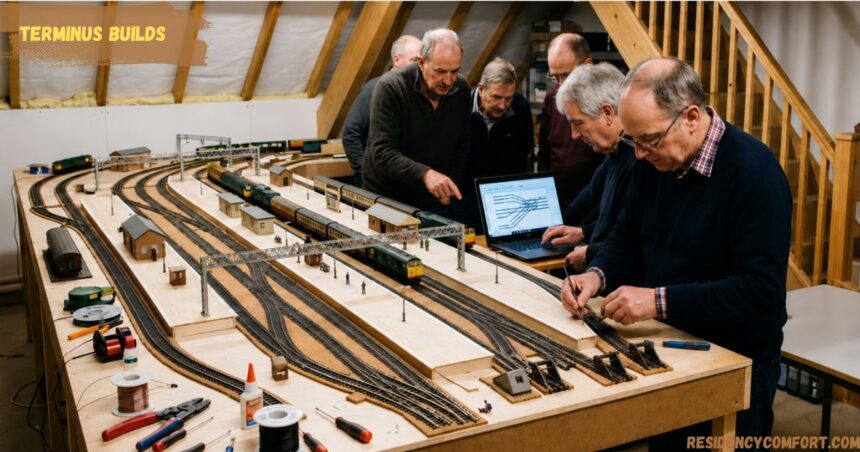
Around that same period, I came across a completely different terminus story on a hobbyist forum. A modeller, 59 and approaching retirement, was sketching out a physical terminus layout alongside a friend named Martin, basing it on a two-decade-old CJ Freezer design and bringing it to life with Templot software. With the kids grown and gone, he now had a loft above a double garage free to use complete with stairs, heat, and lighting perfect for a multi-level 00 gauge layout inside an 18-foot square room.
At the same time, an entirely separate digital project was getting off the ground elsewhere. A real-time city-building game also called Terminus returned to Kickstarter after a prior Indiegogo campaign had failed back in January. Built by studio Harbourgames, this digital effort came with new funding targets, backer updates, and actual gameplay footage demonstrating how its own version of terminus building works. The game’s premise: humanity fleeing a dying Earth aboard a colonization ship, racing the solar system’s collapse to avoid extinction.
Mechanics of Board Game Terminus Builds
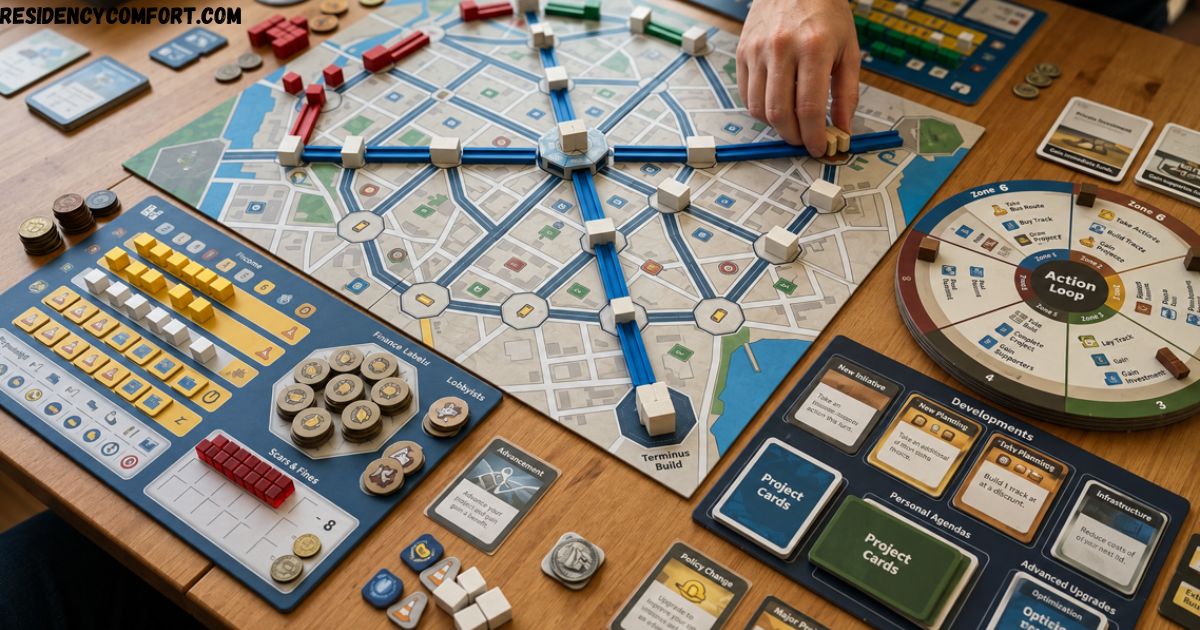
Each game year, my income comes from several combined sources, and figuring out how to manage it well transformed my whole approach to the game. Money comes in based on the number of stations I’ve placed on my player board, and each round I also select one bonus from a shared pool covering Construction, Blueprint, Power, and Permit resources on top of being able to call on any of my 8 lobbyists for a boost. My player board organizes everything using octagonal spaces.
Turn order becomes especially important in years 2 and 3, when sitting in reverse order means starting each round with 12 coins. Placing my first station on an open plot establishes my initial hub, linked to nearby plots, and from there I manage four resources Permits, Blueprints, Power, and Construction each represented by its own icon, like the traffic cone or the folder. Every income stream ties directly back into my cash reserves, so smart terminus builds depend on tight cash flow management early on. Storage remains limited throughout, though, so boosting capacity early on matters just as much as defending that first station among the full pool of 12 available stations.
Terminus Builds in Board Game Strategy Navigating the Rondel
Taking Actions on the Rondel With 13 possible actions spread across 6 Zones, the Action Loop eally a rondel in disguise governs what I’m able to do on my turn. I spend coins to purchase resources like Permits, Blueprints, Power, and Construction from a closed economy, keeping a close eye on my storage, which caps out at just 8 items shown as cube icons on my board. Beyond purchasing, I can also acquire Track and Stations from my personal supply, expand my capacity, and then actually Build Track and Build Stations on any open plot.
Strict placement rules apply whether I’m claiming fresh territory or connecting to an opponent’s station in exchange for a Power token and 1 coin. The terminus rule enforces a strictly linear track with no branching allowed, keeping every terminus build honest. Building extra power means pursuing Developments from a pool of 15 randomly drawn tiles, stationing lobbyists near a relevant block, or committing to Advanced Upgrades, limited to two per game out of six available options.
Higher-tier Standard Upgrades open up hub construction, while Projects (drawn from 4 Project cards), personal Agendas, and district-specific Demands all contribute to endgame scoring and final victory points particularly once Hubs start stacking up and I’m leveraging connection rules alongside resource substitution or bonus actions to generate more income.
Critiques and Impressions of Terminus Builds
Nothing released since 2024 began has captured my attention quite like this game has, and that’s coming from someone who’s taught plenty of dense, complicated titles to nervous newcomers. The rules teach quickly despite their depth, the clever mechanical touches genuinely reward forward planning, and watching everyone’s terminus builds take shape at the table is deeply satisfying.
Keeping a flexible mindset around the Action Loop and its rondel keeps all 9 orbits feeling genuinely tense, particularly as money, cash flow, and that tight 8-item storage cap collide with a stretched roster of 8 lobbyists.
Deciding which Developments and Standard Upgrades to prioritize is what drives the game’s long-term replay value, since the combination of Projects and Agendas never repeats the same way twice. That said, the sheer volume can be a lot for newer players confronting all 15 Developments simultaneously juggling complex terminus builds genuinely takes practice to master.
Player Interaction and Component Quality
Interaction at the table has that classic Euro feel non-destructive, built around contested resource tokens, with competitive track-laying and station-building that still spills into engaging back-and-forth play. I’ve had the most fun with 4 players, since the pace tightens up nicely, though 5 players still delivers a satisfyingly meaty experience.
At 3 players the board opens up more, and both the built-in solo mode and 2-player variant rely on a well-designed Automa opponent, with sessions running roughly 45 minutes per player. The components hold up well too crisp artwork, substantial resource tokens, and iconography that’s clear enough once you get comfortable referencing the Development tiles appendix. The board itself stays reasonably compact for the terminus builds it supports, though the rulebook stumbles by dumping confusing Key Concepts on readers before the actual teaching even begins a rare misstep from designers working on their first release.
Criticisms of Board Game Terminus Builds
Not everyone at my table shared my enthusiasm, and that pushback deserves airtime too. Simon Neale wasn’t a fan of the action rondel at all, arguing the resources players actually need tend to surface too late in the cycle, pushing people toward upgrades some quite swingy just to smooth out their terminus builds. Alan H. took a softer stance, sticking to core concepts straight from the rulebook across multiple 3- and 4-player sessions. He joked that owning a second copy of the rules would make that first teach go faster, and he called out the 8-space storage limit specifically as the rule with the most hidden influence over how developments, rail lines, track, and terminus builds ultimately come together.
Final Comparisons and Reflections Ben B. drew comparisons to Nucleum, still his favorite heavier title, but even he came away impressed by how the rail networks evolve over a single play. Simon W. was a fan of the flexible rondel and its storage-management puzzle, describing the overall experience as wonderfully puzzly.
He noted strong variability across the development and project tiles, placing it among his top two games of 2024 for high-strategy tabletop design. Fraser offered a lighter take, admitting the name briefly had him thinking of the Foundation universe and feeling a flicker of disappointment once he realized these terminus builds had nothing to do with deep-space sci-fi.
Maximizing Replay Value in Terminus Builds
Winning consistently means looking past your immediate turn to plan how your final rail network will mesh with the city’s evolving demands. Because the game runs on a closed economy, the rhythm of buying and building shifts noticeably depending on player count. Working the rondel efficiently while managing a tight storage cap ensures no two terminus builds ever feel quite the same cementing its place as a standout in the puzzle-strategy space.
FAQs
Q1: What are Terminus Builds, and how do they streamline the construction process?
Terminus Builds refer to pre-planned, modular, or specialized construction frameworks designed to simplify project execution. They combine standardized structural designs, efficient material sourcing, and streamlined assembly steps to accelerate timelines, reduce costs, and maintain high quality control.
Q2: What types of projects benefit most from this type of build process?
Modular and pre-planned structural systems work exceptionally well for commercial developments, multi-family residential units, retail spaces, and infrastructure expansions where speed, precision, and repeatable quality are essential.
Q3: How do pre-planned builds manage cost efficiency and budgeting?
By standardizing components and locking in material specifications upfront, these systems minimize unexpected change orders, reduce material waste, and cut down on labor hours required on-site, offering predictable cost estimates throughout the project lifecycle.
Q4: Can these modular designs be customized for specific site needs?
Yes. While the core frameworks follow precise engineering standards, exterior finishes, interior layouts, and energy efficiency upgrades can be adapted to align with regional building codes, site conditions, and aesthetic requirements.
Q5: How do I get started with custom planning for Terminus Builds?
Getting started with Terminus Builds begins with an initial consultation to evaluate your site conditions, project requirements, and budget constraints. From there, design engineering plans are finalized, permits are secured, and manufacturing or site prep schedules are locked into place.