

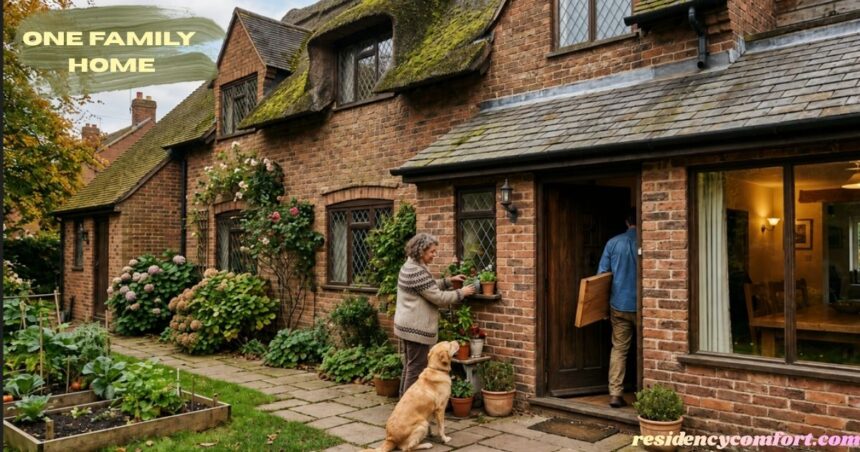
It means something different to everyone who lives inside it, and that is exactly why this topic deserves a fresh look. In Nottinghamshire, the Hartley family turned tired flat-pack furniture into solid oak pieces across every room in their one family home, spending a full year on the project while their two teenagers and dog watched the hallway and dining room slowly change shape, right down to the Sunday lunch table where the whole family now gathers.
Green Features and Investment Trends in the One Family Home Market
Chris Brown, Head of Lifetime Mortgages and Distribution at OneFamily, has been speaking to customers and organisations who are more environmentally aware than ever when updating or purchasing a one family home. He explained how the firm’s lending policy now welcomes green features such as eco-friendly solar panels, domestic wind turbines, and ground source heat pumps alongside air source heat pumps, plus a genuine openness to alternative construction methods.
On a completely different scale, the market for residential investment in the this sector has its own key challenges, with investors watching the Single Family Housing segment the way a buyer studies a showroom, taking careful measurements every week before committing money to any single move.
Sustainability & Construction Methods in the One Family Home
Fund managers across the UK now treat sustainability as a serious part of running a one family home portfolio, not a side note, because investors and sustainability features shape how prospective tenants cope with the cost of living crisis, how housebuilders meet rising EPC ratings, and how much a household pays in running costs, all of which feeds directly into property valuations and the rents landlords can charge for genuinely greener homes.
A Modular Answer to the Housing Shortage?
Some firms are turning to modern methods of construction, including modular housing, as a practical answer to the housing shortage, though local engineers still wrestle with complicated heating systems, and property teams question whether the insulation and energy efficiency gains are worth the higher build cost. This is especially true since institutional investors, fund management firms, and valuers are still working out how to judge rental stock built this way, given the thin covenant strength among newer manufacturers and the case for industry consolidation.
Considering Alternative Construction Methods
For families drawn to alternative construction methods for their one family home, options built from climate-friendly materials and sustainable building techniques include Cob construction (a form of earth architecture), Thatched roofing (widely seen as environmentally friendly), and Wattle and Daub (made from renewable, sustainable sources with little energy consumed).
Defining the Single One Family Home
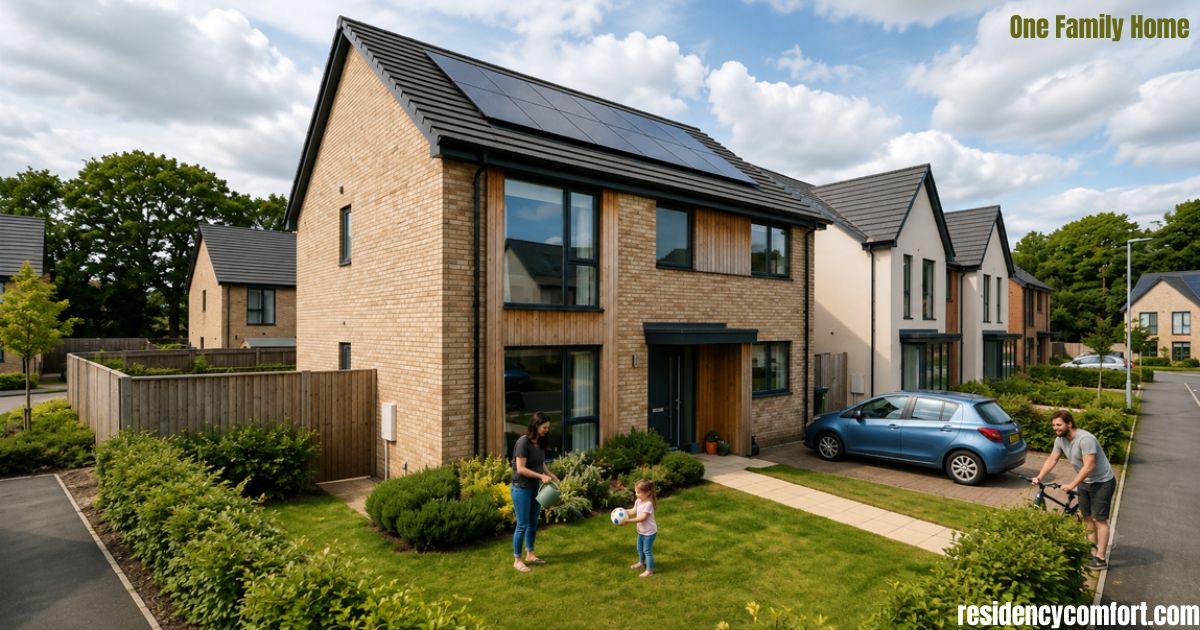
Single Family Housing, often shortened to SFH, simply means standard housing built for one family home renting each unit, and that single detail separates it from blocks of apartments where multiple units house several households under one roof, a model known as multi-family housing or MFH.
Much of the SFH stock available today still comes from housebuilders who originally built it for owner-occupation, yet a growing share is now created specifically for institutional investment and long-term rental accommodation. This purpose-built approach falls under the Build-To-Rent banner, or BTR, a term that has quickly become common shorthand across the housing industry.
Financial Advantages and Social Value of Single Residential Properties
Compared with multi-family blocks, single homes usually show lower cost leakage and a stronger gross-to-net rental income ratio, simply because there is less maintenance of common areas and fewer ancillary services to fund.
This gives the income streams a longer duration than the rental income from short lease lengths typical of apartments, which is exactly why pension funds are folding these homes into a broader living strategy built around residential property with mixed risk profiles.
Beyond the numbers, there is a genuine social impact: the country needs more family homes, and institutional investment speeds up housebuilder delivery, helps de-risk building projects, raises specification requirements thanks to institutional capital, lifts the overall quality of housing stock, and earns support from Government.
Key Challenges Facing the One Family Home Sector
Life is not simple for institutional landlords trying to build single-family developments themselves, since land acquisition is a tough fight against experienced housebuilders, so many turn to forward funding for new developments, even though agreeing wholesale prices with builders is never easy, and rising interest rates have recently tilted the balance of power back toward the institutional landlord.
Running a geographically diverse portfolio adds its own headache, because the economics of single housing shift from region to region across the UK, with larger homes favoured in the north east and smaller homes working better in the south east
. On top of location, every institutional landlord must weigh ESG goals and sustainability features demanded by investors, and greening older stock costs more in expensive markets than in cheaper housing areas, while debt players have pulled back in favour of equity, leaving less development debt available, fewer housing starts overall, and a clear opening for Government to step in.
The Risk of Rent Controls
Predicting the impact of rent control legislation on the whole Build-to-Rent sector is genuinely difficult, a point raised earlier in our residential series, even though the social regulated market cap already looks fairly generous to most landlords. In theory, Government and industry could work collaboratively to give renters more certainty of rent and land on a workable solution that suits everyone.
The Scottish model shows what happens when this goes wrong, since it has already squeezed housing supply and pushed higher rents, proving that affordability is far better solved through greater supply than through blunt rules.
The Hartley Family A One Family Home in Need of Change
The Hartleys were an ordinary household, two parents and two teenagers living in a 1990s semi, surrounded by flat-pack furniture built from kits bought over a decade earlierfurniture that had started to sag, chip, and wobble no matter how often anyone tightened the screws.
Their home’s layout was one that many British families would recognise straight away, with a compact living room doubling as a lounge and homework battleground, and a dining area that had turned into a landing strip for post and school bags instead of a place to eat, while the bedrooms had been furnished piece by piece as the budget allowed. Before changing anything, the family measured every one of the rooms, photographed the existing layout, and wrote a list of what actually needed replacing.
Why They Treated Their This Project Like a Project, Not a Shopping Spree
Rather than making random impulse buys over one chaotic weekend, the family ran this transformation like a structured project, working room by room and choosing solid oak every time instead of oak timber substitutes such as veneered chipboard or MDF dressed up in an oak-effect costume that only looks convincing under showroom lighting.
Oak Castle Furniture gave them plenty of collections to compare, including Paris Oak, London Oak, Heritage Oak, Barcelona Oak, and Manhattan Oak, yet the family kept the same material running through every room so the finished house never felt like a mood board of disconnected trends but rather one cohesive living space.
Before spending a penny, the parents worked through the Oak Furniture Buying Guide for First-Time Homeowners, and that quiet research phase, covering construction and finish, turned out to be the most transferable lesson of all, proving that reading beats scrolling through pictures of sofas every time.
Room-by-Room Oak Furniture Transformation in a One Family Home
The whole transformation of their one family home ran across three phases spread over twelve months, a pace chosen deliberately so daily life never felt too disruptive. Each space in the house took on its own collection style, shaped by the family’s earlier choices about oak.
FAQs
What products does One Family Home offer to support long-term household financial planning?
OneFamily provides a range of dedicated savings products, Junior ISAs, and lifetime investments designed to build a secure foundation for your household’s future milestones.
How do I log into my online account to manage savings?
You can access your account anytime by visiting the official sign-in portal on the website or logging into the mobile app with your registered credentials.
What is the process for withdrawing funds from a Child Trust Fund once a child reaches maturity?
When a child turns 18, the fund matures into an adult account. The account holder can easily register online to verify their identity and choose to either withdraw the funds directly to a bank account or roll them over into an adult ISA.
How can I contact customer support for assistance with my account?
You can reach the customer care team by calling their direct support helpline, using the online contact form, or reaching out through the secure messaging feature within the mobile app.
How can starting a savings plan early with One Family Home benefit my child’s future? Opening a dedicated child savings account or Junior ISA early gives your money more time to benefit from potential growth, helping create a meaningful nest egg for their education, first vehicle, or eventual property deposit.