

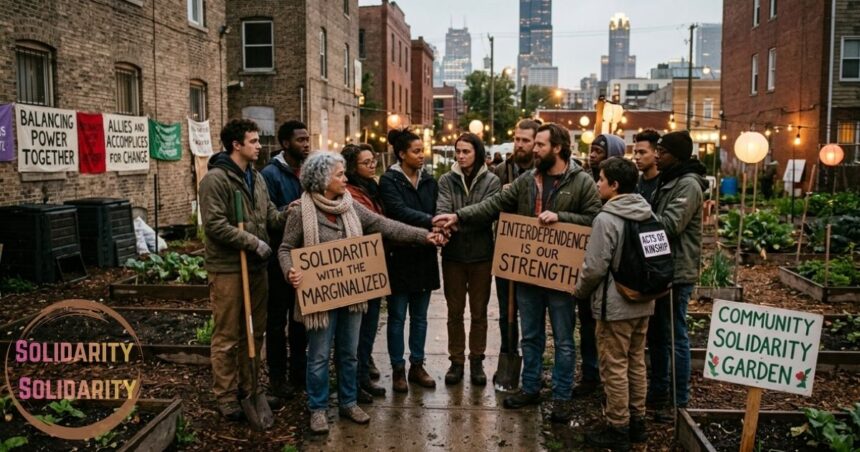
I feel real Solidarity Solidarity growing out of a crisis of meaning, especially when I look at today’s polycrisis up close. Ecological breakdown, political breakdown, spiritual breakdown, and social breakdown never come alone; they arrive together and shake old certainties apart. This constant shaking leaves humanity searching for solid ground, yet in that shared vulnerability, a deeper mutual bond begins to form.
Solidarity Solidarity in Times of Crisis
I notice how many politicians, academics, doctors, experts, and leaders lose the trust people once gave them. Their buffoonery reminds me of the old story of the emperor with no clothes, standing proud while everyone sees the truth. A strange extinction illness spreads through our minds, and it carries heavy psychological collateral effects with it.
Depression and denial sit side by side in many people I talk to about the future. Some react with humility, while others slide into hubris, and both responses shape how we survive the Anthropocene. I try to read the context around me clearly, because real meaning-making starts there, like learning to notice the oxygen we breathe without thinking about it.
I see Solidarity Solidarity less as a slogan and more as a communal act, even a spiritual act that pulls people together. There is real power in becoming part of something bigger than yourself. Looking at the etymology of the word helps me understand this pull better.
Etymology and Shared Purpose
The word traces back to Latin, where solidus once named a unit of account used across ancient Rome. Later, the French language shaped it into solidaire, a word tied to interdependence between people. From there it moved into English, where it settled into meaning agreement and support.
I think of Solidarity as a bond that links one group to another, or one individual to a shared idea. It works like a bond of unity built around a common cause that everyone can stand behind. At its heart, this bond always carries a sense of accountability.
Modernity and Historical Context
Living inside modernity feels different from any past age, and some writers compare it to the Kali Yuga, the dark ages described in the Vedic traditions of India. I share these five premises in the spirit of honest allyship, not as proof of special expertise. I don’t claim any moral authority here; these are just subjective notions.
Every idea comes from a specific historical moment, carried by a biased individual like me, shaped by ancestors and unseen forces. This creates a tangled set of antecedents that link the past, the present, and the future all at once. I remind myself of this every time I write about activists and what it means to be a good citizen.
Ethics and Storytelling in Troubled Times
I often return to Donna Haraway, whose book Staying with the Trouble talks about the Chthulucene and why matters shape the stories we tell each other. She reminds me that knots knot other knots, and thoughts think other thoughts in the same tangled way. Descriptions describe other descriptions, and ties tie other ties, building whole worlds out of the stories we choose.
Most of us never studied moral philosophy outside our own institutional religions or educational systems, and I include myself in that group. I like a simple applied ethic for these troubled times: side with those who hold less power. This small shift in disposition changes how I read every conflict I come across.
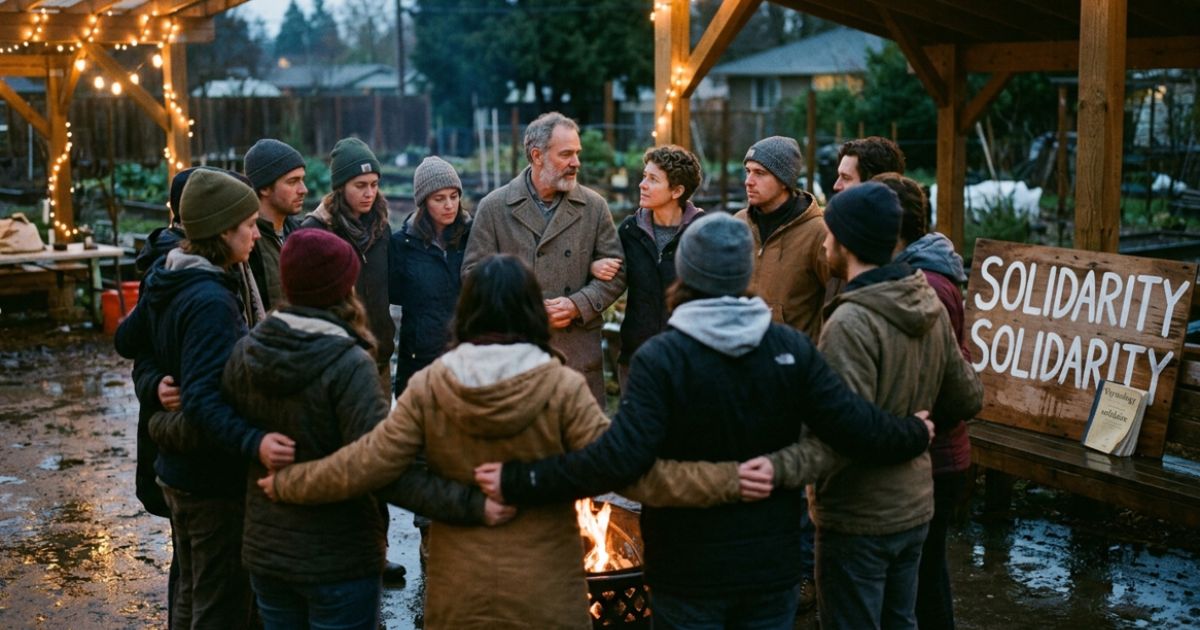
Balancing Power and Practicing Active Solidarity
Inside capitalist modernity, borrowing a phrase from Abdullah Öcalan, this means standing with the oppressed, the exploited, the immiserate, the marginalized, and the poor. I ask who holds domination over whom, and I check whose rights actually get respected. This kind of critical thinking helps me place my moral will where it matters most.
Balancing power becomes the real goal, whether we talk about human groups or the more-than-human world of other species and animate ecosystems. I never see myself as the final judge or arbiter in these situations. I use this only as a heuristic, a rough guide for placing my own moral weight.
I know I carry subjective beings’ limits, shaped by pre-existing identities and implicit biases I did not choose. My own identities affect how I show up for others, so solidarity demands real wisdom and sharp discernment. It also asks for careful strategy paired with honest compassion.
Allyship, Identity, and Action
Sometimes acting as an ally means gently educating an oppressor, nudging their consciousness toward equity through open relationship and steady commitment to their better self. More often, though, real change needs an accomplice, someone ready for direct higher being-level courage against power. That courage sometimes means a flat affront to the system itself.
Part of my responsibility involves understanding the construct of identity I live inside, shaped by race, gender, and socio-economic status. I try to notice my own cognitive biases without pretending I can erase my beingness. Instead, I place that beingness inside the wider society, so I can build real kinship with others.
Deconstruction, Power, and Moral Service
Stepping outside my usual role-type lets me disidentify, even briefly, from my everyday social personas. This opens space for real service to people affected by harmful cultural constructs. Understanding the inner landscape and the hidden ley lines of intersecting identities takes patient, ongoing work.
I also study the cultural byproducts that come from this hidden landscape, alongside my own inner deconstruction. It helps to picture a whole matrix of different histories and backgrounds overlapping at once. Using the lens of power, I try to feel the plight of others clearly before I judge anything.
This practice builds sharper moral judgement over time, and I now see it as a basic requirement, not a rare gift. Rebuilding our meaning-making sensibilities takes real dedication and steady care. Without that work, we drift further into a painful social hierarchy and a deeper impoverishment of spirit.
Cultural Awareness and Unseen Systems
I like the line from Marshall McLuhan about the fish that never notices the water around it. Most of us swim through culture the same blind way, rarely building a real critique of culture. Max Weber described people as caught inside webs of significance that we spin ourselves.
Only by pulling on these threads can we question our own perceived reality and open a wider horizon of possibility. Living inside a dominant culture, especially across the West, keeps many of us infantilized about basic facts of life. I mean simple things, like where our money, waste, energy, resources, food, and national wealth actually come from.
Structural Power and Cultural Critique
This gap in knowledge works as a quiet artifact of power, and I now see privilege as a real constraint, even a blinding constraint on clear sight. Inside neoliberal capitalism, selfishness often hides behind the mask of efficiency. Destruction, war, and violence get wrapped up in soft talk about economic growth and new jobs.
The same trick turns colonization into simple “development,” and it hides patriarchy behind a few loud exceptions. Structural racism gets brushed off with talk of pulling yourself up by your own bootstraps. To decode culture properly, I need sharp critical faculties, built through honest practice.
Continuous Decolonization and the Practice of SolidaritySolidarity
Real de-colonization never stops; it stays an ongoing praxis of deprogramming old habits of greed and short-termism. I try to notice patterns of extraction, commodification, and usury in daily life. These patterns feed disconnection and quiet numbing, along with other life-denying tendencies.
Reprogramming this pattern touches the whole mind-soul-heart-body complex, not just the mind alone. I try to live by intrinsic values like altruism, generosity, cooperation, and empathy. Non-violence stays at the center of my values, shaping my beliefs, my behaviors, and my closest relationships.
Real change even shows up in our neural patterns, our brain, and the quiet somatic responses felt in the body. I treat this whole shift as an act of remembering, not invention. This is what a working politics of solidarity solidarity looks like in daily life.
Beyond Single Issues and the Capitalist Paradigm
Chasing one single issue, like corporate taxes or mandatory vaccinations, without checking the wider associational politics blocks real structural change. Defending capitalism as the safest source of innovation, calling it the best-worst system, ignores the 8,000 species we lose every year to growth-based imperialism. Blaming poverty on plain ignorance or fixed human nature wastes our shared ingenuity, our connection, and every real possibility we still have..
Solidarity’s Colonial Dimension
When I study mechanical solidarity, I picture small groups bound by shared values, almost like early medics and missionaries working side by side for one goal. This kind of social cohesion grew into a full sociological method under Émile Durkheim, who first shaped the Durkheimian concept we still use today. Colonial officers later bent this thinking into working colonial policies.
Colonial Law and the Sociology of Knowledge
Colonial law grew heavier once every colonial administrator picked up these new ideas as a tool of rule. Marcel Mauss kept building on the theory even after Durkheim’s death, drawing on rich historical material collected across empire. This branch of sociology treated colonized subjects and oppressed people as case studies, while calling the opposite pattern organic solidarity.
The Application of Sociology in Colonial Governance
By 1917, these theories moved through clear stages, applied directly onto real colonized societies. Officials studied everyday tasks and the local division of labor, framing it all as proof of mutual support. They called their approach effective, and they tested it first across the French colonies, often working with a trusted local collaborator.
Much of this research served hidden political purposes dressed up as pure science about primitive societies. The stated goal was interdependence between colonizing nations and the people they ruled, but real power stayed with the administrators and the colonial state . New concepts grew directly out of studying pre-industrial European society, and sadly, some carried proto-fascist views into public policy.
Theoretical Foundations of Colonial Governance and Solidarity Solidarity
This mix of ideas reshaped modern law and gave clean, scientific cover to harsh colonial governance. Some scholars pushed openly racist views, dressing plain colonial exploitation in academic language. An APSR article I read recently shows how anthropologists helped design these so-called developmentalist reforms, some resting on flat essentialist views about people far from European industrial society.
Researchers pointed to small-scale societies and their workers as living proof for theories claiming to offer true social solidarity solidarity while remaining humane. Early in the twentieth century, one bright student turned this into a full theory of national cohesion. Albert Sarraut, another colonial voice, used the same logic to link distant civilizations with older ancient societies.
FAQs
What is Solidarity Solidarity and why is it important?
Solidarity Solidarity is a unifying concept and community initiative focused on driving collective action, mutual aid, and social impact across diverse groups to build stronger, resilient communities.
How can individuals get involved in local solidarity efforts?
You can participate by volunteering with community organizations, supporting mutual aid networks, attending local workshops, or organizing neighborhood initiatives that address local needs.
What are the main goals of building strong community solidarity?
The core objectives include fostering social cohesion, ensuring equitable access to local resources, amplifying marginalized voices, and creating reliable support systems during times of crisis.
How do organizations measure the impact of their unity initiatives?
Organizations evaluate success by tracking active community engagement, resource distribution efficiency, participant feedback, and long-term improvements in local social support structures.
Where can I find resources and updates related to Solidarity Solidarity?
You can access updates, guides, and involvement opportunities through official partner network portals, community bulletin boards, and social media channels dedicated to Solidarity Solidarity.