

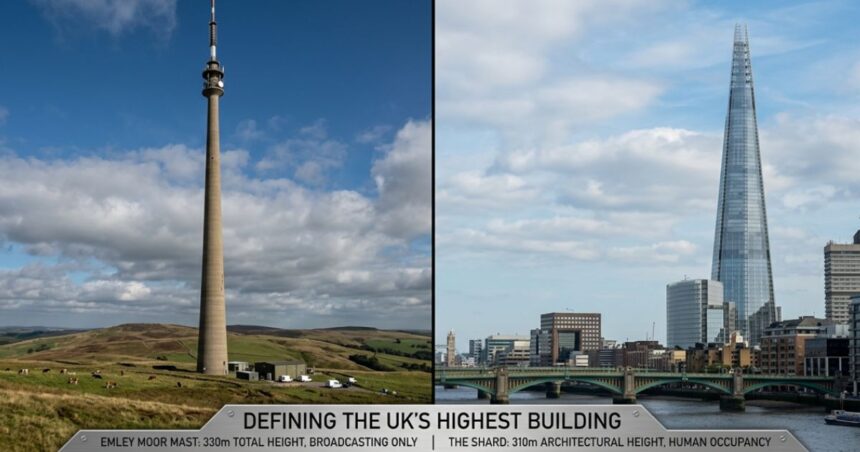
Ask people what stands tallest in Britain and you get all sorts of answers, because a tower built for signals and a building built for people are two very different things and both have a real claim to the crown.Ask ten people the same architectural question what is the tallest structure in the UK? and you will get a different answer each time, because the reply depends on whether you mean the UK highest building meant for human occupancy or something built purely for signals. Up on the Pennines near Emley Moor, in West Yorkshire, stands the Emley Moor Mast, a telecommunications tower that beams TV signals across Yorkshire.
Emley Moor Mast vs. The Shard Masts, Structure Heights, and the UK’s Tallest Buildings
Up on the Pennines near Emley Moor, in West Yorkshire, stands the Emley Moor Mast, a broadcasting mast that beams TV signals into homes across Leeds, Bradford, Doncaster, and Sheffield. The very first television tower on this spot went up in 1956 at just 125 metres, but its replacement, raised in 1966, shot up to a staggering 385 metres, making it briefly the sixth tallest freestanding structure on the planet.
That tower was built from curved steel segments held steady by huge steel ropes, and in the brutal Yorkshire winters, ice and icicles formed on the metalwork; when they broke loose under high winds, they caused real danger below, and sadly in 1969 the whole structure came down, scattering debris and cutting television reception until temporary masts could be rigged up.
A new steel mast, this time rising from a tapering concrete base, opened in 1971, and it now stands at around 330 metres, earning the title of 25th tallest tower in the world by freestanding height and giving it the crown for total height among UK structures, even though it does not carry any occupancy.
Architectural Height vs. Total Structure Defining the UK Highest Building
Riding the lift to the microwave link room near the top takes about seven minutes, which shows just how much this tower dwarfs ordinary buildings, and in 2002 it earned Grade II listed status in recognition of its place on the Yorkshire skyline.
This is where the engineering question gets interesting, because when people talk about height they usually mean antennae included, which is very different from architectural height. Consequently, when evaluating the title of UK Highest Building versus tallest overall structure, The Shard in London claims its own record of 310 metres as the country’s tallest occupied building, completed in 2012.
Defining What Qualifies as a UK Highest Building
Not every tall thing counts as a building, and that is the whole purpose behind how we sort tall structures. Towers, masts, monuments, and antennas can soar into the sky, yet architects and regulators only count something as one of the tallest buildings in the UK if it offers habitable spaces real floors where people can work or live, whether that means offices, hotels, or homes.
When it comes to height measurements, standard rules follow architectural standard practice of using architectural height, which counts the visible architectural top of a structure, including spires, but leaves out antennae and other non-architectural appendages such as broadcast equipment. These conventions establish strict criteria for what can legally and architecturally claim to be a UK Highest Building.
That is exactly why The Shard in London is recognised at 310 metres, without any antennas on site being added to the figure, and this is what separates it from towers built purely to carry signals. Looking across the current leaders on the skyline, two patterns keep repeating: location, since London dominates while other city centres are catching up, and mixed-use design, since so many modern towers combine mixed-use occupancies with office-first planning tied to the economic life of the capital. Understanding this history and these conventions helps readers make sense of future projections as new tallest buildings in the UK keep rising.
History and Evolution of the UK Highest Building Skyward Shift
The story of height in Britain rests on Victorian foundations, laid down in the late 19th century when new steel construction methods and elevator technology first made taller blocks possible, marking the start of early modern tall structures that slowly replaced low-rise urban forms. Those early buildings carried elegant glass-and-steel shapes, born out of the wider steel-and-glass transition period of the age, and while modest by today’s standards, they set the tone for everything that followed.
The 20th century brought post-war innovation, as skyscraper construction picked up pace in cities rebuilding after conflict, with Manchester and London leading a wave of high-rise profiles and residential blocks designed to give firms a strong corporate presence. From the late 1990s onward, a clear London-led ascent took hold, driven by growing financial districts and a hungry finance sector chasing premium office space across the capital, which pushed the whole idea of urban scale in a new direction.
The Shard and the Evolution of the Modern UK Skyline
This modern era reached its peak with The Shard, finished in 2012, a modern tower that pushed past 300 metres and helped define supertall forms across Europe’s skyline, cementing part of Britain’s national identity while setting new standards for every subsequent UK Highest Building. Since then, steady high-rise developments have reshaped the modern UK skyline, reflecting the country’s global business footprint and shifting international perceptions of what British cities can build.
Current Skyline Leaders: Measuring the UK Highest Building Contenders
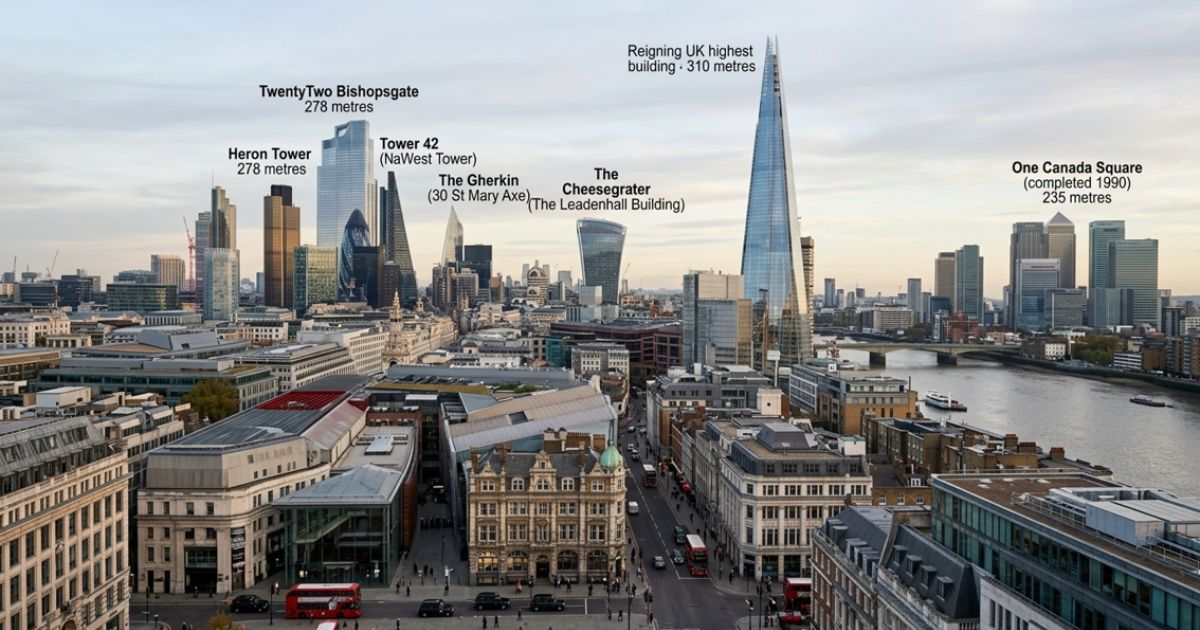
As the reigning UK Highest Building, The Shard (completed in 2012) still tops the list at 310 metres, functioning as a mixed-use anchor that combines offices, a hotel, and an observation deck in one striking form.
Close behind sits TwentyTwo Bishopsgate (also known as 22 Bishopsgate), which reached 278 metres when it opened in 2020 in the heart of the financial district, showing off careful wind engineering and a bold corporate aesthetic.
Iconic Skyscrapers Across London and Regional Cities
Over at Canary Wharf, One Canada Square has stood since 1990 at 235 metres, while Heron Tower, completed in 2009, rises to 230 metres and sits alongside older icons like Tower 42 (once known as the NatWest Tower). Other famous shapes on the skyline include The Gherkin (formally 30 St Mary Axe) and the Cheesegrater (better known as The Leadenhall Building), both adding character next to residential-first towers such as St George Wharf Tower at 181 metres and One Blackfriars at 170 metres, the latter known for its curved crown on the south bank.
Beyond London, Manchester’s Beetham Tower reached 169 metres back in 2006, sparking a wider urban renaissance, while Leeds, Birmingham, and Bristol have all added towers of their own, driven by housing demand, business growth, and steady investment in curtain walling and modern design.
Structural Engineering Behind Every UK Highest Building
Getting a structure to reach record height takes far more than ambition; engineers creating a UK Highest Building must solve severe aerodynamic and foundation challenges using advanced structural systems.
These are built around sturdy vertical frames, solid core structures, and steel cores or concrete cores working together as lateral load-resisting systems to resist sway. Engineers rely on high-strength concrete and careful steel framing to carry loads safely from the crown down through the foundations, and in many projects deep foundations such as reinforced concrete piles or raft foundations are needed because ground and soil conditions vary so much beneath busy urban cores, often crossing tricky subterranean utilities.
At height, wind forces become the biggest challenge of all, so teams turn to wind-tunnel testing and computational fluid dynamics to study vortex shedding, gust loads, and tricky crosswinds; smart choices like tapering, setbacks, and aerodynamic shapes all help cut down on sway and fatigue while protecting resilience and comfort for everyone inside, a field widely known as wind engineering.
High-Performance Façades and Efficiency in UK Highest Building Design
The outer skin also matters a great deal, since glazing systems, glass, cladding materials, insulation, and overall façade performance shape thermal efficiency, solar gain control, and long-term durability, all of which feed into energy performance and lower energy use across the building’s life. Fast vertical transport keeps everything running smoothly, with banks of elevators, destination dispatch systems, and clever shaft layouts cutting down waiting times and boosting floor efficiency to give occupants more usable space.
Finally, sustainability now sits at the heart of design for any modern UK Highest Building, with natural ventilation, water management, indoor environmental quality, better interior comfort, renewable energy generation, and lower energy demand all working together to prove that materials, metal, and clever engineering can meet seismic forces and modern expectations at once.
FAQs
What is the official UK Highest Building currently standing?
The Shard in London holds the record as the UK highest building. Designed by Italian architect Renzo Piano, this supertall glass spire soars to a vertical height of 309.6 metres (1,016 feet) with 72 habitable storeys.
A piercing silhouette that redefined the London skyline, standing as a testament to modern engineering and human vision.
What is the tallest residential skyscraper in the United Kingdom?
Landmark Pinnacle, located in London’s Canary Wharf, is the tallest purely residential tower in the UK. Reaching a structural height of 233 metres (764 feet) across 75 floors, it offers living spaces that overlook the capital.
Which building holds the height record outside London?
Deansgate Square South Tower in Manchester holds the record for the tallest high-rise superstructure in the UK outside London. It climbs to a summit elevation of 201 metres (659 feet) across 64 levels.
How many meters tall must a structure be to be considered a skyscraper in the UK?
In architectural and urban design standards, a high-rise development or skyscraper is generally defined as a building footprint reaching an architectural height of 150 metres (492 feet) or more.
Are there any ongoing projects planned to surpass the UK Highest Building?
While the proposed 1 Undershaft tower in London’s financial district is planned to reach a structural peak of 309.6 metres (1,016 feet), it will match rather than exceed the exact height of The Shard. Therefore, The Shard remains the undisputed benchmark for the UK highest building.