

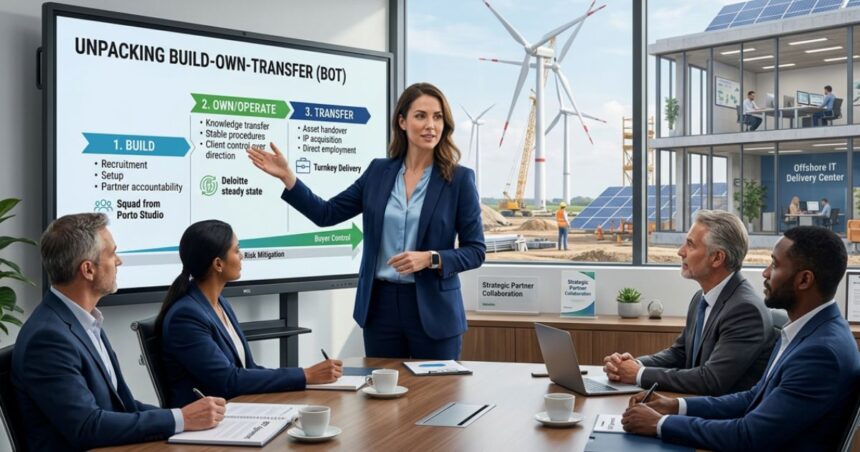
Many companies struggle when hiring internationally because they select the wrong operational model. The Build-Own-Transfer model offers a clear, risk-mitigated pathway: a strategic partner handles initial setup, talent acquisition, and day-to-day management while your business retains full direction over high-level goals and outcomes. This approach allows you to scale effectively without taking on the entire operational burden from day one, establishing a stable foundation before eventual internal ownership.
Key Phases of the Build-Own-Transfer Framework
The whole setup rests on three distinct phases, with each stage handing you progressively more control than the last. Nobody argues that this structure is controversial anymore, given how widely it has been adopted, but using the Build-Own-Transfer model can still confuse people who first encounter the concept in a different industry context. Because financial terms and baseline assumptions shift significantly depending on your sector, always review the fine print carefully before signing any agreement.
Applying the Build-Own-Transfer Model in Renewable Energy
Take the renewable energy sector as a prime example of operational scaling. Build-Own-Transfer agreements, often structured via Build-Transfer Agreement (BTA) contracts, help utilities buy and own completed power projects directly rather than settling for long-term power purchase agreements just to receive electricity. A third-party developer takes on the project, absorbs the heavy construction-related risks, and only hands over the finished asset once the work reaches operational completion.
This differs sharply from a standard transaction where a utility issues a notice to proceed and takes on full construction risk from day one. Overall, development under a Build-Own-Transfer deal moves through three distinct phases: late-stage development, active construction, and post-completion transfer.
Balancing PSA and EPC Dynamics in Agreements
Negotiated BOT contracts sit on a continuum between a purchase and sale agreement, or PSA, and an engineering procurement and construction deal, known as an EPC contract. The PSA-style side treats the deal as a sale of a project on a deferred basis, while both parties still want the rights and protections they would expect from an EPC arrangement.
A utility often pushes for extensive project approval rights and a broad covenant package, while a developer holds out for EPC-like protections such as cost and schedule relief tied to changed circumstances. Every deal carries its own sensitivities and risk tolerances, and project-specific differences mean two BOT deals rarely look the same, though bespoke solutions usually settle around a few common themes.
Securing Intellectual Property and Agility in Offshore IT Growth
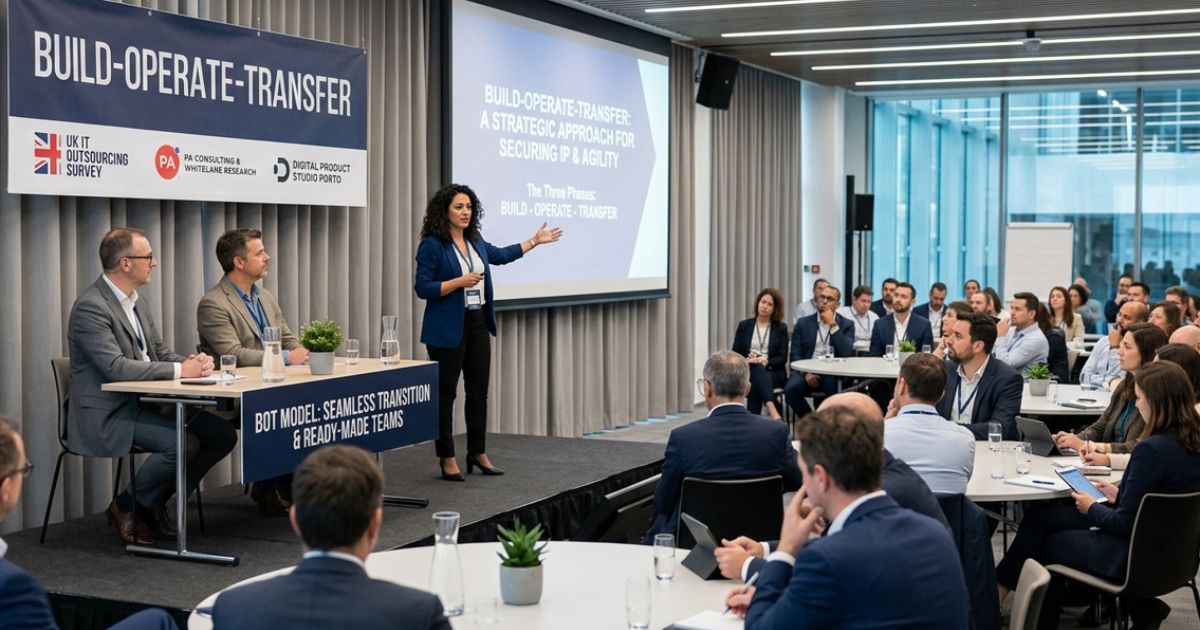
The IT side of BOT tells its own story. The UK IT Outsourcing Survey, run by PA Consulting and Whitelane Research, found that the IT outsourcing sector moves over £15 billion in annual spend across roughly 250 of the UK’s largest IT service users. Two key concerns stood out among customers: 74% worried about keeping their intellectual property, and 75% cared about protecting agile working as their organisational model.
That demand for security, flexibility, and alignment with best practices is exactly why alternative collaboration models exist. The BOT model answers this with a strategic approach that lets companies build customised teams and high-performing teams around their own values, while keeping intellectual property rights and operational agility intact. Once you see the unique benefits, the model reads less like a trend and more like a powerful alternative to the traditional outsourcing approaches many businesses still default to.
What is/does Build-Operate-Transfer mean?
At its core, a partner sets up an operation on your behalf, keeps it stable, and then transfers it over to you. In technology, this often means building a product or engineering team abroad, where the partner recruits, employs, and delivers with the people before eventually moving them onto your payroll and into your own legal entity.
The exact definition matters less than the sequencing itself, because you commit capital and legal exposure in stages rather than all at once, and you get to see the team perform before you take on the cost of employing them. This is not a staffing arrangement, since the partner stays accountable for delivery rather than simple placement, and it is not a permanent outsourcing relationship either, because it comes with a built-in ending.
Seamless Ownership Transition and Turnkey Operational Delivery
We describe it to clients as a collaboration between two business partners, where one side, the service provider, builds , sets up, and runs a service delivery operation with a team that handles the tasks. All the processes, resources, and intellectual property created along the way move into the buyer’s organisational structure once the contract reaches its end date.
People also call this an operational model, or simply a process, and while it once described deals between public agencies and private companies, the IT industry has adopted the same language for its own use.
The transfer phase only happens once the organisational set up is complete and the team runs fully operational. You inherit a finished structure, and that ready-made working structure is honestly the biggest benefit of the whole model. Many teams we have helped set up an IT delivery centre staffed with global engineers found that this single fact changed how quickly they scaled.
The Three Phases of Build-Operate-Transfe
Three phases run through every BOT deal, and only the first one really counts as a firm commitment. The partner assembles a team, delivery starts, and you have no local entity to worry about yet. You hire on your own timing, and each stage should give you an exit rather than lock you into an obligation to keep going.
Getting through these crucial stages takes planning: you agree the terms and scope of the collaboration, run a thorough analysis of your requirements and needs, and share your company culture, your processes, your technologies, and your business goals with your partner. Once that information moves across, the partner starts securing technologies, team members, office space, and equipment for the project.
Establishing Foundation and Team Composition During the Build Phase
During the Build phase, the partner recruits, employs, and onboards the team, and work begins without you needing local employment contracts or an office. Delivery accountability sits with the partner, so an underperforming team becomes their problem to fix rather than your staffing complaint to raise with a contract manager. Most providers differ here more than anywhere else in the deal.
A traditional BOT build phase looks like a recruitment drive with your name on it, basically hiring team from scratch in a market you barely know, but a stronger option pulls a squad from an existing team that already works well together. We run our build phase out of Porto, home to our AI-native Digital Product Studio, where a standing team of 70 plus people means a squad operational in four to eight weeks, well short of a normal hiring cycle. We are not just assigning people to a project either; the squad acts as an extension of team, challenges decisions, and takes ownership rather than just handing over output.
Managing the Operate Phase Stability, Compliance, and Knowledge Transfer
The Operate phase keeps delivery running while you build the permanent structure: your legal entity, payroll, accounting, tax, and every piece of employment infrastructure your country demands. Here is the division that trips up most buyers: you own the entity and the decisions, and the partner owns the delivery itself. Deloitte calls the goal of this stage reaching a steady state, where standardized procedures and service levels hold firm while the operation stabilizes.
Whether the handover stays possible often comes down to documenting knowledge as the team creates it. Setting up in an unfamiliar jurisdiction mostly means knowing who to call, and in Portugal we introduce clients directly to Fresh, beTaxed, Redbridge, AGPC, and Porto City Council, so you contract directly with them; we take no cut and stand in no middle.
The real test of this phase is whether anything slows down, and there should be no productivity gap at all during this extended period, since aligned processes and steady communicate-style updates from your business partner keep both sides on the same page. Training team members also matters here, and your HR department can run workshops followed by 1-on-1 meetings with everyone involved.
Executing the Transfer Phase Knowledge Migration and Asset Handover
The Transfer phase is where you hire people directly and the operation moves fully into your hands. What matters most is that the working knowledge moves with them: the codebase, the reasoning behind it, and how the team runs day to day.
A team raised on AI-native workflows since its first sprint hands over practices that prove far harder to hire for than any single individual. This is what separates a real transfer option from a decorative option, and the terms written into any proposal or BOT agreement deserve a close read, covering the resources transfer, the time frame, and the exact procedure laid out in the partnership contract.
Where the term comes from, and why the technology version is different
BOT did not start in software at all. The World Bank built the original definition around a concession: a public authority grants a private company the right to develop and operate facility work for a fixed project period, during which the company finances, owns, and runs commercially, before the facility transfers back to the authority. Those concessions usually run 25 to 30 years, long enough to amortize the initial investment involved.
Compare that to the technology version, and the economics invert completely. An infrastructure BOT works as a financing structure: the private party puts up the capital, earns back the cost from users over decades, and eventually hands over asset without asking for another payment. A technology BOT works as a capability structure instead, since there is no meaningful capital asset involved, the term measured in years stays far shorter, and the client pays at the point of transfer rather than before it.
Modern Global In-house Center Frameworks and Evolution
Deloitte’s framing of the tech version describes a service provider, usually based in the destination country, doing the work to set up and operationalize a Global In-house Center, which the client assumes later, typically for a fee. Deloitte also splits the history into two waves: a mid-2000s wave driven by market entry and labor cost, and the current wave driven mostly by access to talent. So the same three words describe deals with opposite cash flows, and if a proposal reads like it follows the infrastructure model, where handover automatic and free transfer apply, that is worth a serious question.
Real-World Examples of the Build-Own-Transfer Model
Finding public names of organizations that have executed a Build-Own-Transfer transition can be surprisingly difficult. The public record on completed transfers stays far thinner than the volume written about the framework overall, primarily because an operational transfer functions as a private corporate transaction with no mandatory disclosure obligation attached. The few examples that reach the public eye usually surface when a client voluntarily highlights their strategic transformation or when a publicly traded service partner files regulatory disclosures.
FAQs
What is Build-Own-Transfer?
It is a model where a company hires a vendor to set up, run, and scale a business unit or tech team, then transfers full ownership to the company.
How does it differ from traditional outsourcing?
Traditional outsourcing is permanent; BOT is built to transition team, assets, and IP to you.
Who uses this framework?
IT and software companies expanding offshore without upfront setup costs.
When does ownership change hands?
Usually within 18 to 36 months, once targets and stability benchmarks are met.
How is IP protected in Build-Own-Transfer?
Through initial NDAs, with total legal rights transferring to you upon completion.