


Every house move has a milestone that turns a hopeful chat into real paperwork, and that moment is the Memorandum of Sale. Once sellers and buyers agree on the price, someone has to put the deal into documents that both sides can trust, and that is where this short guide comes in. Having sat across the table from a nervous seller and an eager buyer more than once, the processes around buying and selling a property rarely feel simple on the day itself.
Understanding the Memorandum of Sale in Property Transactions
The good news is that a Memorandum of Sale is not a legally binding contract; it is closer to a summary of intenta friendly document that gives everyone clarification on the main terms before the real sales agreement is drawn up.
It gets issued early, well before anything binding is signed, so think of it as the calm centre of what can feel like an overwhelming, sometimes exciting, whirlwind toward completion. Nothing about this stage is insignificant, even if it looks like a routine form, because it sets the tone for a well-versed transaction from the very first day.
The Basics and Meaning of Memorandum of Sale
In plain terms, a Memorandum of Sale, often shortened to MOS, is a written confirmation that a buyer and a seller have shaken hands on a price. The word memorandum comes from Latin and means a note or a message worth remembering, which fits nicely since this simple document exists so nobody forgets what was agreed.
It is not a contract of sale, and it is not the same as Sold STC, though the two often appear around the same stage of the buying and selling process. An estate agent usually puts it together once an offer is agreed in principle, then sends it to the solicitors on both sides so the sales process can move forward on an accurate, shared basis.
It lists the key details of the deal, gets posted or emailed, and gives everyone something to refer back to before the formal exchange. Some firms create tailor-made versions to suit unusual sales, and even home buying companies and auctioneers use their own style once Under Offer status is confirmed. It is drafted for both parties, covering the legal side loosely without being legally binding, and its only job is to keep everyone on the same page about the property transaction ahead of full conveyancing.
Essential Details and Legal References
A well-written Memorandum of Sale is packed with practical information, starting with the property address, whether the home is freehold or leasehold, and its land registry number as held with HM Land Registry. It records the agreed price, the deposit amount, whether the deposit paid has been confirmed, and it notes the fixtures and fittings that come with the sale.
Funding matters get their own section too, covering whether the buyer is paying in cash or arranging a mortgage through a lender, alongside a decision in principle obtained with help from brokers. For a cash buyer, a quick cash house sale, or an auction sale, extra notes might include the date of exchange, confirmation that the hammer fell, and proof that the verified deposit matches what was promised.
Timelines, Terms, and Contact Details in the Memorandum of Sale
The document also gives confirmation of ownership, the company name of the estate agent, and the property type, plus proposed timelines such as the expected exchange date and completion date. It flags any special conditions of sale, warns of delayed completion where relevant, and can mention a cash advance and an option agreement.
Contact information rounds it off, listing the name, current address, phone, and email for the conveyancer on each side, together with any legal issues, planning restrictions, rights of way, or other constraints worth flagging. It even records years remaining on the lease for leasehold homes, plus extra notes, observations, and contact details all gathered as a central reference point for the full address and any outstanding fees.
Why is a Memorandum of Sale Necessary?
The honest answer is that a Memorandum of Sale brings clarity at a crucial step in the property transaction process, making things go much smoother once the key details are put down on paper. Without it, an agreement can drift between phone calls and half-remembered chats, whereas once it is recorded, both solicitors and conveyancers have the same key information in one place to work from. That single step cuts out a lot of confusion and stops small misunderstandings from
turning into real delays, which is exactly what makes for a smoother property transaction. It saves unnecessary time too, since nobody wants endless to-ing and fro-ing by phone when selling a house should already feel settled once the sale confirmed stage arrives. An agent gets it circulated quickly and efficiently, sometimes from a standard template, and even someone selling privately benefits from having a complete confirmation of terms in writing.
It is worth remembering it is not legally binding, so a buyer can still withdraw, but keeping the paperwork honest and transparent means everyone knows where they stand before anyone has to sign anything. In short, it protects trust between strangers who are about to make one of the biggest deals of their lives.
What Happens After the Memorandum of Sale is Sent?
Once the Memorandum of Sale lands, the wider house sale process properly begins, with the estate agent updating the property listing to Under Offer or Sold Subject to Contract (STC). From here, the solicitors take the lead, running buyer checks on the financial position, asking for proof of mortgage offer, and expecting a full mortgage to be arranged within roughly 2 months. A Decision in Principle (DIP) or Agreement in Principle (AIP) is usually already in place, alongside proof of deposit showing the buyer really can afford the purchase.
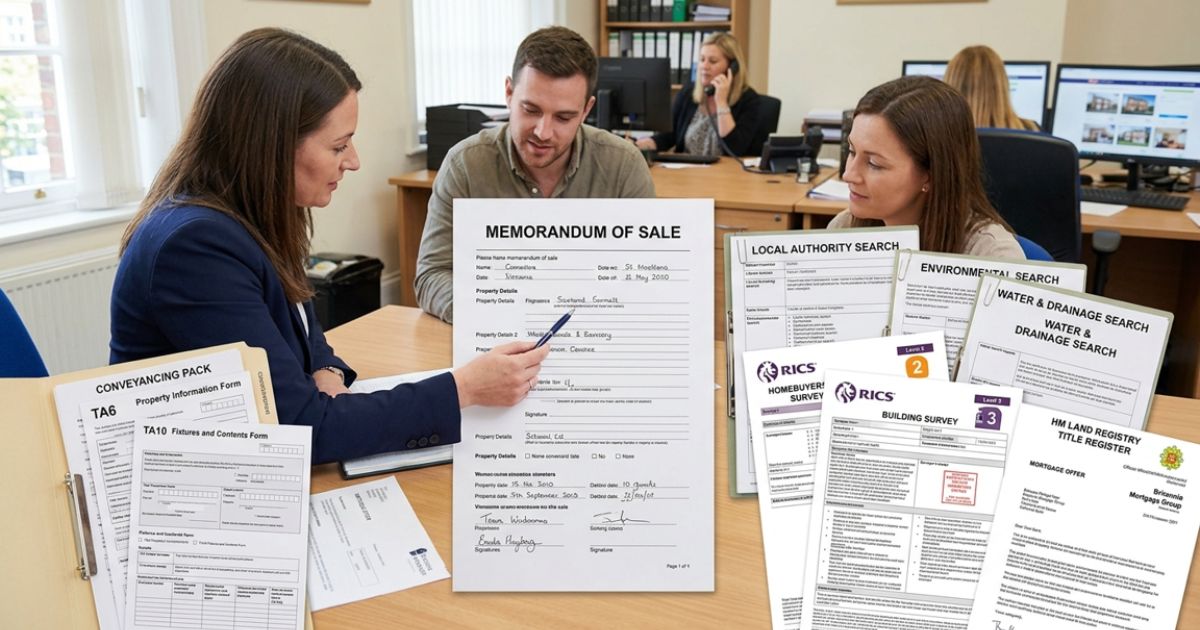
Meanwhile, conveyancing kicks into gear, with ID checks, checks on funds on account, and paperwork such as the TA6 Property Information Form, the TA10 Fixtures and Contents Form, and, where relevant, the TA7 Leasehold Information Form issued through guidance from the Law Society.
Legal Checks, Searches, and Surveys
Buyers must supply certified identification, while sellers gather warranties, guarantees, planning permission, and building control certificates, and solicitors request the Title Plan and Register from HM Land Registry.
The mortgage company confirms mortgage funds ahead of contract exchange, and a wide net of searches gets ordered, including Local Authority, Environmental, Water, Drainage, Chancel repair, Coal mining, Tin mining, Brine, Common Registration, and Clay searches.
A survey is arranged too, typically through RICS (Royal Institute of Chartered Surveyors), with a basic RICS General Condition Report as the minimum requirement most mortgage companies ask for, giving a quick look at the overall state of the property from a qualified surveyor in about one hour to flag any notable issues.
Structural Reviews and Finalizing the Contract
Some buyers choose a deeper RICS Homebuyers Survey, an in-depth check for damp, subsidence, and other structural issues, while qualified surveyors work around existing furniture to limit disruption and produce a proper valuation.
If the HM Land Registry data or survey results reveal a problem, either side can renegotiate the price, and at the seller’s discretion, a price correction may lead solicitors to revise the Memorandum of Sale after informing legal representatives on both sides.
For older or unusual homes, an RICS Structural Survey (Building Survey or Level 3 report) gives a more rigorous and detailed look, offering real peace of mind thanks to its forensic approach and exhaustive report, though it comes at extra costs, sometimes alongside a Red Book Valuation.
Finalizing the Property Transaction From Inquiries to Completion
Solicitors also raise Property Enquiries by email to uncover encumbrances, restrictive covenants, positive or negative easements, or overage clauses, particularly where a leasehold property involves a freeholder or management company.
All the findings feed into a Report on Title, the heart of the legal work carried out by legal representatives, involving reviewing documents, thorough legal checks, and pulling together every result from the surveys and searches.
Once mortgage arrangements are locked in with the lender, solicitors move on to contract drafting, both sides review contracts, and the process builds toward the exchange of contracts, after which contracts are signed and exchanged and finally legally binding.
From there, completion day arrives, ownership transfer takes place, the sale finalized notice goes out, and steady communication between buyer and seller keeps everything on track right to the very end.
Auctions, Templates, and Fast Sales
Not every sale follows the traditional route, and firms like Property Solvers are known for offering a fast house sale, while auctions bring their own rhythm to the Memorandum of Sale, often working to a 28-day completion window through wider estate agency services. Many companies now offer a downloadable Memorandum of Sale template, though buyers and sellers should remember any confidential information on it must stay data protected, since a solicitor needs the full picture without exposing private details that might reveal issues before either side is ready.
A firm built on being fully informed tends to move faster, and a quick buying company can push the sales process along by locking in a firm date for exchange and completion, sometimes within 24 hours in urgent repossession cases where specific stipulations apply.
Auction Rules and the Memorandum of Sale Process
A cash advance clause can protect key information upfront, alongside insurances that keep a sale guaranteed for anxious clients, and good firms are upfront about conveyancing quotes, estate agency costs, and other associated fees from day one. At auction, the fall of the hammer or gavel means the buyer exchanges contracts on the spot and becomes legally committed immediately, usually with a deposit of 10–25% due there and then, on top of any auction house fees.
ID checks still apply, paperwork is forwarded quickly once the buyer must exchange contracts, and all relevant documentation including the Memorandum of Sale is shared without delay. Online auction houses have made this route more efficient and faster than ever, giving sellers another real option beyond traditional auction houses.
FAQs
Q1: What is a Memorandum of Sale?
It is a non-binding document issued by an estate agent after an offer is accepted, detailing the agreed price, property, and solicitor info to kick off conveyancing.
Q2: Is it legally binding?
No, it is strictly “subject to contract.” Neither party is legally bound until the formal exchange of contracts.
Q3: How much does it cost?
Nothing extra. It is included in the seller’s standard estate agency fees.
Q4: How long does it take to issue?
Usually 1 to 3 working days, once ID, proof of funds, and solicitor details are verified.
Q5: What happens after the Memorandum of Sale is sent?
Solicitors use the Memorandum of Sale to open files, order property searches, and draft the initial contract.