

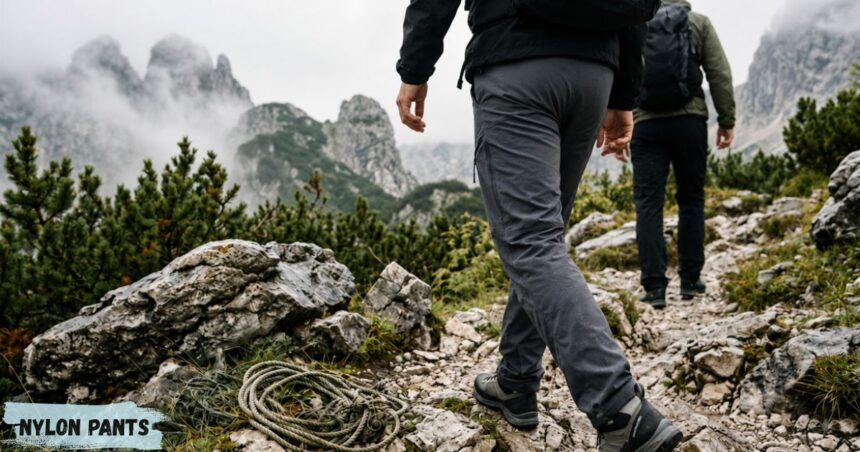
A pair of nylon pants gives you real strength without weighing you down, which is why so many hikers pick them for long trips. The fabric brings durability, lightweight comfort, and a water-resistant finish that shrugs off sudden rain far better than cotton ever could. People who love sportswear and travel gear also like that nylon pants are wrinkle-free and quick-drying, so a damp pair hung up at camp is ready to wear again by morning.
The Trade-Offs Worth Knowing of Nylon Pants
Nothing is perfect, and nylon pants do have a few cons worth mentioning before you buy a pair. Because the fiber is petroleum-based, it traps heat and feels less breathable than natural cloth, which can make hot weather days uncomfortable. This is also why nylon is not always called eco-friendly on its own, and it pushed the industry to look for cleaner ways to make the same tough fabric.
From Waste Stream to Wardrobe Recycled Nylon
The good news is that a lot of nylon fabric today comes from recycled material, pulled straight out of the waste stream instead of freshly drilled oil. Factories collect scrap, regrind, and rework material left over from the manufacturing process much like a baker gathers the leftover dough after cookie cutting, then kneads it and has it rolled out again for the next batch. This kind of re-utilization cuts down on contaminated plastic wastage and lowers the industry’s hunger for virgin nylon, which helps from a legal, economic, and ecological perspective all at once.
ECONYL® and the Fishing Net Story
One of the most interesting names behind recycled nylon pants is ECONYL®, made by the European manufacturer Aquafil in Slovenia. This Nylon 6 material is gathered from industrial carpet users, fish farms, and even discarded fishing nets pulled from the sea by groups like the Healthy Seas organization, which calls these tangled nets ghost nets. Through mechanical recycling, this 35% Post-Consumer Nylon material becomes free-flowing material again, ready to spin into new fabric for households, commercial facilities, and institutional facilities alike.
Chemical Recycling and the Push for Purity
Beyond simple mechanical methods, companies are now using chemical recycling technologies to reach virgin-like quality even from bi-monomer Nylons with mixed single monomer content. A Taiwanese company, Formosa Chemicals, runs this kind of chemical recycling technology using waste gathered from Chile, aquafarms, and Vietnam, while BASF runs a similar ChemCycling™ platform that turns mixed plastic waste, municipal waste collection scraps, and old automotive tires into pyrolysis oil that behaves like crude fossil oil. Through a mass balance approach, this oil becomes conventional Nylon 6 again, showing how far synthetic recycling has come since 2021 for everyday textile products.
Biobased Nylon A Newer Path Forward
Alongside recycling, Biobased Nylon is opening a fresh chapter for the material’s life, drawing on renewable feedstock resources instead of only fossil oil. These biobased plastics use renewable resources and reduce the $CO_2$ released during the growing phase, standing apart from older fossil-based materials in the wider biobased economy.
The word bioplastics is really a collective term for several plastic types, and their composition ranges from biomass-based fibers to fully biodegradable or compostable plastic that microorganisms break down at the End of Life through a natural chemical process, leaving behind only water and carbon dioxide unlike PLA, most nylon blends for technical applications still hold their shape for textiles, since the term biobased has an unprotected meaning and is in free use across the trade.
This wider plastic chemistry category includes a true biopolymer, built from a repeating chain of monomers and raw material like PA 4.10 and PA 10.10, sometimes boosted with an additive to make hard plastics, or labelled biosynthetic when blended for modern Old Economy-to-New Economy style.
When Nylon Left the Runway and Entered Daily Life
High-end nylon pants owe part of their reputation to fashion history, and the Italian fashion house Prada played a huge role. Long known for leather goods, bags, and trunks since 1977, Miuccia Prada grew tired of a bourgeois, boring status quo, and by 1984 she introduced the Vela bag, a piece that shook up luxury goods with a revolutionary spirit that drew in young customers even past the doubts of skeptics over its unusual price tag next to classic leather bags.
Her team spent three to four years shaping the now-famous Prada Vela Nylon Backpack, and by the 90s she folded that same nylon into a womenswear collection, refusing compromise ideas just to be more commercial, and holding onto full creative control over women’s looks and menswear looks on the runway a visionary attitude that changed how luxury goods and fashion treated Prada’s heritage.
Nylon Beyond Fashion Houses
Nylon’s practical side shows up outside fashion too. Fashion legend Issey Miyake, working from his eponymous studio since 1970, always aimed for wearable clothing that felt materially provocative, and when Sony chairman Akio Morita asked him in 1981 to design new uniforms for employees, Miyake built a jacket with zipper-detachable sleeves and a vest meant for year-round use.
Lightweight nylon gave the uniform real comfort and functionality compared to conventional winter uniforms that felt stiff, and pieces like the San San Gear nylon 2WAY WAVE JACKET, the Issey Miyake Nylon Convertible Jacket, and the Issey Miyake Nylon Uniform Vest live on today in the Sony Uniform Vest archive and My Clothing Archive, alongside novel textile developments that blend art and technology.
In 1985, textile director Makiko Minagawa even created the Seashell coat using treated nylon fishing line woven with cotton-linen threading, and this fabric composition and design gave a gentle cocoon effect, almost like swaddling the body, a piece now kept at the J. Paul Getty Museum.
A New Generation Pushes Design Further
Contemporary designers keep proving that nylon pants have room to grow. Young fashion brands and emerging talents are building on this groundbreaking legacy with new capabilities and new ways of cutting cloth, and in Seoul, the label Post Archive Faction, or PAF, is known for subversive looks made from technical fabrics in a futuristic enterprise built on asymmetry, layering, and paneled construction.
Their garments sit across categories marked RIGHT, CENTER, and LEFT, forming an experimental collection and an ever expanding archive through evolution. Some designers now rely on laser-cut garments and patterns shaped with a parametric modeling tool like Grasshopper, the same kind of software architects use for complex visuals, applying it to a bodice where the laser-cut fabric leaves markings on the top surface that seals the edges and stops fraying, resulting in intricate garments and mesmerizing garments full of cut-out motifs.
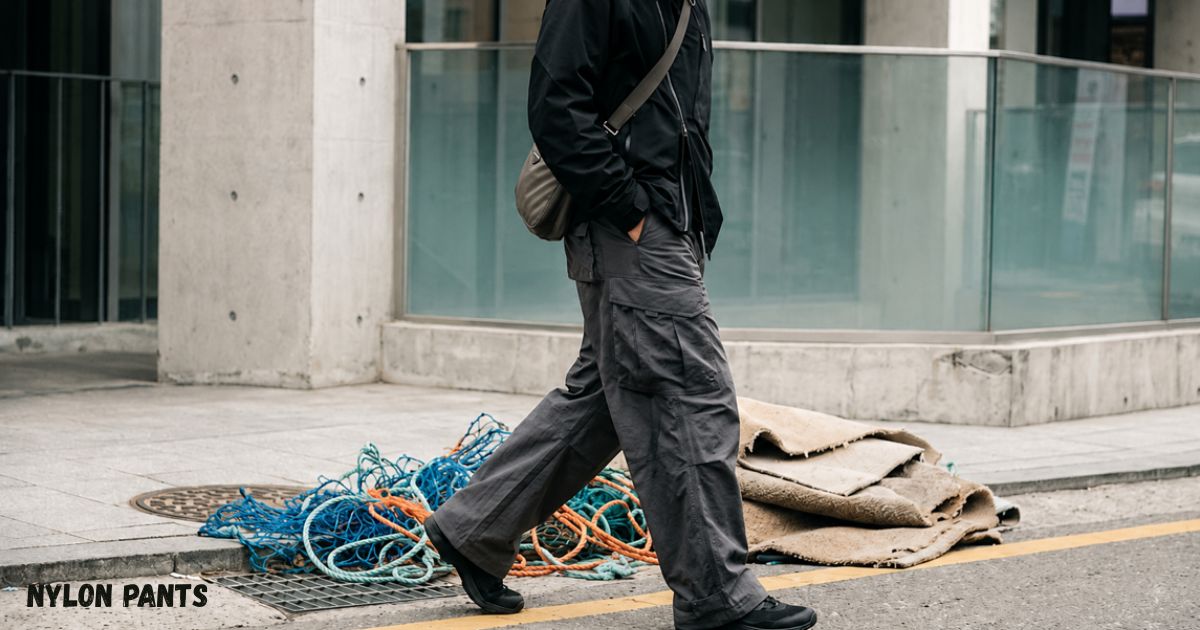
Cotton Trousers The Natural Alternative
To choose well, it helps to know the choices beyond nylon pants. Cotton, a natural fiber worn for centuries, gives clothing a soft, breathable, skin-friendly feel that suits hot climates and long wear.. Cotton trousers, especially khadi cotton trousers, remain a sustainable choice for formal settings as well as relaxed, casual wear.
Cotton Pants vs Nylon Pants A Quick Comparison
Looking at both fabrics side by side makes the choice easier. On breathability, cotton stays high while nylon stays low, and cotton feels very soft while nylon offers only moderate comfort. For wrinkle resistance and moisture handling, nylon wins with its absorbs sweat-free, quick-dry, water-resistant nature, while cotton is the more eco-friendly, esp. khadi option, best for office, casual, and formal wear, compared to nylon’s edge in travel, outdoor, and sports settings.
Final Thoughts on Choosing Your Next Pair of Nylon Pants
When I think about comfort, breathability, and sustainability together, cotton trousers, especially handwoven khadi cotton pants, feel like the better choice for everyday office wear, formal events, and casual outings. But when priority shifts to durability and quick-dry performance, weather resistance makes nylon pants the more practical pick for outdoor adventures and travel. In the end, it comes down to style, utility, and toughness and honestly, I keep one pair of each in my bag, because both fabrics earn their place.
FAQs
What makes Nylon Pants a popular choice for activewear and daily comfort?
Nylon pants are highly favored for their exceptional lightweight durability, quick-drying capabilities, and impressive flexibility, making them perfect for both intensive workouts and casual, everyday errands.
Are nylon trousers breathable enough for hot weather?
Yes, most high-quality athletic or casual track pants feature moisture-wicking properties and lightweight weaves that allow air to circulate freely, keeping you cool and comfortable even on warmer days.
How do I properly wash and care for synthetic track apparel?
To maintain fabric elasticity and longevity, wash your activewear in cold water on a gentle cycle and hang them to air dry. Avoid using harsh bleach or high heat in the dryer.
What is the best way to style sporty activewear for a casual outfit?
Pair slim-fit or relaxed track bottoms with a simple fitted t-shirt, a crisp jacket, and your favorite sneakers for an effortless, modern street-style look.
How should Nylon Pants fit for maximum performance and mobility?
Nylon pants should fit comfortably around the waist without digging in, offering a relaxed feel through the hips and legs to allow full range of motion without excess sagging.